When your ISA allowance runs out, the GIA starts to bite
The £20k ISA allowance is generous until you want to save more. What happens in a general investment account, and how CGT lands.
By Mike Gallagher,
You have filled the ISA every April for a decade. Pension is busy too. The money keeps arriving and the obvious places to put it are full. The next place is a general investment account, and that is where things get slightly more interesting.
What a GIA is and isn't
A general investment account is just an investment account with no tax wrapper. You pay tax on dividends above the allowance. You pay capital gains tax on realised gains above the annual exemption. There is no cap on how much you can put in. There is no age restriction. It is the default bucket once the wrapped accounts are full.
The tax drag is real but not disqualifying. A £3,000 capital gains allowance, £500 dividend allowance. After that you are paying 18 or 24 percent on gains, and 8.75 or 33.75 percent on dividends, depending on your income band.
Ordering it
For most higher rate earners the order looks like this. Employer match in the pension. ISA up to £20,000. Pension beyond the match for tax relief. GIA for anything after that.
That order flips for people who need liquidity before pension age and have already filled their ISA. At that point the GIA beats additional pension because a pension you can't touch until 57 doesn't help you at 50.
Capital gains reality
Most people who touch a GIA underestimate how fast gains accumulate. A decade of reasonable returns on a meaningful balance leaves you with a gain that is a large fraction of the original pot. Sell it all and the tax bill is sizeable, even after the annual allowance.
The usual counter is bed-and-ISA. Each April, sell a chunk of GIA, rebuy it in the ISA, use up the £20,000 allowance, crystallise a small gain under the annual CGT exemption. Over five or ten years you migrate a meaningful amount into the wrapper.
- Realise small gains each year, under the annual exemption, on purpose.
- Use the bed-and-ISA move to move assets from GIA to ISA.
- Consider spouse transfers to use both people's allowances.
- Harvest losses where you have them, to offset realised gains.
The GIA is not a failure mode. It's the next bucket once the wrappers are full, and it's fine provided you don't ignore the tax side of it.
Modelling the overflow
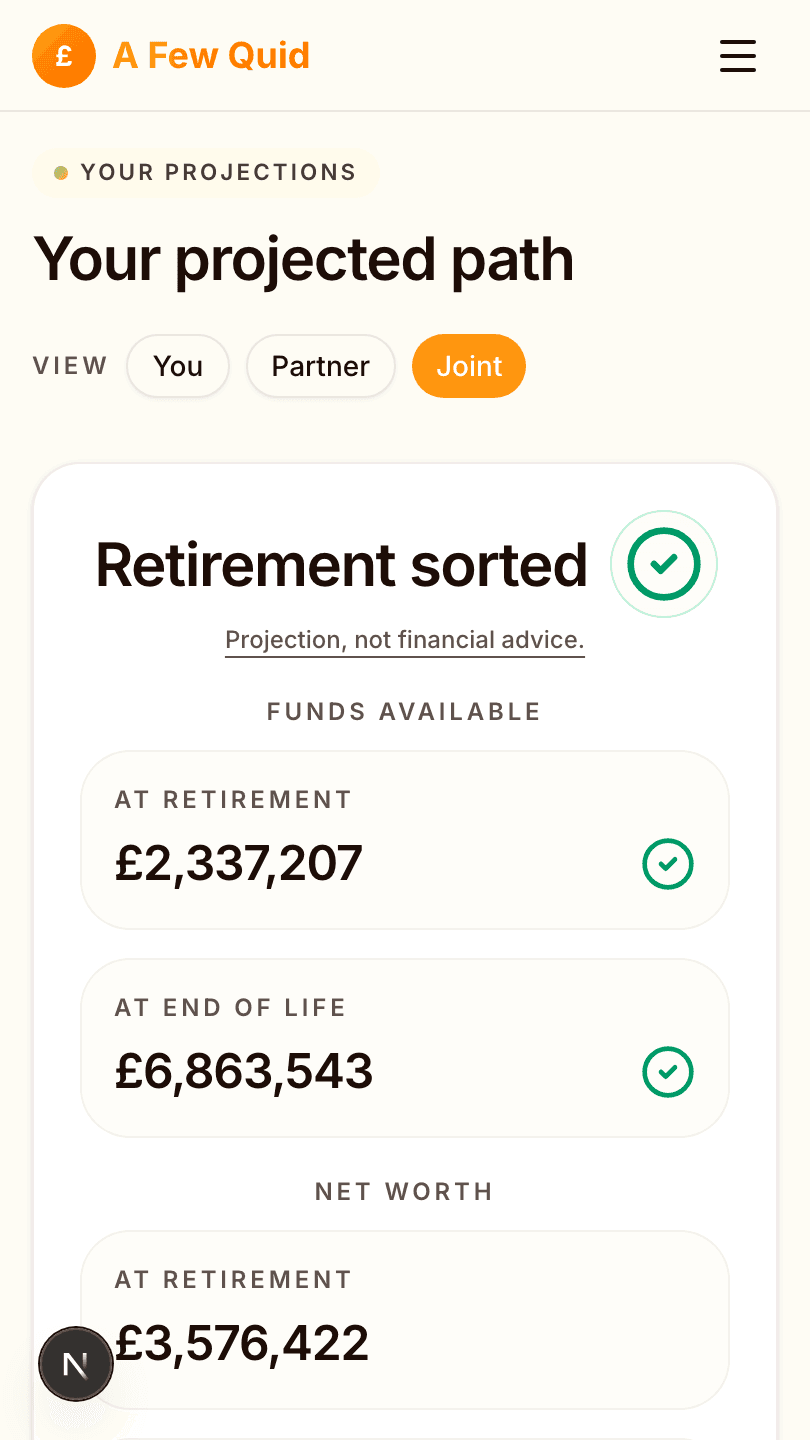
A Few Quid tracks ISA and GIA separately, with tax applied to the unwrapped side. The net worth line is your net worth after tax, not before. When you run scenarios, the graph reflects the actual tax drag, not a pretend world where everything is tax-free.
Most people who fill their ISA for a few years are surprised how quickly the GIA starts mattering. Running it in the app is a good sanity check for whether you are giving away more in CGT than you realised.