Joint finances without the awkward spreadsheet share
Couples' money is two people, two salaries, two pensions, and a shared plan. Modelling it in a shared spreadsheet usually ends in a row.
By Mike Gallagher,
Some version of this conversation has happened in every house with two earners. Can you look at the spreadsheet tonight, I've added a column for the new nursery payment and the projection is doing something weird. The spreadsheet gets opened. Something unrelated has broken.
Joint finances are hard not because the maths is hard but because two people rarely have the same patience for maintaining a shared model. One of you built it. The other has notes about it. Every major change requires a meeting.
Two salaries aren't one household
Adding two salaries and dividing by two is not a household projection. The household picture depends on who pays into which pension, whose ISA has the most headroom, who is in which tax band, who has got the bonus structure, who is taking the parental leave.
A good household model treats each actor as its own financial entity with its own allowances and contributions, then composes the household position from the sum. A spreadsheet can be coerced into doing this, but it gets fragile fast.
What joint modelling actually looks like
Two separate income profiles. Two separate pension schemes with their own contribution rates and employer matches. Two separate ISAs ticking through £20,000 allowances each year. Shared outgoings, like the mortgage, rent, kids. Private spending attributed to the person doing the spending.
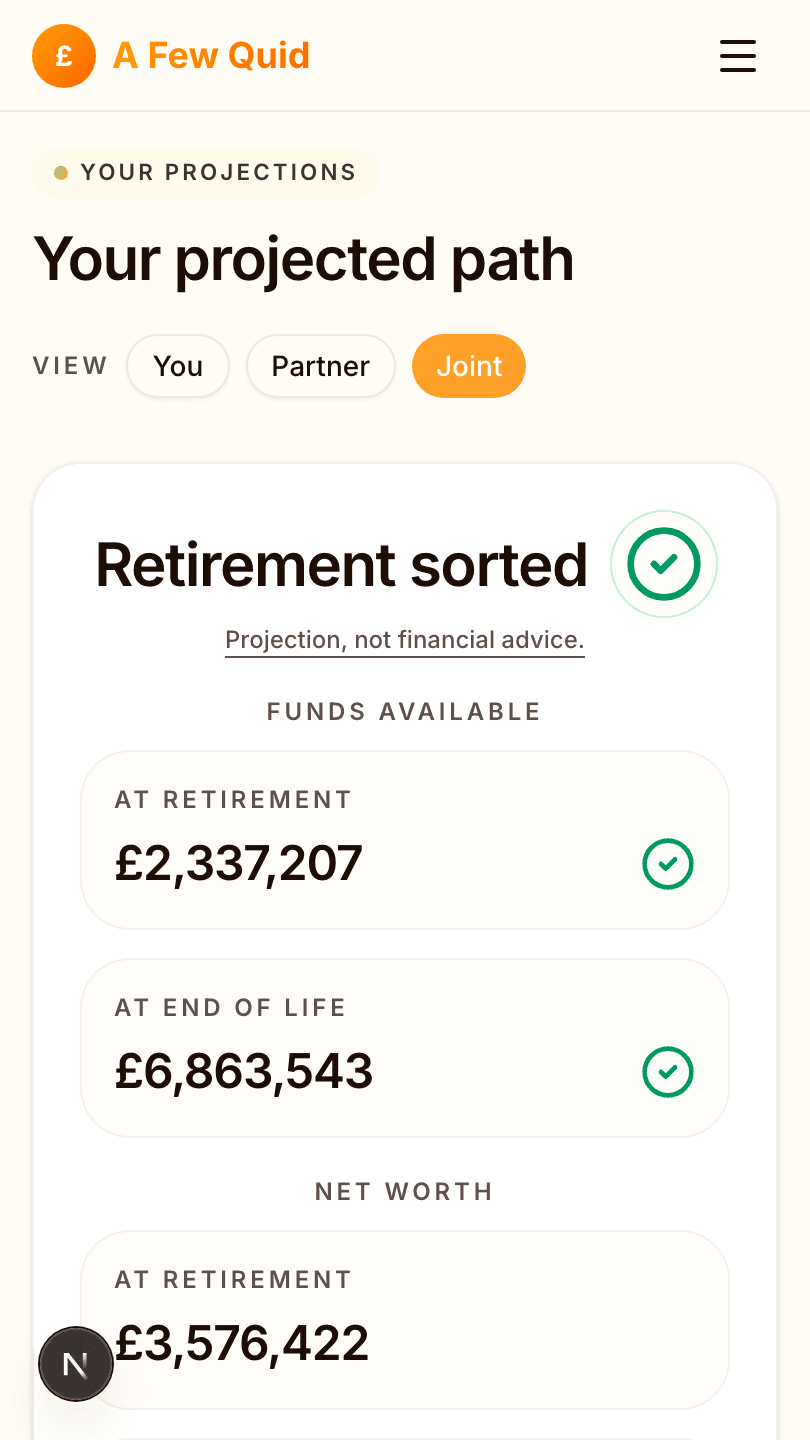
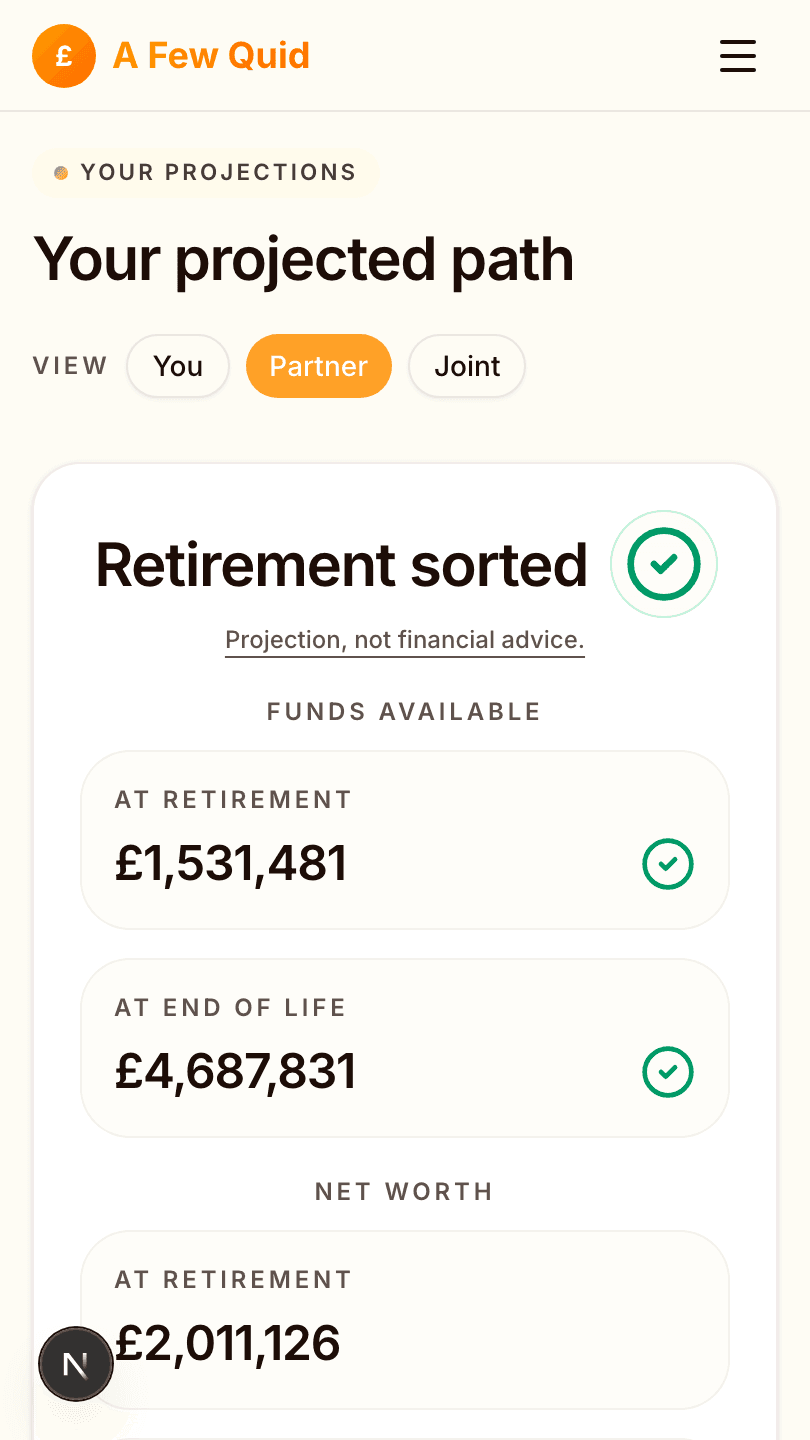
The joint view is where you see the household net worth line and the household net income line. The individual view is where you see each person's contribution to the total.
Where couples usually disagree
- How aggressively to save. One wants to retire at 55, the other at 65. Both answers change what the household should be doing.
- Whether to prioritise the higher earner's pension or the lower earner's ISA. Usually both, but the order matters.
- What to do with windfalls. Bonus, inheritance, sale proceeds. This is where most real friction lives.
- Taking parental leave or career breaks. The maths is different depending on which partner does it.
A shared tool that can hold both perspectives removes a lot of the friction. It doesn't resolve the disagreement. It means both people are looking at the same numbers when they have the conversation.
The point of a joint projection isn't harmony. It's that both partners are arguing about the same set of facts.
What you avoid by not using a spreadsheet
The version-control problem. Whose spreadsheet is the real one. Whether the copy on the shared drive has the latest rent number.
The I don't understand what this tab is doing problem. A partner who doesn't want to dig into formulas is not being unreasonable. They are pointing out that the tool has stopped being usable.
The can we quickly change this and see what happens problem. Replaying one what-if in a spreadsheet means either trusting your future self not to mess up the copy, or spending twenty minutes you don't have.
Running the household plan
A Few Quid models two people by default. Two salaries. Two pensions. Shared household expenses. Separate private spending if you want it. The joint view is where you plan. The partner view is where each person audits their own piece.
It isn't a substitute for the conversation. It replaces the bit of the conversation where one person is trying to defend a formula.