Mortgage overpayment or invest? The honest comparison
Overpaying the mortgage feels responsible. Investing the same money feels greedy. The numbers don't care about feelings. Run them.
By Mike Gallagher,
Your mortgage rate is 4.5 percent. Your investment returns, historically, are maybe 6 to 7 percent real. The numbers are close enough that the decision feels like a coin flip. It is not, but it depends on specifics you might not have named yet.
What the mortgage actually costs
Say your mortgage rate is 4.5 percent. Any amount you overpay today reduces the principal, which reduces future interest. A lump-sum overpayment today saves you interest over the remaining term worth more than the overpayment itself, give or take the specific amortisation.
That is a guaranteed, tax-free return of roughly 4.5 percent per year. You pay no tax on it because you are not earning it, you are avoiding it. And it is risk-free. The mortgage rate is the mortgage rate.
What the alternative returns
A stocks and shares ISA, over twenty years, has historically returned somewhere in the 6 to 7 percent real range. In an ISA it is tax-free. In a GIA, knock a point off for tax drag.
On paper, 6.5 beats 4.5. That makes the investment side look obviously better. The edge is smaller than it looks once you count the risk, the sequence, and the emotional weight of debt.
When overpayment wins
- Your mortgage rate is close to or above your expected real return. A 6 percent mortgage rate against 5 percent expected returns means overpay.
- You are risk-averse and losing sleep over a large outstanding balance.
- You want the mortgage gone before retirement because retired you doesn't want a debt line on the page.
- Your ISA and pension are already full and the alternative is a GIA.
When investing wins
- Your mortgage rate is low relative to your expected return. A 3.5 percent fixed against 6 percent real expected.
- You have pension and ISA headroom. The wrapped accounts beat the post-tax equivalence easily.
- You are young and the horizon is long. Compounding does more work on the investment than interest savings do on the mortgage.
The maths usually whispers invest for a higher-rate earner with ISA headroom and a sub-5 percent mortgage. Most people overpay anyway, because feelings compound too.
The compromise nobody talks about
Split the money. Half to the mortgage, half to the ISA. It isn't mathematically optimal in either direction but it covers two different kinds of risk at once. The optimal answer assumes your assumptions are right. The compromise assumes they aren't.
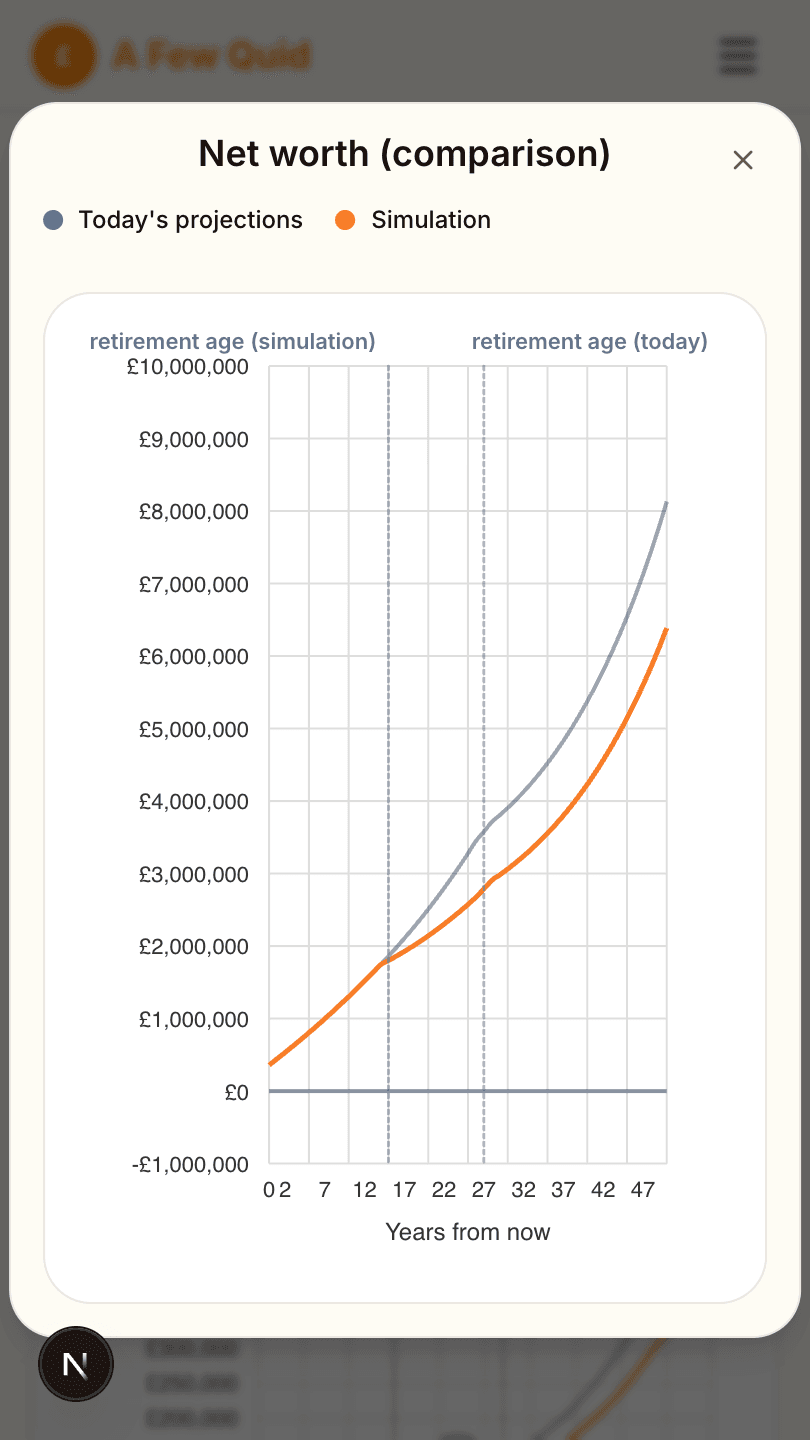
A Few Quid runs both as scenarios. Overpay the mortgage each year. Invest the same amount. See the net worth line for each. Usually the lines start close and separate over time, with the investment line pulling ahead in the median case but having fatter tails on both sides.
The honest version of this answer isn't a rate comparison. It is which net worth line you would prefer under a bad market scenario, and whether you can live with the worst case of the other option.