The state pension is at 68. You would rather leave at 55
The state pension age keeps drifting. You don't have to wait for it. Here is how to model a finish line that sits a decade earlier.
By Mike Gallagher,
The UK state pension age is 66. It is moving to 67 by 2028. Then to 68, probably in the mid-2040s. If you are 35 now, what that number actually is when you reach it is anyone's guess.
The timetable that keeps moving
State pension age has been climbing for two decades. Every review pushes it a bit further. The current legal timetable has the next increase to 68 slated for 2044 to 2046. Most planners assume it will actually happen earlier. Nobody with a financial model should be betting on a fixed date.
Triple lock is the other moving part. It is the commitment to raise the state pension each year by the higher of inflation, wage growth, or 2.5 percent. It is politically popular and politically expensive. Over a thirty-year horizon, some version of triple lock probably stays. Exactly how generous it is, year by year, is a guess.
Not waiting for it
A plan that requires the state pension to be what it is today, when you retire, is not a plan you should be confident in. It might turn out fine. It might also turn out that the age moves up another two years and the real value drifts down against wages.
The useful position is building a plan that doesn't need the state pension at all, and then treating whatever lands as a bonus. That sounds aggressive. In practice for most UK optimisers it isn't.
What to model
- Your retirement spend in today's money, independent of the state pension.
- Your pension pot at 57, 60, 65. When it can sustain your spend without the state pension.
- The state pension as a top-up from whenever it arrives, scaled by the expected value in real terms. Default to something lower than current, not higher.
- A stress test where the state pension age goes up two more years and the real value drops ten percent.
Run the plan with and without. If the graph is fragile to the state pension assumption, the plan isn't ready. If it survives, you have a plan that works in the worst plausible case, and a bonus in the median case.
The state pension is a top-up, not a foundation. Plans built on it as a foundation are one policy review away from needing to be rebuilt.
Leaving at 55
For UK savers, the meaningful early-exit age is 57 (the pension access age from 2028). Before that you need non-pension money. ISAs for the bridge, pension for everything from 57 onward.
The state pension rolls in somewhere in your late sixties. By then your ISA has usually been drawn down. Your pension has been providing the bulk of your income for a decade. The state pension shows up, and it is the cream on top.
Modelling the whole curve
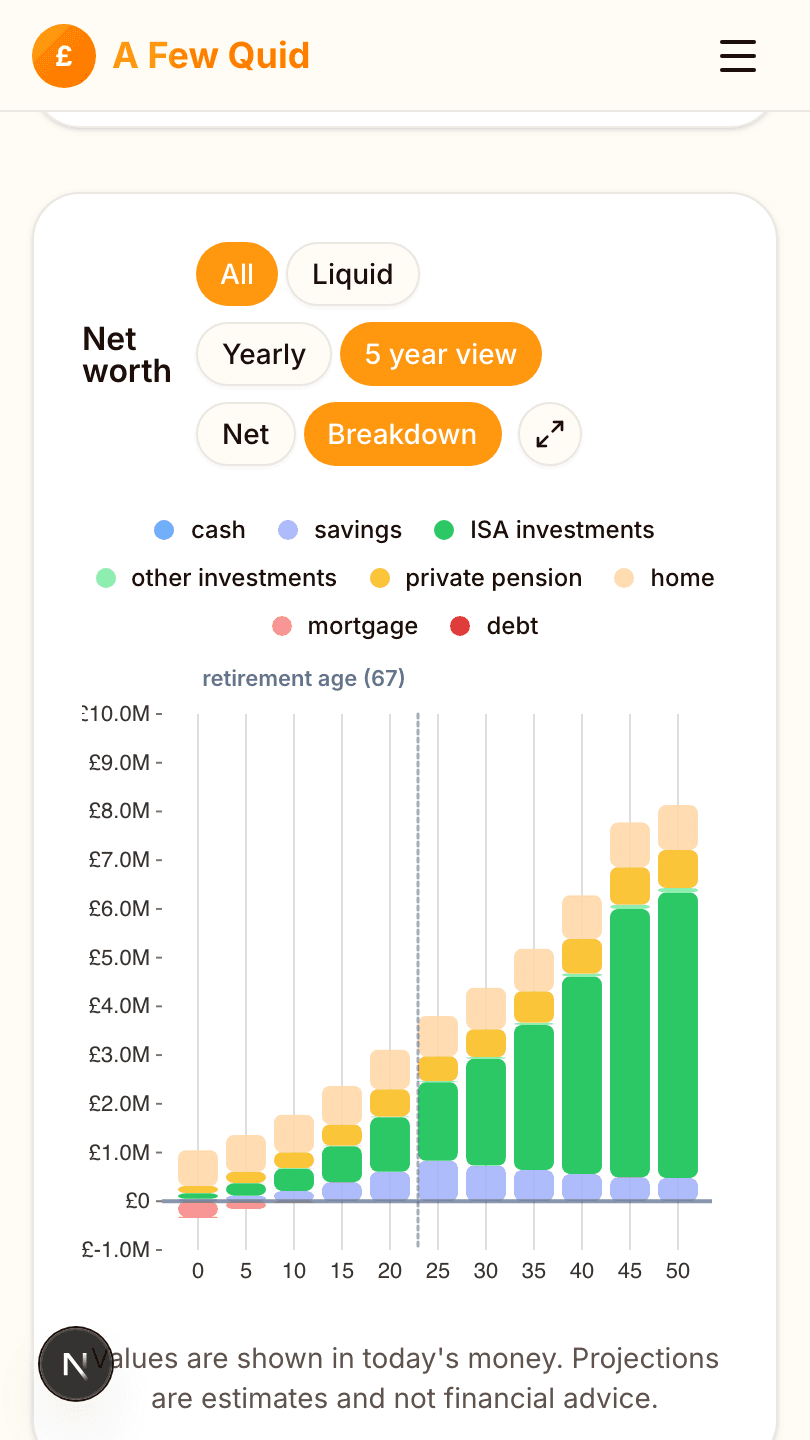
A Few Quid layers all three income sources on the same chart. ISA drawdown, pension drawdown, state pension arriving when it arrives. The shape of the curve shows where the fragile spots are. A dip around the pension-access transition. A step up when the state pension kicks in.
You can't make the state pension age move the way you want. You can build a plan that doesn't need it to.