Salary sacrifice is good. Is it better than an ISA?
Salary sacrifice gets the tax relief and the NI saving. An ISA gets flexibility and tax-free withdrawal. Which one wins, and when.
By Mike Gallagher,
You have been maxing salary sacrifice for a few years, someone asks why you don't just use the ISA, and suddenly the answer is less obvious than it was.
Both are good. That is not the useful framing though. The useful framing is which one gets the next pound you have spare, given your tax band and how close you are to retirement.
What salary sacrifice actually saves
Say you are a higher rate taxpayer. You agree to sacrifice a chunk of gross pay into your pension. You save 40 percent income tax. You save 2 percent employee national insurance. Your employer saves 13.8 percent employer national insurance, and a decent employer often passes some of that back to you as additional pension contribution. The effective value of every £1 sacrificed is usually worth somewhere between £1.58 and £1.70 in the pension.
It comes out taxed. If you are in the basic rate band in retirement, you pay 20 percent income tax on three-quarters of the withdrawal (the other 25 percent is tax-free up to the cap). The net effective rate on exit is around 15 percent. The round-trip tax cost is far lower than the upfront saving, and the pot compounded for longer on a bigger base.
What an ISA gives you instead
An ISA contribution is post-tax money. A higher rate earner putting away £1 in an ISA started with about £1.72 of gross earnings. No tax on growth. No tax on withdrawal. No age restriction.
The upside of the ISA is access. Need the money at 45 to help with a house move. Fine. Need it at 52 to fund a career transition. Fine. Want it at 68 tax-free while your pension pays out taxed. Fine.
The downside is the upfront tax bill. You have already paid 42 percent on the money before it landed in the account.
When each wins
- Higher rate earner with fifteen or more years to retirement. Salary sacrifice usually wins because the upfront saving compounds for long enough to outweigh the exit tax.
- Higher rate earner who needs money before 57. ISA, because the pension is locked.
- Basic rate earner, no employer salary sacrifice. ISA often wins because the round-trip saving on pension shrinks without the NI boost.
- Additional rate earner with sacrifice. Pension pulls ahead further because the saving is at 45 percent plus NI.
- Anyone within five years of needing to buy a house with the money. ISA, by a mile.
Most people need both
The right frame is almost never salary sacrifice or ISA. It is how much of each, in what order, with what trigger to flip.
The optimiser's version of the answer is not the higher return. It is the strategy that survives the most plausible futures.
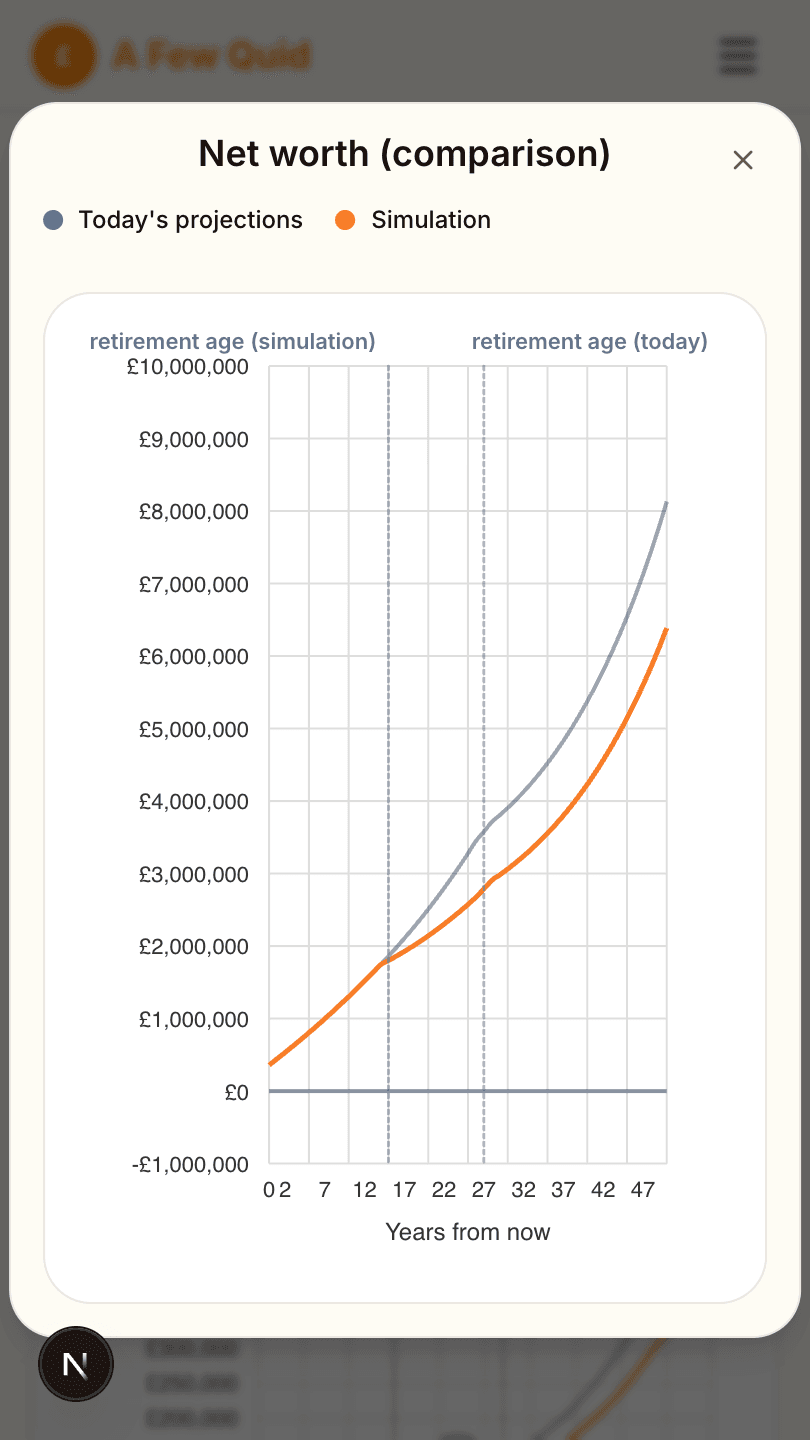
A Few Quid compares them as paired scenarios. Same starting numbers, same market assumptions, different allocation between pension and ISA. The graph separates over time. The gap at 65 tells you which scenario the arithmetic prefers for your inputs. Then you can decide how much weight to give the arithmetic versus the flexibility.
Often the honest answer is keep the employer match, fill the ISA, then come back for more pension. Not either-or. Both, ordered.