Why your spreadsheet is lying about your retirement
Your retirement spreadsheet can't model UK tax bands, partner income, or what-if scenarios. That is why the numbers feel off.
By Mike Gallagher,
Everyone has a retirement spreadsheet. Most of them are broken in the same three ways. You don't notice because the numbers still add up at the bottom. It is just that they're adding up to the wrong answer.
Three things spreadsheets can't do
- Model UK tax bands that change as your contributions change. The 60 percent band around £100k, the child benefit taper, the personal savings allowance. All of these move based on decisions the spreadsheet can't see.
- Handle two people. Once you add a partner with their own salary, pension, and allowances, the spreadsheet becomes a spider's web of cross-references that nobody wants to maintain.
- Replay scenarios cleanly. Duplicating a tab every time you want a what-if leaves you with six tabs and no confidence in any of them.
Under any of those, the spreadsheet has stopped projecting and started approximating. The number at the bottom is still a number, but it is the wrong kind of number.
Tax bands change when contributions change
Sacrifice a few thousand into your pension and your adjusted net income drops by that much. If that drop moves you under £100,000, your personal allowance comes back. The effective value of the sacrifice isn't the gross number you put in, it is the gross plus the reclaimed allowance. A spreadsheet that doesn't re-run the tax bands after the contribution misses that entirely.
The same thing happens with child benefit. Sacrifice enough to drop your adjusted net income under the threshold and you stop owing the charge. The spreadsheet doesn't know which side of the threshold you are on unless it is doing the tax every year, with the up-to-date bands.
Partners interact
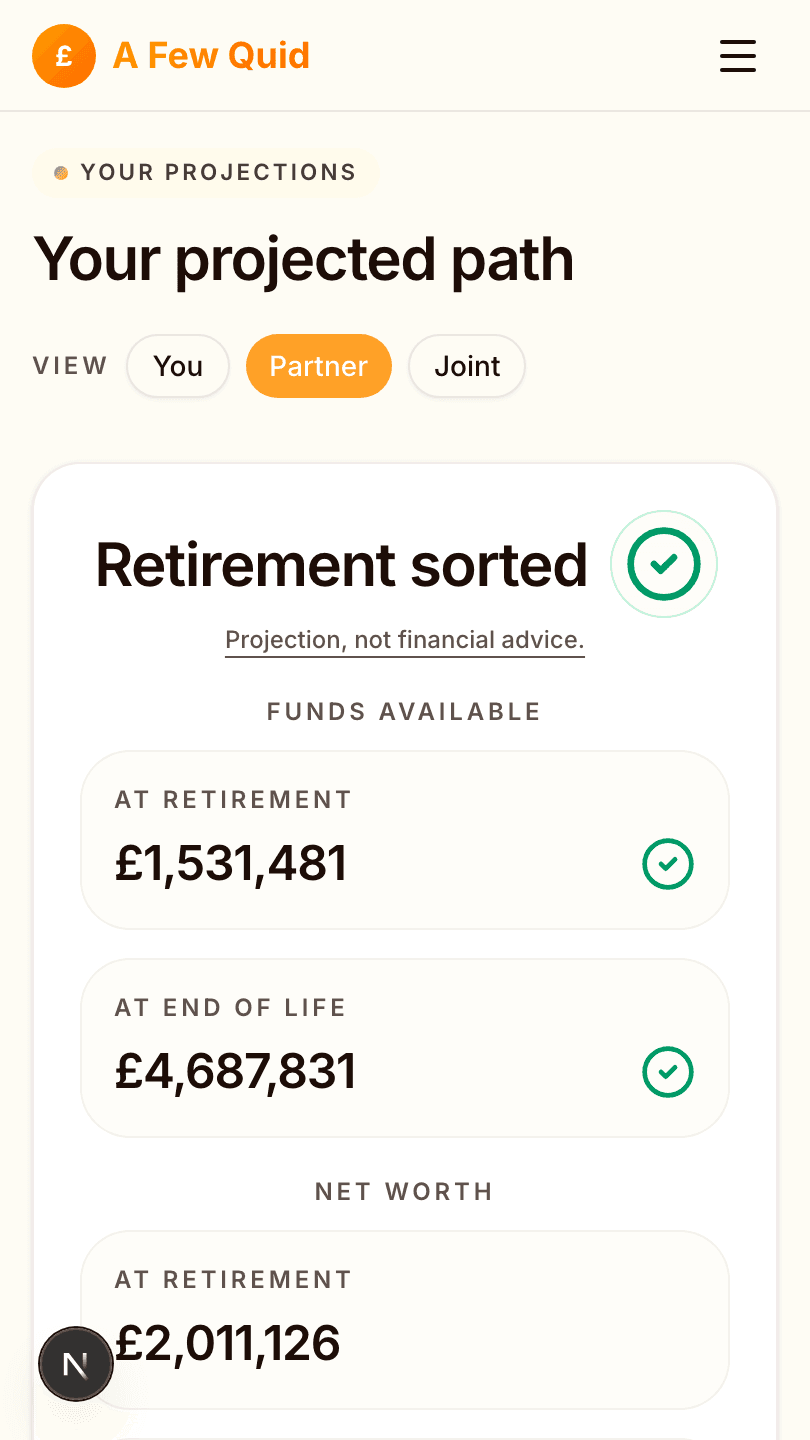
Your partner has their own salary, pension, ISA, and allowances. The interesting household questions are about the combined picture. Who should sacrifice more. Who has the higher-growth employer scheme. Whose ISA fills first. Whose pension hits the annual allowance first. A spreadsheet can be made to do this. Most of them don't.
Saying your partner's financial situation can have tax implications on yours isn't a throwaway. It is the thing most spreadsheets never represent.
Replay versus recalculate
The difference between a replay and a recalculate is the difference between a valid projection and a plausible one. A replay re-runs the whole simulation under a changed assumption, then shows you the new end state. A recalculate updates the last number and hopes the rest still makes sense.
A spreadsheet that only recalculates tells you what happens at the bottom of column AF. A projection tells you the whole path, not just the last cell.
Path matters because questions like what happens if the market drops in year four, and what happens if I take eighteen months off starting when the second kid is five, are not final-cell questions. They are trajectory questions.
What a projection should do instead
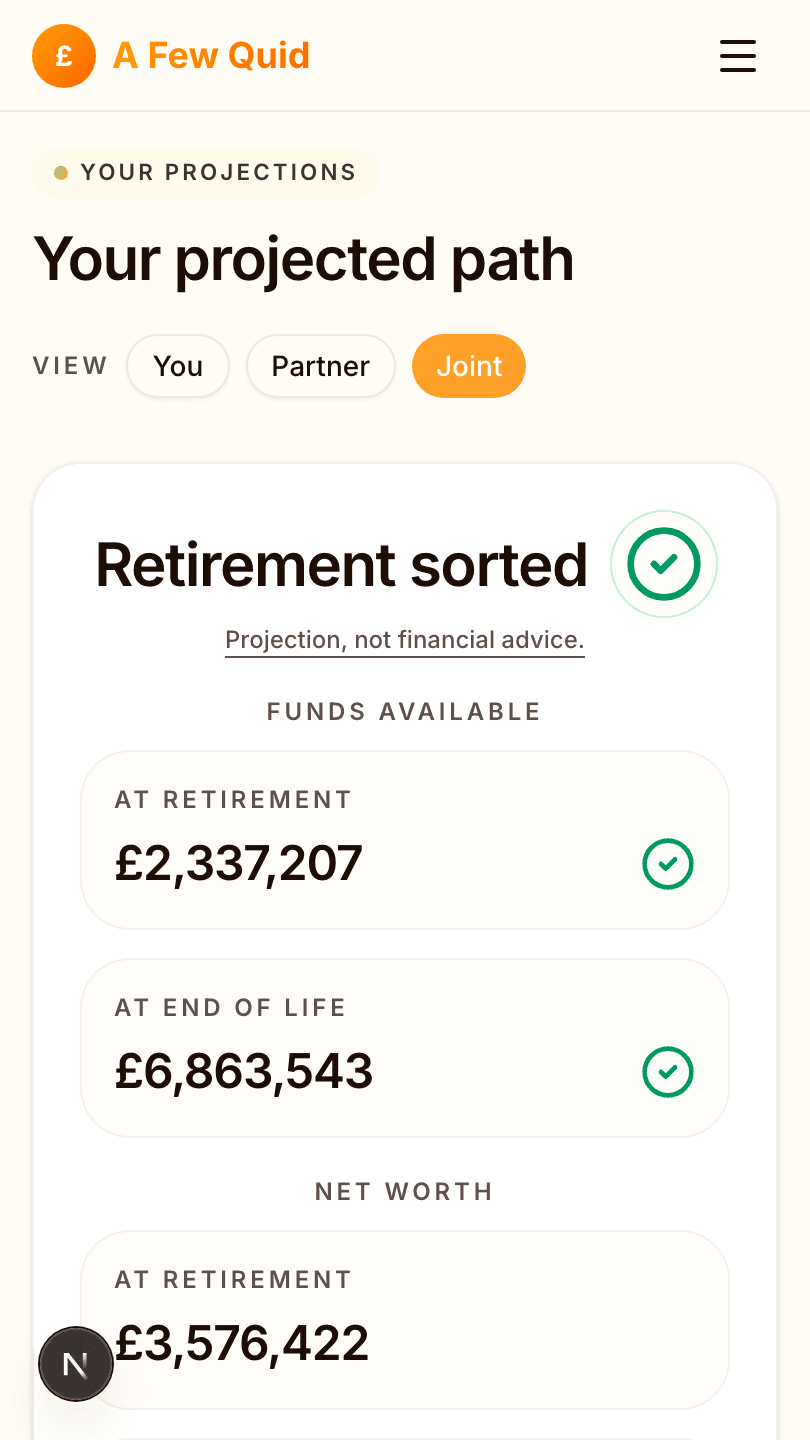
A Few Quid replays the whole simulation year by year. It applies the current UK tax bands at each step. It handles a partner. It lets you save a scenario and compare it to another.
The point isn't that spreadsheets are bad. A spreadsheet is a great scratchpad. The point is that once the question is where your household sits in 2046, a scratchpad stops being enough.