The what-if question you should actually be asking
Can I afford it is the wrong question. The useful one is what saying yes to this thing does to your net worth in twenty years.
By Mike Gallagher,
Can we afford a new kitchen is the question that gets asked. What does saying yes to the kitchen mean for our net worth in 2046 is the question worth asking.
Most financial questions are framed at the wrong timescale. Can I afford this holiday is usually yes. What the pattern of holidays looks like over twenty years is where the real answer lives.
The better question
The short-term affordability question is almost always solvable. Money exists. The transaction clears. The kitchen is fitted. The holiday is booked. The yes is easy.
The longer question is about the cumulative shape of the yes decisions over two decades. A kitchen every seven years. Two weeks away three times a year. Car replacements every six. None of those decisions feel large on their own. The envelope they describe is where net worth in retirement actually sits.
Some what-ifs worth running
- What if we spend 10 percent more each year on lifestyle. The net worth line bends earlier than most people expect.
- What if one of us takes two years off when the kids are young. The pension contribution gap and the compounding cost of it.
- What if we move to a bigger house at 40. Stamp duty, bigger mortgage, higher running costs, smaller investments.
- What if we max the ISA every single year. The graph often shows a surprisingly short path to financial independence.
- What if we retire at 55 versus 65. The gap is smaller than the emotional sense of it suggests.
Why sticking a finger in the air isn't enough
The intuition on long-horizon finance is systematically bad. People overweight the present and underweight compounding. A decision that feels small this year is often the one that dominates the net worth line twenty years out.
A decision compounded for twenty years is always a bigger decision than it feels in the month it's made.
What-if tooling closes the gap between the intuition and the arithmetic. You see the line. You see the gap. You decide.
The AI what-if
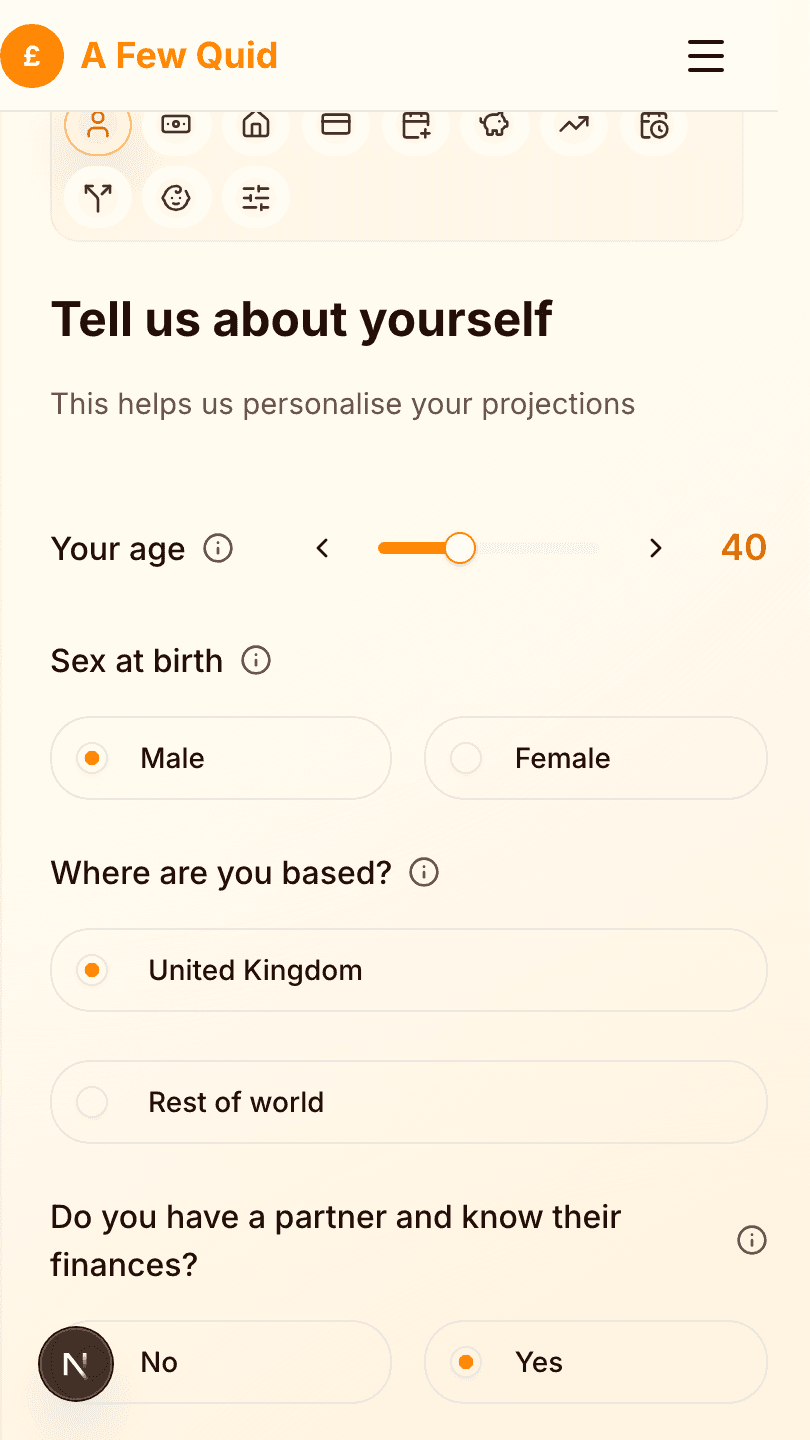
A Few Quid has a what-if feature that lets you describe a decision in plain English. What if I take a career break in 2030 for eighteen months. What if I move to Bristol and spend less on a house than I would in London. The app parses the change, applies it to the simulation, and shows the delta.
That isn't magic. It is a convenient way to do what used to take half a Sunday with a spreadsheet. The decision is still yours. But you are looking at the graph when you make it, and the graph usually has an opinion.
The point of the what-if is not to get to the right answer by computation. The point is to stop making twenty-year decisions with a two-week horizon.