Why A Few Quid exists, and what it does for UK money
Most UK adults guess at their financial future, miss obvious tax breaks, and rely on US-centric advice. A Few Quid is a UK-first answer built on real projections.
By Mike Gallagher,
Most working-age adults in the UK are quietly guessing at their financial future, not in a reckless way but in the way that happens when there's a spreadsheet somewhere, an old pension statement, and a rough sense of where things are heading. Ask the simple question of whether you'll be okay, and the honest answer for most people is that they don't actually know.
The reasons tend to look the same from one person to the next. Time gets spent optimising the small, visible things while big structural decisions sit untouched, US-style advice gets copied across without checking whether it even applies to UK tax rules, and the spreadsheet that was meant to help is either too simple to trust or too fragile to update. Underneath all of that is the same flat admission, which is I don't know where to start.
A Few Quid is built to fix that.
The problem with how most UK money gets planned
If you're a working-age adult in the UK trying to plan your finances, you're almost certainly doing at least one of the things in this list.
- Guessing at the future rather than modelling it, and hoping that it works out.
- Missing optimisations that are quietly worth tens of thousands over a lifetime, like salary sacrifice, ISA ordering, pension versus mortgage decisions, and stamp duty timing.
- Focusing on the wrong things, such as obsessing over small monthly subscriptions while leaving far bigger structural decisions unexamined.
- Following outdated or US-centric advice that doesn't match UK tax rules, ISA allowances, or the state pension.
- Wrestling with a spreadsheet that can't model a career break, a house move, or a market crash without breaking in a dozen places.
- Not knowing where to start, or which lever actually matters right now.
Financial planning software exists, but most of it is US-first and built around 401(k)s, Roth IRAs, HSAs, and Social Security. The UK version of the problem is a different shape, covering ISAs, private pensions, salary sacrifice, workplace pensions, stamp duty, the state pension triple lock, and capital gains allowances, and it needs its own tool rather than a US one with the wrong tax model painted over it.
What A Few Quid does
A Few Quid is UK-focused financial projections and AI-powered what-if scenarios, built to answer the two questions that matter most, which are where are you heading, and what happens if you change something?
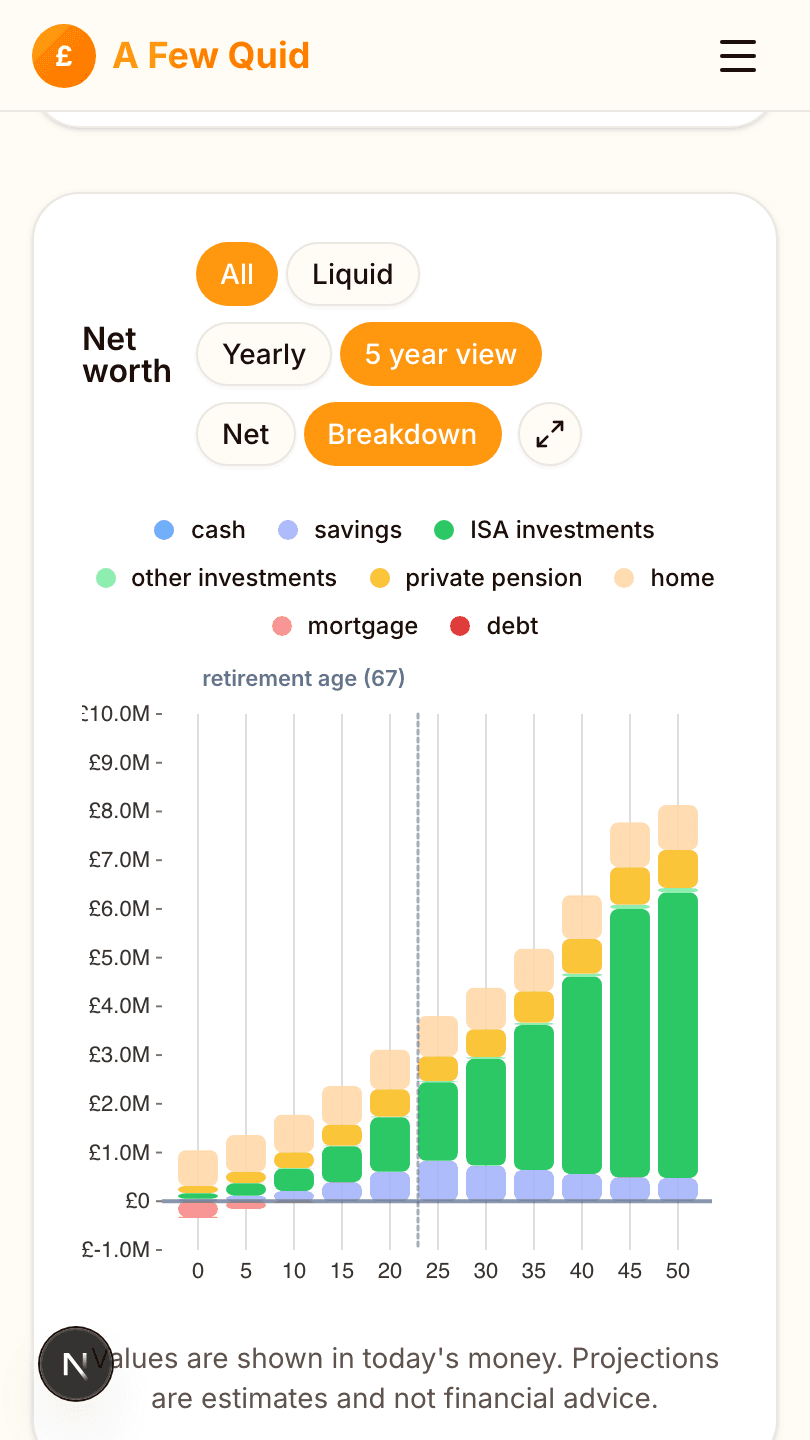
The headline output is a net-worth projection, drawn as a clear line showing what your savings, pensions, investments and equity look like from today through retirement. Change any assumption, whether that's a pay rise, a career break, or a bigger pension contribution, and the line redraws instantly to show what that decision actually does to the shape of your future.
Ask a money question in plain English
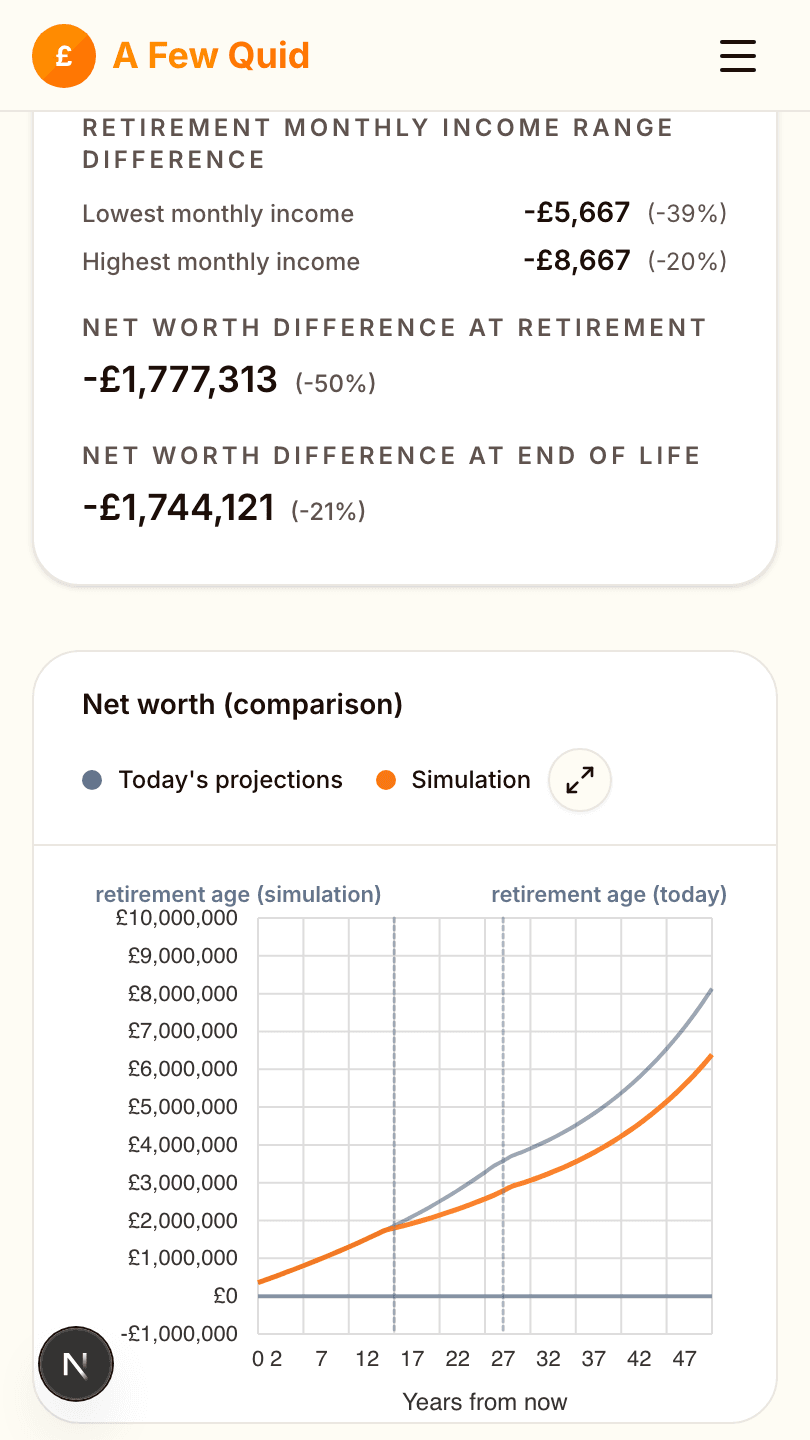
You can type a question the way you'd ask a friend, and the AI builds the full scenario without needing menus or dropdowns. Ask something like "what if I retire at 55" and the app sets up pension drawdown, the right state pension timing, and shows whether your savings actually last long enough to make it work.
See future money, year by year
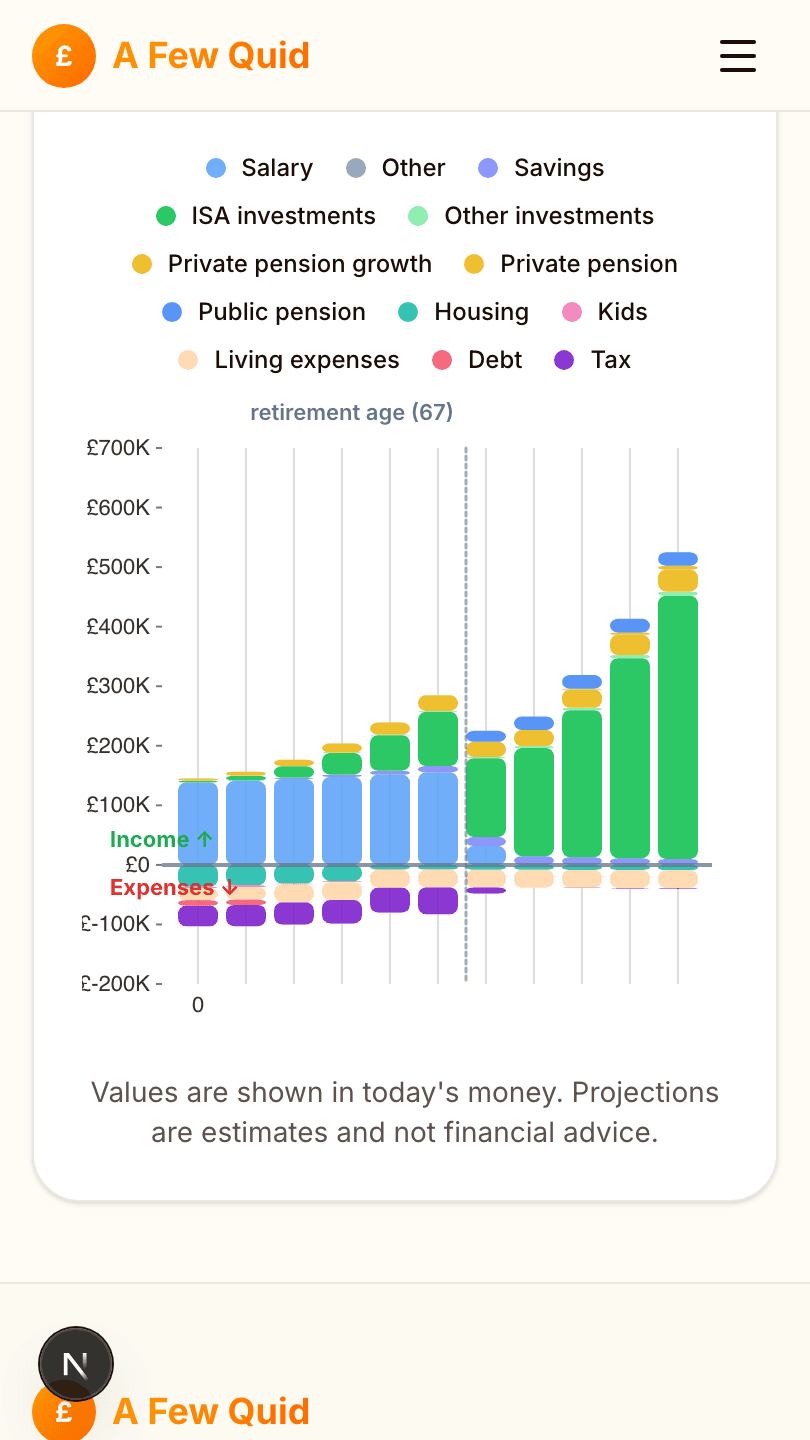
Beneath the headline projection is a living year-by-year timeline of income, spending and tax, which makes it easy to see how small changes compound. A 1% annual pay rise can turn into tens of thousands more by 60, and a single skipped pension uplift can quietly cost a house deposit over thirty years, both of which tend to look very different once they're drawn on a chart rather than imagined in the abstract.
UK tax built in, not bolted on
Income tax bands, National Insurance, capital gains and dividend allowances are all wired into every projection, so there are no US defaults to override and no settings to toggle before the numbers make sense for Britain. Comparing salary sacrifice into a pension against taking the cash is a single click, and the answer includes the tax you'd actually pay under UK rules rather than an approximation of them.
Pension planning that makes sense
Workplace pensions, private pensions and the state pension all live in one place, which makes it possible to forecast what the state pension will actually pay and to compare private pension against ISA outcomes side by side. The question of whether to put more into a pension or an ISA finally has a specific answer for a specific situation, rather than a generic rule of thumb that may or may not apply.
Mortgage, rent and stamp duty
Repayments, overpayments, stamp duty, and the rent-versus-buy trade-off all use UK-specific calculations, so a question like "what if we overpay £200 a month" becomes a clear line on a chart showing the interest saved and the years knocked off the mortgage.
Plan as a couple
A partner can be added with their own salary, pension and tax, and the combined projections show how decisions ripple across the household rather than sitting in isolation. One partner taking time off for kids while the other works becomes a few clicks instead of a weekend rebuilding a spreadsheet.
Life events, investments, and market shocks
Kids, career breaks, private school, and salary changes can all be modelled alongside a stress test for a 2008-style crash at age 50, because knowing the shape of the bad scenarios is what makes it possible to sleep at night during the good ones.
Why this exists
Most UK financial tools fall into one of three categories, and none of them are great. A bank dashboard tells you what you already have, a US app forces the wrong tax model onto a UK life, and a calculator answers one narrow question and stops. None of them answer the basic question of where your money is heading over the next thirty years under the actual rules that apply to you.
The result is that most working adults are flying half-blind and deferring the hard questions to a vague future version of themselves who'll figure it out eventually. That future version rarely arrives, and the decisions made in your thirties compound whether they were made on purpose or not.
If you don't know what you're heading towards, you can't tell whether today's choice makes it better or worse.
A Few Quid is built to replace guessing with a view. There's no certainty on offer, because nobody can honestly give you that, but a clear enough picture makes it possible to make deliberate choices instead of hopeful ones.
Where to start
The fastest way to see what this looks like for your own situation is to try the demo, pick a realistic version of yourself, and start asking what-if questions. It tends to become obvious fairly quickly which levers actually matter, and usually they're not the ones that were worrying you.
A Few Quid is made in the UK, for UK money, with no 401(k)s and no Roth IRAs, just your salary, your ISAs, your pension, your mortgage, and a clear view of where it's all heading.