
Council tax, stamp duty, and the property tax that might replace them
A Hartlepool semi pays more council tax than Buckingham Palace. How 1991 ended up setting your bill, what would replace it, and who gains or loses.
A long-read policy briefing, roughly an hour
A Few Quid is not authorised or regulated by the FCA. This article is general information, not advice.
There is a house at the end of the Mall with 775 rooms, 78 bathrooms and a garden of 39 acres. It sits in Band H, the top council tax band in England, and Westminster City Council charges it £2,095.70 a year. Twenty-five miles up the A1 and then another two hundred and fifty, a three-bedroom semi in Hartlepool sits in Band D. Hartlepool Borough Council charges it £2,556.88. The Hartlepool family pays £461 a year more than the palace. Neither council is doing anything wrong. Both are applying the same statute, the same eight bands and the same fixed ratios Parliament set in 1992. What they are applying them to is a set of valuations carried out in the spring of 1991, by valuers who mostly did not get out of the car.
That is the system, and after thirty-three years almost nobody defends it. What people disagree about is what to put in its place. One answer comes from a campaign called Fairer Share, and Andy Burnham backed it before he became Prime Minister last month. Scrap council tax and stamp duty together, and charge every home a flat 0.48% of what it is worth today. Another answer is a tax on land rather than buildings. A third is to revalue and add some bands at the top, which Scotland has legislated and Wales keeps postponing. A fourth is where the government has actually landed for now. Leave the machine alone, and bolt a surcharge onto the most expensive 1% of homes.
This guide walks through all of it. Where council tax came from, and why it was built in such a hurry. Exactly how it went wrong. What stamp duty does to the housing market on top. What each of the replacement designs would do to a real household. And how to work out, in about ten seconds, which side of the line your own home falls on.
A Few Quid is not authorised by the FCA (the Financial Conduct Authority). This article is general information, not advice. Nothing here is a personal recommendation. For decisions about buying property, mortgages or investments, speak to a regulated financial adviser who can look at your full situation.
How to read this guide
This is a long piece, so here is the shape of it before you start.
The first block is the machine itself. What council tax is and how your bill is worked out covers the mechanics. The band ratios turn out to be doing most of the damage, and almost nobody knows they exist. Then where council tax came from, a story about panic after the poll tax rather than about tax design. Then the rush of 1991, which explains why the valuations were done the way they were. No government since has dared repeat the exercise.
Then the diagnosis. How council tax became regressive measures the problem three separate ways, against 1991 value, against today's value and against income. The three answers differ, which matters more than it sounds. Why bills keep rising faster than inflation covers where the money actually goes and the arrears and bailiff problem sitting underneath it. Most of the rise comes down to a cap set in Westminster. Stamp duty is the other half of the swap, and the half with the clearest evidence against it.
The middle of the guide is the politics and the designs. What Andy Burnham has proposed and ruled out separates what he said as mayor from what he has said as Prime Minister. The two are not the same. How a proportional property tax would actually work goes through the Fairer Share design in full, including the parts the headline rate leaves out. The rival designs covers land value tax and the split national and local model, plus the unglamorous option of just revaluing.
Then the distribution, which is what most readers actually came for. Who would pay less and who would pay more give the regional numbers and the household-level break-even. What changes for renters, landlords and first-time buyers covers the group the debate usually forgets. Under the main proposal, tenants stop being liable altogether. The objections takes the criticisms seriously and sorts the real ones from the rhetoric. What is already changing covers the mansion tax that is already law, plus what the other three UK nations are doing. One of them has been running a proportional property tax for years, with almost nobody noticing.
The last block is yours to use. Two worked examples, better off under a property tax and worse off under a property tax, follow the same household through both outcomes with the dials named. How to cut your council tax bill this year is the practical chapter that works regardless of what any government does. And how to decide what any of this means for you brings it back to a decision you might be making now. Whether to buy and where, and how much weight to give a tax that could change.
1. What council tax is and how your bill is worked out
Council tax is an annual charge on domestic property, paid by the people living in it. It funds part of what your local authority spends. In England for 2026/27 it raises £46.8 billion, according to the Ministry of Housing, Communities and Local Government, up 6.1% on the year before.
Most people assume the bill is a percentage of something. It is not. Two steps build it, and they have almost nothing to do with each other.
Step one: your band
Every home in England and Scotland was placed in one of eight bands, A to H, according to what it was worth on 1 April 1991. Wales has nine bands, A to I, on 2003 values. In England the brackets are these.
| Band | Value on 1 April 1991 |
|---|---|
| A | Up to £40,000 |
| B | £40,001 to £52,000 |
| C | £52,001 to £68,000 |
| D | £68,001 to £88,000 |
| E | £88,001 to £120,000 |
| F | £120,001 to £160,000 |
| G | £160,001 to £320,000 |
| H | Over £320,000 |
Two features of that table deserve a second look. Band G is enormous. It spans a full £160,000 in 1991 money, twice the width of Bands A to D combined. Band H has no ceiling at all, so a £320,001 home in 1991 and a £30 million home in 1991 sit in the same band and pay the same bill. Everything above the top of Band G went into a single bucket. That is why the surcharge described later had to be invented from scratch rather than added as a band.
Step two: your council's Band D rate
Each billing authority sets a single figure, its Band D charge. It then adds the precepts of every other body that levies on the same bill. Police and crime commissioners, fire authorities, combined authorities, the Greater London Authority and parish councils all precept. The average Band D parish precept in England for 2026/27 is £100, up 8.2% in a year. That is the fastest-rising line on most bills. Almost nobody checks it.
Every other band is then a fixed statutory fraction of Band D, and this is where the design does its real work.
| Band | Fraction of Band D | As a percentage |
|---|---|---|
| A | 6/9 | 67% |
| B | 7/9 | 78% |
| C | 8/9 | 89% |
| D | 9/9 | 100% |
| E | 11/9 | 122% |
| F | 13/9 | 144% |
| G | 15/9 | 167% |
| H | 18/9 | 200% |
Read the two ends together. Band H pays exactly three times Band A, because eighteen-ninths divided by six-ninths is three. That ratio is fixed in statute and applies identically in every authority in England. It does not matter that a Band H property was worth at least eight times a Band A property in 1991, or that today the gap is usually much wider than eight. The tax stops responding at three.
Almost every unfair-looking comparison you have seen runs through that mechanism. It is not a bug that crept in, and it is not the result of valuations going stale. Parliament wrote it deliberately into the Local Government Finance Act 1992, to keep bills on large houses politically survivable in the immediate aftermath of the poll tax.
What the average bill actually looks like
For 2026/27 the average Band D council tax in England is £2,392, an increase of £111 or 4.9%. The average bill per dwelling, which weights for the fact that most homes are below Band D, is £1,868. By area type, London averages £2,068, metropolitan areas £2,409, unitary authorities £2,490 and shire areas £2,452.
That London figure is the one to keep hold of. The most expensive housing market in the country has the lowest average Band D bill of any area type in England.
Whatever the number turns out to be for you, it is not a one-off. It is a line in the bottom half of every year of your financial life, next to the mortgage and the energy bill, and it carries on after the mortgage has gone.
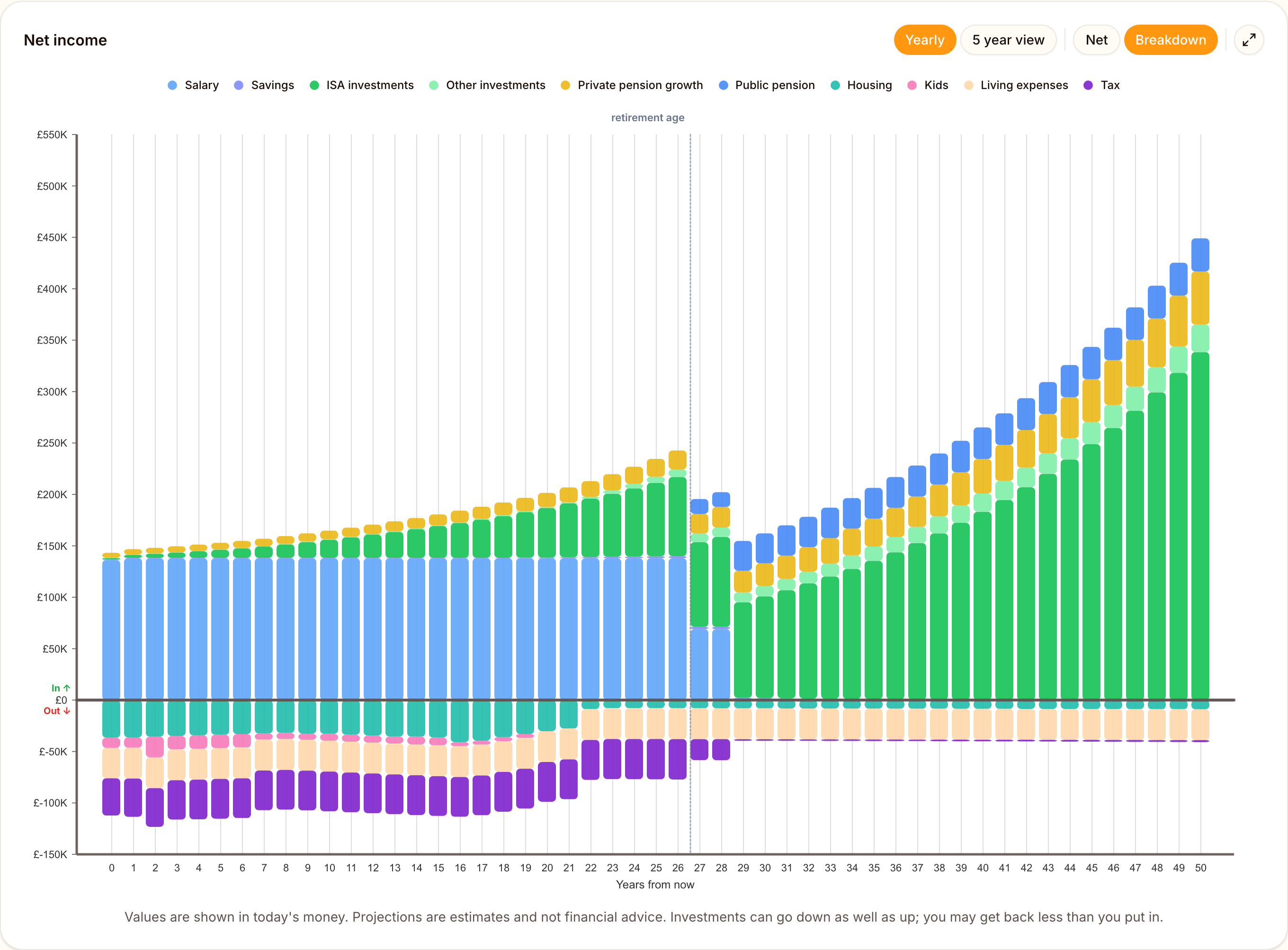
The bars above the line are money arriving, the bars below are money leaving, and council tax lives in the teal and purple bands at the bottom for every single year on that chart. A few hundred pounds either way looks like nothing on one bar. Across fifty of them it is the difference between two quite different retirements, which is why the rest of this guide bothers with the arithmetic at all.
2. Where council tax came from: domestic rates, the poll tax and the riots
Council tax looks the way it does because a government in a hurry designed it to end a crisis.
Rates, which lasted nearly four centuries
Before 1989, local government in Britain ran largely on domestic rates, a property tax that traces back to the Poor Relief Act of 1601. Rates charged the occupier a poundage on the property's assessed rental value. That is a property tax in the ordinary sense, proportional to a valuation, with the usual property-tax virtues. It was cheap to collect and almost impossible to avoid. Nobody could move a house offshore.
It also had a political problem that mattered enormously to the Conservative governments of the 1980s. Rates fell on property owners, and a large share of local electors, particularly in urban areas, paid little or nothing. The complaint was that councils could spend freely because the people voting for the spending were not the people paying for it.
The community charge
The answer was the Community Charge, introduced in Scotland in 1989 and in England and Wales in 1990. It replaced a tax on property with a tax on people. Nearly every adult paid the same flat amount, whatever their income and whatever their home was worth. The name that stuck was the poll tax.
Nobody needs the arithmetic explained. A duke and a bus driver in the same borough paid roughly the same. Non-payment became widespread and then organised. A demonstration in Trafalgar Square in March 1990 turned into a riot. Margaret Thatcher, who had staked considerable political capital on the charge, resigned in November of that year, and the tax was one of the reasons why.
Council tax, built in eighteen months
Michael Heseltine's replacement had to do three things at once. It had to be a property tax again, because that was what worked. It could not look anything like rates, which had been abolished with great fanfare. And it had to be in place fast, with the poll tax still being collected and still being resisted.
The compromise was council tax, legislated in 1992 and live from April 1993. It taxes property, like rates. But it bands rather than values precisely, which blunts the link between what a home is worth and what it costs. It assumes two adults in the household and gives a 25% discount if there is only one, the small ghost of the poll tax that survives in the design. And the ratio between the top and bottom bands is capped at three to one. That was the political price of getting large-house owners to accept a property tax again, so soon after being told they never would.
Every criticism of council tax in the rest of this guide traces back to that last decision. It was made for reasons that made sense in 1992, and nobody has revisited them since.
3. The rush of 1991, and why those valuations still set your bill
More than 20 million homes had to be banded before April 1993, and the government did not have the valuers to do it properly.
Second-gear valuations
The work was largely contracted out to estate agents. They were handed lists of addresses and property types, and asked to assign bands from the outside. Valuers worked in pairs, driving down streets and allocating bands at a glance. They became known as second-gear valuations, because the cars mostly did not stop. One agent later put the pace at around 400 homes a day, working from a list, in rural areas where the properties were sometimes not even visible from the road.
The result is a national dataset assembled at roughly a minute a house. MoneySavingExpert has been telling readers to check their band against their neighbours' for two decades on exactly this basis. The check still works, which tells you how much error went in at the start.
Why nobody has fixed it
Three governments have looked at revaluation in England and three have walked away.
A revaluation was legislated for 2007. In September 2005 it was postponed until after the next general election. It has never been rescheduled, and England's bands are still 1991 bands in 2026. Scotland is in the same position, though its 2026/27 Budget commits to revaluing homes worth over £1 million and adding two new high-value bands from 1 April 2028.
Wales is the one nation that actually did it, and the Welsh experience is why the others did not. It revalued on 2003 values, applied from April 2005. More than a third of Welsh homes moved up a band, some by as many as four. Only 8% moved down. A revaluation is close to revenue-neutral overall by construction. But the winners barely notice a £50 reduction, while the losers notice a £400 increase immediately and vividly. Wales then scheduled a second revaluation for April 2025 and pushed it back to April 2028. In June 2026 it confirmed it was reviewing whether to proceed at all.
What thirty-five years of divergence has done
Rising prices alone would not have mattered much. They rose by wildly different multiples in different places, and the bands never followed.
In 1991 the average detached house in the North sold for around £83,000 and in London for £152,653, a ratio of about 1.8. Today London's house price to income ratio sits near 9.6, close to three times the equivalent figure in Scotland and the North. English prices overall are roughly 5.3 to 5.4 times their 1991 level. That national average hides a range running from under four in parts of the North East to well above seven in inner London.
Council tax bands froze the 1991 relationship in place. Every year since, the real distribution of housing wealth has drifted further from the distribution the tax is charged on. That drift, and not the original banding error, is the larger problem now. The Institute for Fiscal Studies found that more than half of Scottish properties are now in what it calls the wrong band, with around 30% too high and a similar share too low. Homes now worth much the same can face bills hundreds of pounds apart, while two homes hundreds of thousands of pounds apart in value land on the identical bill.
4. How council tax became regressive, measured three ways
Regressive gets thrown around loosely, so pin it down. A tax is regressive when it takes a larger share from those with less. Council tax is regressive on three separate measures, and each one tells you something different about the design.
Against 1991 value, which is what the tax claims to be based on
The purest test holds the valuations constant and asks only whether the band ratios are proportional to what the bands represent.
A Band H home was worth more than eight times a Band A home in 1991, since Band A tops out at £40,000 and Band H starts at £320,000 with no ceiling. It pays exactly three times the tax. So even judged on its own terms, with no reference to any later price movement, council tax charges the expensive property a far lower rate than the cheap one. As the IFS puts it, the tax is regressive with respect to property value by construction. Stale valuations are a second problem stacked on top of that one.
Against today's value, which is what people actually own
This measure combines the band compression with thirty-five years of divergent price growth. It is where the numbers get uncomfortable. Take four real households, each with the published 2026/27 bill for a plausible band in that authority.
| Home | Band | 2026/27 bill | Current value | Tax as a share of value |
|---|---|---|---|---|
| Hartlepool terrace | A | £1,704.59 | £131,000 | 1.30% |
| Manchester semi | C | £2,055.15 | £247,000 | 0.83% |
| Guildford family home | E | £3,057.00 | £525,000 | 0.58% |
| Westminster flat | G | £1,746.42 | £1,500,000 | 0.12% |
The bands here are the ones a home at each of those prices would most likely occupy, worked out by dividing the current price by the regional multiple since 1991. Bills are the published charges for those authorities and bands. On that basis the Hartlepool household pays roughly eleven times the rate on its property that the Westminster household pays on its. Property Tax Lab's population-wide version of the same calculation puts Band A homes at about 1.01% of value a year and Band H homes at about 0.13%.
Against income, which is what people pay out of
The Resolution Foundation tracks council tax as a share of household income. The poorest fifth of households pay 4.8% of theirs, the richest fifth 1.5%. That is a gap of more than three to one, running in the wrong direction. Income tax and National Insurance run the other way, taking more as income rises. That is why the comparison lands.
The trend is worse than the level. Back in 2002/03 the poorest fifth were paying 2.9% of income, so the burden has grown by roughly two thirds in twenty years. Bills rose faster than earnings at the bottom, and Council Tax Benefit was abolished in 2013. That handed each council the job of designing its own means-tested scheme, and left many working-age claimants paying something where they had previously paid nothing.
The comparison that keeps getting made
Because the three measures all point the same way, individual examples land hard. Paul Johnson, then director of the IFS, pointed out that Buckingham Palace sits in Band H in Westminster. On the bill of the day, 46% of English households paid more council tax than the Palace did. On 2026/27 figures the Palace's Band H charge is £2,095.70 against Hartlepool's Band D charge of £2,556.88, so the comparison has if anything got sharper.
Jonathan Brash, the Labour MP for Hartlepool who chairs the cross-party group on council tax reform, makes the same point with the bottom band. Hartlepool's Band A bill of £1,704.59 is 2.44 times Westminster's Band A bill of £698.57. Identical band, identical statutory ratio, two and a half times the money.
Every authority's published 2026/27 schedule, side by side.
| Band | Hartlepool | Manchester | Guildford town | Westminster |
|---|---|---|---|---|
| A | £1,704.59 | £1,541.36 | £1,667.45 | £698.57 |
| B | £1,988.68 | £1,798.25 | £1,945.36 | £814.99 |
| C | £2,272.78 | £2,055.15 | £2,223.27 | £931.42 |
| D | £2,556.88 | £2,312.04 | £2,501.18 | £1,047.85 |
| E | £3,125.08 | £2,825.83 | £3,057.00 | £1,280.71 |
| F | £3,693.27 | £3,339.61 | £3,612.82 | £1,513.56 |
| G | £4,261.47 | £3,853.40 | £4,168.63 | £1,746.42 |
| H | £5,113.76 | £4,624.08 | £5,002.36 | £2,095.70 |
Every column obeys the same statutory ratios. The differences between columns come from the Band D rate each authority sets. That depends on how much it needs to raise, and how large a tax base it has to raise it from. Westminster has an unusually large commercial base and a great many high-value homes to spread its requirement across, so its residential rate can stay low. Hartlepool has neither, and a population with high social care needs, so its rate has to be high. The system rewards places that are already wealthy with lower rates on more valuable property, twice over.
5. Why bills keep rising faster than inflation, and what they pay for
Council tax has risen faster than prices and faster than wages for most of the last fifteen years. Local profligacy has very little to do with it. The rise is a mechanical result of how councils are funded.
The squeeze that produces the rise
Central government grant funding to English councils fell steeply through the 2010s. Meanwhile the two largest cost lines, adult social care and children's services, grew with demography and with the cost of placements. Councils have few ways to close that gap. They can cut discretionary services, and they have. They can raise fees. Or they can put up council tax, up to a limit set in Westminster.
That limit is the referendum principle. For 2026/27 an authority with adult social care responsibilities triggers a referendum at 5% or more, made up of 3% general and 2% specifically for adult social care, which is why almost all of them settle on 4.99%. Shire districts trigger at 3% or £5, whichever is the greater. A handful of authorities in the deepest financial trouble were granted higher limits, rising through 6.75% for Bournemouth, Christchurch and Poole, 7.5% for Trafford, Warrington and Windsor and Maidenhead, and 9% for North Somerset, Shropshire and Worcestershire.
The pattern this produces is entirely predictable. Of 384 English authorities subject to the cap in 2026/27, 274 used the maximum flexibility available and a further 50 came close to it. Of the 153 adult social care authorities, 142 used all of their 2% precept and the remaining 11 used some, raising £688 million between them. Only 21 authorities held bills flat or cut them. No authority has held a referendum in 2026/27, and only one council in the history of the mechanism has ever tried.
So the headline that the average bill rose 4.9% says less about local decisions than about a cap set nationally and hit almost everywhere. Bills rise to whatever number the cap allows, because the alternative is cutting statutory services.
Where the money goes
Adult social care dominates. It is means-tested and demand-led, and rising in both volume and unit cost, which is why the separate precept exists at all. Children's social care, particularly residential placements, is the second pressure. In several authorities it is the line that tipped them into a section 114 notice. After those two come waste collection, highways, libraries, planning, environmental health and everything else people picture when they think about a council. Together, that lot takes a shrinking share.
The uncomfortable version is that a growing proportion of a bill nominally charged on property value is funding care for people who mostly do not live in the property being taxed.
What happens when people cannot pay
This part of the council tax story gets the least attention and probably deserves the most.
Cumulative council tax arrears in England stood at £6.642 billion at 31 March 2025, according to MHCLG. Debt Justice puts the Britain-wide figure at a record £9.3 billion. Council tax debt is the single largest category of debt collected by enforcement agents, and referrals to bailiffs rose around 30% in two years.
The mechanism that produces this deserves naming, because it is a design choice rather than an inevitability. Council tax is billed as an annual sum paid in instalments. Miss one instalment and, after a reminder, you can lose the right to pay by instalments and become liable for the entire year's bill at once. A missed £180 payment becomes a £2,160 demand, then a liability order, then costs, then an enforcement agent. Shelter and the Money Advice Trust have both documented how fast a household with a temporary cash-flow problem ends up with a bailiff at the door. The Enforcement Conduct Board's 2024 review of body-worn camera footage found repeated breaches of the national standards against vulnerable people.
Around 3.7 million households in England receive Council Tax Reduction, at a cost of roughly £4.2 billion a year. That is the safety net. Since 2013 each council has designed its own working-age scheme, so two identical households on identical incomes can face different bills on opposite sides of a boundary. Pension-age claimants are protected by national rules and can still receive a 100% reduction. Working-age claimants in many areas cannot.
6. Stamp duty, the other property tax, and the case against it
The proposals in this guide replace two taxes rather than one. The second is Stamp Duty Land Tax, and economists agree to a rare degree that it ought not to exist in its current form.
How it works now
SDLT applies in England and Northern Ireland. Scotland charges Land and Buildings Transaction Tax and Wales charges Land Transaction Tax, both with their own thresholds. The English rates have not changed since 1 April 2025, when the temporary pandemic-era thresholds expired. April 2026 brought nothing new.
| Slice of the price | Standard rate | First-time buyer rate |
|---|---|---|
| Up to £125,000 | 0% | 0% |
| £125,001 to £250,000 | 2% | 0% |
| £250,001 to £300,000 | 5% | 0% |
| £300,001 to £500,000 | 5% | 5% |
| £500,001 to £925,000 | 5% | 5% |
| £925,001 to £1.5 million | 10% | 10% |
| Above £1.5 million | 12% | 12% |
First-time buyer relief is worth a flat £5,000 anywhere between £300,000 and £500,000. One pound above £500,000 it vanishes entirely, and standard rates apply to the whole price. Buyers of additional property, including second homes and buy-to-let, add a 5% surcharge to every slice.
You can price any purchase in the stamp duty calculator in a few seconds. Do it before you view rather than after you offer, because the number is bigger than most buyers expect at the middle of the market.
The economic objection
Stamp duty is a transaction tax. It is charged not for owning a home but for changing one. That makes it unusual among taxes, and unusually damaging, because the thing it discourages is exactly the thing an efficient housing market needs.
The Mirrlees Review, the most thorough modern survey of UK tax design, called it highly inefficient. The mechanism is straightforward. Every time somebody decides not to move because the tax makes the move uneconomic, a transaction that would have made both sides better off does not happen. Nobody collects the value that was destroyed. That is deadweight loss, and transaction taxes generate more of it per pound raised than almost anything else.
The consequences show up in three places. Households stay in homes that no longer fit, which is part of why around 40% of English households are under-occupied while 3% are overcrowded. Older owners who would downsize do not, which keeps family housing off the market. And people turn down jobs in other regions, because moving costs more than the pay rise is worth. Property Tax Lab estimates that abolishing stamp duty would lift transactions by around 9%, roughly 72,500 additional sales a year, and remove around £981 million of annual deadweight loss. It would also enable roughly 15,235 more long-distance moves, with the productivity gains that come from better job matching.
Why it survives anyway
Because it raises a great deal of money and the people it stops from moving never write to complain about a move they did not make.
SDLT receipts were £15.159 billion in 2025/26, £507 million above forecast. When the thresholds tightened in April 2025 the Treasury predicted £1.2 billion of extra revenue and collected £2.4 billion. Dan Neidle of Tax Policy Associates modelled the effect. The long-run drag settles at around 2.6% to 2.7% of transactions, which works out at 25,000 to 30,000 households a year who would move and do not. His summary of the result is the cleanest statement of the problem anyone has managed. The increase did raise revenue, and that does not make it good policy.
His examination of HMRC's own ready reckoner adds a detail that should embarrass the design. A percentage point on the 2% band raises about £420 million and a point on the 5% band raises about £685 million, but a point on the top 12% band loses about £25 million. The top of the scale is already past the point where raising the rate raises money. The highest band collects less than a lower rate would, while doing maximum damage to the most valuable transactions.
7. What Andy Burnham has proposed, and what he has ruled out
This section needs care. A lot of coverage has run together what Andy Burnham said as Mayor of Greater Manchester and what he has said since becoming Prime Minister on 20 July 2026. The two are not the same.
The position he took before office
As mayor, Burnham was one of the most prominent political backers of the Fairer Share campaign. He described council tax as highly regressive. The north of England, he argued repeatedly, was subsidising the south through a tax charged on 1991 values that had never caught up with thirty-five years of divergent house prices. Fairer Share's proposal, which he endorsed, is the 0.48% proportional property tax covered in detail in the next chapter.
Fairer Share also ran the parliamentary petition on this, and coverage has blurred what it actually asked for. The petition did not ask for the 0.48% charge. It asked the government to commission a full independent review of council tax and stamp duty. The Ministry of Housing, Communities and Local Government responded in April 2026, conceding shortcomings in the system but defending both taxes and declining a review. The petition then crossed the 100,000 threshold on 16 July 2026 and closed a week later on 101,910 signatures, which puts it in front of the Petitions Committee for a Westminster Hall debate. Reporting at the time put that debate after the summer recess, though no date had been set when the petition closed.
What he has said as Prime Minister
In his first major broadcast interview after taking office, on 27 July 2026, Burnham repeated the diagnosis and declined the cure.
On the diagnosis, he was unambiguous. There are people in Greater Manchester, he said, who pay a much higher council tax than people living in much larger homes in London. He also defended the previous chancellor's decision to start reforming council tax at the top end to create some fairness in relation to homes of much greater value.
On the cure, he was equally clear. Asked directly about replacing council tax and stamp duty with a single property tax, he said that would not be happening. It was not the case, he added, that plans on that scale were being brought forward at this moment in time. Number 10 separately denied reports that a 0.48% annual charge or a land value tax was under active consideration. Stamp duty will not be reformed in the coming Budget.
He also gave the constraint that explains the retreat. Labour was elected on a manifesto, and any change on this scale would immediately raise the question of whether it was consistent with that manifesto. A wholesale replacement of two major taxes was not in it.
What remains live
Four things, on the record and not withdrawn.
The first is the mansion tax threshold. The High Value Council Tax Surcharge starts at £2 million. Reports suggest the threshold could fall to £1.5 million, which would bring in roughly 150,000 additional households. Burnham has not confirmed this.
The second is capital gains tax on property. He has indicated a willingness to look at aligning rates on second homes and buy-to-let with income tax bands of 20%, 40% and 45%, rather than the current residential property rates of 18% and 24%.
The third is a wealth tax, which sits alongside rather than inside the property tax debate. Research by Gabriel Zucman of the Paris School of Economics and Ben Tippet of King's College London models a 2% minimum charge on households with assets above £100 million. It would touch fewer than 1,000 UK households, and is forecast to raise £10.4 billion in 2026. Burnham has indicated it could form part of a ten-year economic strategy. That is a tax on the very top of the wealth distribution rather than a replacement for council tax, and conflating the two has produced a lot of confused coverage.
The fourth is the one that got least attention and may matter most. On 31 July 2026 the government announced that England's mayors will keep a share of the tax raised in their areas, starting with business rates from April 2027 and a share of income tax from April 2028. Income tax rates themselves do not change. What changes is where a slice of the money lands, and the announcement left the important details blank, including what proportion is retained and how the base is defined. Nobody has said what happens in a downturn. If the funding of local government is being rewired anyway, the tax that currently funds a quarter of it is unlikely to sit still for long.
The Chancellor is John Healey and the Autumn Budget falls on 28 October 2026. That is when the current government's actual position becomes visible rather than inferred, on the mayoral share as well as on property.
What the opposition says
The Conservative response has been consistent and blunt. James Cleverly, the shadow housing secretary, said Andy Burnham and Labour are just looking for more ways to tax middle England and raise taxes on people's homes. A replacement house price tax, he argued, would leave people across England paying more rather than less.
Mel Stride, the shadow chancellor, wrote in The Times that behind the language of reform lies a simple reality. A new annual property tax, he said, would represent a huge tax rise on family homes. He also made a substantive argument worth engaging with. Property value is a poor proxy for ability to pay, and a land value tax would in practice become a levy on gardens, needing regular valuations that breed disputes and uncertainty. The Conservative alternative is to scrap stamp duty on primary residences outright, funded from welfare savings, with no annual replacement.
From the Labour side, Lord Blunkett has warned that a land value tax would be politically problematic and is not realistic in the short term. Jonathan Brash, who chairs the cross-party group on council tax reform, wants wholesale reform and cites the Hartlepool and Westminster comparison as the reason.
8. How a proportional property tax would actually work
The Fairer Share design is the most fully specified of the replacement proposals, and it is the one most people mean when they talk about scrapping council tax.
The mechanics
A single annual charge of 0.48% of a home's current market value, replacing council tax, stamp duty on main homes, and the bedroom tax. Second homes, long-term empty homes and homes owned by non-residents pay double, at 0.96%. On a £300,000 home the annual charge is £1,440. The full design is published by the Fairer Share campaign.
Two design choices in that paragraph matter more than the rate.
The first is that the owner pays, not the occupier. Under council tax the tenant is liable. Under this proposal the legal liability sits with whoever owns the property, so a renter would simply stop receiving a bill. That is a large change and it gets very little attention.
The second is that the charge is on current value, so the base has to be revalued regularly. The proposal assumes automated valuation of the whole housing stock. That is technically feasible for ordinary homes, which sell often enough to generate comparables. It is much harder at the top of the market, where a genuinely unique property may have no comparable sale in a decade.
What you would actually pay
You do not need to work anything out. Find the row nearest what your home would sell for, and compare the figure to the bill sitting on your fridge.
| If your home is worth | At 0.48% you would pay | At 0.52% | At 0.62% |
|---|---|---|---|
| £150,000 | £720 | £780 | £930 |
| £200,000 | £960 | £1,040 | £1,240 |
| £250,000 | £1,200 | £1,300 | £1,550 |
| £300,000 | £1,440 | £1,560 | £1,860 |
| £350,000 | £1,680 | £1,820 | £2,170 |
| £400,000 | £1,920 | £2,080 | £2,480 |
| £500,000 | £2,400 | £2,600 | £3,100 |
| £600,000 | £2,880 | £3,120 | £3,720 |
| £750,000 | £3,600 | £3,900 | £4,650 |
| £1,000,000 | £4,800 | £5,200 | £6,200 |
| £1,500,000 | £7,200 | £7,800 | £9,300 |
Lower than your current bill means you gain. Higher means you lose. Three columns rather than one because 0.48% is the campaign rate and 0.52% to 0.62% is what the sums actually require, which the next section goes into.
The half a percent rule
A table is fine for your own house. A rule you can carry to anyone else's is more useful.
Everything in this proposal is a percentage of what a home is worth, so the only question that matters is what percentage you pay now. Across England that runs from roughly 1.3% on a modest terrace in a high-rate northern authority down to about 0.12% on an expensive flat in Westminster, with the England-wide average near 0.6%. The proposal charges everyone 0.48%.
Call it half a percent and the rule falls out. If your council tax bill is bigger than half a percent of what your home would sell for, you pay less under the proposal. Half a percent of £250,000 is £1,250. Of £400,000, it is £2,000. Of £600,000, £3,000. A bigger bill than that puts you on the winning side, along with most of the country.
The pattern that falls out is the whole argument in one line. Cheap homes in high-rate areas pay a large percentage and gain. Expensive homes in low-rate areas pay a tiny percentage and lose. Nothing else in this chapter changes that.
The part the headline rate leaves out
The 0.48% figure was calibrated against 2019 data and no longer covers the bill.
The arithmetic set out by Property Tax Lab is straightforward. At 0.48% on current values the tax raises about £44.8 billion. It needs to replace a council tax requirement of about £44.1 billion, which is the 2025/26 figure their analysis uses, plus roughly £4.2 billion of stamp duty on main homes. That is about £48.3 billion in total, which the 0.48% rate falls roughly £3.5 billion short of. The council tax side has since risen to £46.8 billion for 2026/27, taking the requirement to about £51 billion and the shortfall on today's figures to roughly £6 billion. A genuinely revenue-neutral rate today sits between 0.52% and 0.62%, depending on whether you measure against full liabilities or against what is actually collected after discounts and reductions.
That range is not a technicality. Run the break-even calculation again on the average Band D bill of £2,392. At 0.48% the break-even home value is £498,333. At 0.52% it drops to £460,000. At 0.62% it drops to £385,806. Every tenth of a percentage point moves the line by tens of thousands of pounds, and shifts several hundred thousand households from the winning side to the losing one. Any analysis quoting 0.48% is describing a tax that does not raise enough to replace what it abolishes.
Transition
The proposal caps increases at £100 a month, so no household's charge on a main residence rises by more than £1,200 a year during transition. About 5.4% of English dwellings, roughly 1.4 million homes, would need that cap, rising to 23% in London. There is also a deferral option letting owners who cannot pay roll the charge up until sale.
The cap has a flaw that its critics have correctly identified. It ends when the property is sold. So the households facing the largest increases, whose bills are only survivable because of the cap, find their homes unsellable at anything like the previous price. A buyer inherits the uncapped charge. A reform justified partly on the grounds that stamp duty deters moving would rebuild a moving deterrent for exactly the households it currently protects.
9. The rival designs: land value tax, a split rate, and plain revaluation
The proportional property tax is one answer among several, and the alternatives fail and succeed in different places.
Land value tax
A land value tax charges the value of the land alone, ignoring the building on it. Economists like it more than any other property tax, because land cannot be manufactured or moved in response to taxation. The levy therefore discourages nothing anyone would otherwise do. It also avoids the perverse feature of a whole-property tax, where building an extension raises your bill and the tax lands on improvement.
Dan Neidle's detailed modelling, published in July 2026, is the most serious UK work on this. It is also the work of a supporter who came away considerably more cautious. Replacing council tax and residential stamp duty, roughly £57 billion, would need a rate of around 1.28% on land value.
The distributional consequences are far more extreme than under a whole-property tax, because land value is a much larger share of the price in expensive areas than in cheap ones. In the cheapest parts of Blackpool, once rebuilding costs are subtracted, the land is worth almost nothing. Homes currently paying some of the highest council tax in England would pay next to nothing. A £550,000 one-bedroom flat in Kensington and Chelsea would pay about £4,000 more than its current council tax.
Neidle's own illustration is the clearest. Two teachers each earning £45,000 would face a land value tax of about £5,600 in Islington against a £2,000 council tax bill, roughly 4% of their post-tax income. The same couple in Blackpool would pay £459 against a £2,100 bill. He describes the resulting regional redistribution as just too high. Letting regional rates vary to soften it creates a fresh problem, because a higher regional rate in a poorer region penalises the wealthy areas inside it.
Then there is valuation. Land under an existing building has no observable price, so it has to be inferred by subtracting rebuilding cost from total value. Welsh Government research published in 2026 tested several methods and concluded that none was accurate enough to deploy in a live tax. Lloyd George attempted a land value tax between 1909 and 1914. It was repealed in 1920, partly over valuation. Denmark's modern land tax valuations are regarded there as a major IT scandal. Administration is estimated at £300 million to £1 billion a year, around four times HMRC's average cost of collection.
Neidle does not conclude that it cannot be done. He concludes that it has to be done slowly, with transitional relief for people who recently paid stamp duty, deferral for those who cannot pay, and a phase-in long enough for prices and people to adjust. His warning about capitalisation is the one to keep. Land values could fall by more than 40% if the effect were complete and isolated. In practice he models roughly a 27% fall in Kensington prices against a 40% to 70% rise in Blackpool. Whoever owns the property on announcement day absorbs that, which he calls the pass-the-parcel problem.
The split national and local rate
The think tank Onward proposes something more incremental, designed by its chief economist Tim Leunig. Value below £500,000 is taxed at a locally set rate, averaging around 0.44%, which replaces council tax and keeps local accountability intact. Value above £500,000 is taxed nationally at 0.54% up to £1 million and 0.81% above that, replacing stamp duty. There is a minimum payment of £800 on any home so that every household contributes something to local services.
The advantage over the flat proportional model is that it separates the local funding job from the redistribution job. Councils keep a locally set rate on the part of the base that resembles what they have now, and the progressive element is national. A single flat rate has to do both jobs at once, which is why it does neither especially well.
Revaluation, with more bands
The least glamorous option, and the one with the strongest institutional backing, is to keep council tax and fix it. Revalue on current prices. Add bands at the top so the ratio between the most and least expensive homes stops being three to one, then commit to revaluing every few years so the problem cannot recur.
The IFS has modelled this in England, Scotland and Wales. Revaluation on its own turns out to be modest, with 61% of households moving by less than £50 a year. Real change comes from pairing revaluation with a less regressive band structure, which cuts the average bills of lower-income, younger and disabled households while higher-income and older households pay more.
It is also the only option any UK government has actually legislated. Wales has scheduled revaluation with five-yearly repeats from 2028, though it is now reviewing whether to proceed. Scotland is revaluing homes over £1 million and adding two bands from April 2028.
How the public sees the choice
YouGov finds 56% support for making council tax proportionate to home value, which is a solid majority for the principle. Support for the specific swap is weaker. Abolishing stamp duty and replacing it with a land value tax drew 34% support against 39% opposition. Simply scrapping stamp duty with nothing named to replace it drew 63%.
The pattern is the one you would expect. People like proportionality in the abstract and dislike an unfamiliar annual charge in the concrete. A tax cut with no visible funding is the one they love.
10. Who would pay less, and by how much
The numbers are clearest in this part of the debate, and the arithmetic favours reform by a wide margin.
The national picture
Property Tax Lab's analysis of the 0.48% proportional property tax finds that 82% of English dwellings would pay less, roughly 20.5 million homes, while 18% would pay more. Fairer Share's own figure is slightly more conservative at 77% of households. The IPPR modelled a 0.5% flat rate designed to raise the same as council tax and stamp duty combined. It also found around three quarters of English households paying less.
Three independent models converging on roughly the same answer is unusual in tax policy. The winners genuinely do outnumber the losers by something like four or five to one.
The regional picture
The regional breakdown is where the politics live.
| Region | Average value | Average council tax | Average at 0.48% | Change | Share paying less |
|---|---|---|---|---|---|
| North East | £181,026 | £1,956 | £869 | £1,087 lower | 99% |
| Yorkshire and the Humber | £240,593 | £1,922 | £1,155 | £767 lower | 96% |
| North West | £248,737 | £1,990 | £1,194 | £796 lower | 95% |
| East Midlands | £265,437 | £2,014 | £1,274 | £740 lower | 97% |
| West Midlands | £275,187 | £1,985 | £1,321 | £664 lower | 95% |
| South West | £357,331 | £2,258 | £1,715 | £542 lower | 89% |
| East of England | £387,606 | £2,196 | £1,861 | £335 lower | 83% |
| South East | £451,152 | £2,409 | £2,165 | £244 lower | 80% |
| London | £655,918 | £2,150 | £3,149 | £998 higher | 36% |
Read down the change column and the shape of the reform becomes obvious. It is a transfer from London to everywhere else, with the size of the gain falling steadily as you move south. The North East gains more than a thousand pounds a household a year. The South East is popularly imagined as a loser, but it gains on average, if only modestly. Its council tax bills are high enough to offset its higher property values for four out of five homes.
London is the outlier, and not by a small margin. It is the only region where a majority pays more. The average increase there is roughly the size of the average gain in the North West.
Who the biggest winners are
Four groups gain most, and they overlap.
Households in low-value homes in high-rate authorities. This is the Hartlepool case and it is the sharpest gain available. A Band A home worth £131,000 pays £1,704.59 today and would pay £629 at 0.48%, a saving of £1,076 a year. The break-even value for that bill is £355,122, and the home is worth well under half that.
Households in the North and Midlands generally, where 95% to 99% of dwellings pay less. The reform reads as a levelling-up measure for that reason, and Burnham championed it from Greater Manchester.
Frequent movers at the middle and upper-middle of the market, because they stop paying stamp duty. A household buying a £525,000 home three times over 25 years pays £48,750 in stamp duty under the current rules. Under the proposal that is zero.
Renters, potentially and with an important caveat, because the legal liability moves to the owner. That one is complicated enough to need its own chapter.
What a saving is worth over time
An annual saving is not a one-off. Run it forward and it turns into a serious sum, which most coverage of this debate ignores entirely.
Take the annual difference at 0.48% for each of the households in the table above and invest it rather than spend it, at 5% real (roughly 7.5% nominal at 2.5% inflation), over 25 years. You can reproduce any row in the compound interest calculator. Everything below is in today's money.
| Household | Annual saving | Value at year 25, 3% real | At 5% real | At 7% real |
|---|---|---|---|---|
| Hartlepool, Band A, £131,000 | £1,076 | £39,222 | £51,344 | £68,042 |
| Manchester, Band C, £247,000 | £870 | £31,703 | £41,501 | £54,998 |
| A Band D home at £410,000 | £424 | £15,459 | £20,236 | £26,818 |
| Guildford, Band E, £525,000 | £537 | £19,579 | £25,629 | £33,965 |
The Hartlepool household's saving compounds into more than a third of what its house is currently worth. That is the scale of transfer a thousand pounds a year represents when it runs for a working lifetime. The argument is not really about bills at all, but about how much wealth the tax system moves between regions over decades.
The Band D row uses a notional £410,000, which is the middle of the 1991 Band D bracket grown at the roughly 5.3-fold rise in English prices since. It is not the average English house price, which is £292,000.
There is a further point hidden in that table. Council tax has risen faster than inflation for years, while a percentage-of-value charge stays flat in real terms as long as house prices track inflation. If council tax keeps outgrowing inflation by two percentage points a year, close to its recent record, the Hartlepool saving compounds to £69,182 rather than £51,344 at the same 5% real return. The gap between the two systems widens on its own, and the worse off worked example sets out what that does to every row.
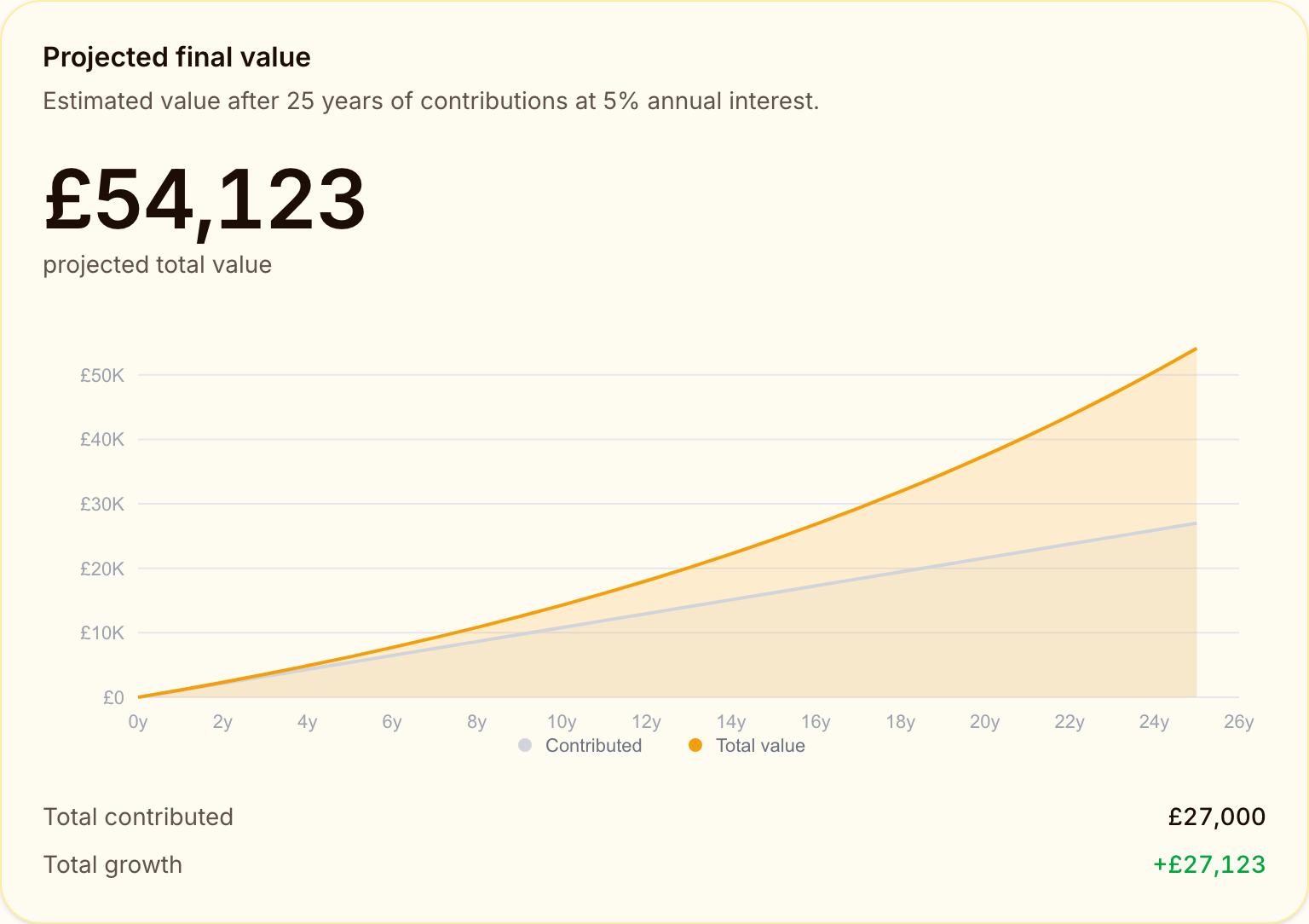
The calculator returns £54,123 where the table says £51,344, and the difference is worth understanding rather than glossing over. In the table the saving lands once at the end of each year. The calculator spreads it across twelve monthly payments, so every pound spends longer invested. Contributing monthly rather than annually is worth about 5% over a quarter of a century, which is roughly what paying your council tax over twelve instalments instead of ten is worth in the other direction.
11. Who would pay more, and the asset-rich cash-poor problem
The losers are fewer, but they lose much harder than the winners gain. They are also concentrated in a way that makes the politics brutal.
The asymmetry
The average saving under the 0.48% proposal is £742 a year. The average increase is £1,449 a year, roughly twice as large. So while winners outnumber losers by about four and a half to one, the aggregate is nothing like as lopsided as the headcount suggests.
At the top the numbers stop being incremental. Property Tax Lab finds London Band H properties, on estimated values averaging £4.3 million, facing average increases of £17,106 a year. Some 98% of London Band H homes would rely on the transitional cap. The ten most affected councils in England are all London boroughs, led by Kensington and Chelsea, where the average increase is £6,561 a year on homes averaging £1.83 million.
Why London specifically
Two effects compound. London's house prices have risen further from their 1991 level than anywhere else, so its bands understate its values by the largest margin. And London boroughs have unusually low Band D rates, because they have large commercial tax bases and a great many properties to spread the requirement over.
Westminster is the extreme case. Its 2026/27 Band D charge is £1,047.85, less than half the England average of £2,392. Its Band H charge of £2,095.70 is lower than Hartlepool's Band D. A Westminster household in a £1.5 million Band G flat pays £1,746.42 today and would pay £7,200 at 0.48%, an increase of £5,454 a year before any cap.
None of that makes Westminster households unfairly targeted. They have been paying an extraordinarily low effective rate for decades, and correcting that in one go produces a jolt rather than an adjustment.
The asset-rich, cash-poor problem
The strongest objection to any annual property tax lives here, and it is a real one rather than a rhetorical one.
Consider a household that bought a modest home in a London suburb in 1985 on an ordinary income, paid the mortgage off and retired. The house is now worth £900,000 because of what happened to London property prices, not because of anything they did. Their income is the state pension plus a small occupational pension. Under council tax they pay a Band F or G bill. Under a 0.48% charge they would pay £4,320. Under a land value tax at 1.28% on the land element they could pay considerably more.
They cannot pay it out of income. The wealth is entirely illiquid and sitting in the house they live in.
Three answers are on offer, and none of them is clean.
Deferral lets the charge roll up, usually with interest, until the property is sold or the owner dies, at which point it comes out of the estate. It is the standard solution and it works arithmetically. Neidle notes surprisingly low take-up in overseas schemes. People are reluctant to build up a debt secured on their home even when the alternative is worse, and it visibly reduces what they leave behind.
Caps limit the annual increase, which is what the Fairer Share design does at £100 a month. The catch, already covered, is that the cap dies with the sale.
Downsizing is the answer that gets given least sympathetically, and it is not entirely unreasonable. A tax that nudges under-occupied family homes onto the market is doing something the housing market needs. It also asks an eighty-year-old to leave the house they have lived in for forty years because of a tax change, and politicians can count the votes on that.
The recent buyer problem
There is a second group of losers that gets less attention and has a stronger complaint.
Somebody who bought a £600,000 home last month paid £20,000 in stamp duty. If that tax is abolished and replaced with an annual charge, they have paid the transaction tax and now start paying the annual one too. They get the worst of both regimes purely because of the timing of their purchase.
Neidle takes this seriously enough to propose a transitional credit against stamp duty paid in recent years, and notes it would cost around £5 billion up front. Without it, as he puts it, people would be furious and they would be right.
Capitalisation, the loss nobody bills you for
The subtlest loser is whoever owns an expensive property on the day the reform is announced.
A permanent annual charge on an asset reduces what a buyer will pay for it, because the buyer is now purchasing the house plus an obligation. That effect is called capitalisation, and it lands immediately and entirely on the current owner. Neidle's land value tax modelling estimates a fall of around 27% in Kensington property prices and a rise of 40% to 70% in Blackpool. The Blackpool owner receives a windfall for owning a house on the right day, while the Kensington owner takes a capital loss nobody ever billed them for.
The distributional case for reform survives this. The observation that it is arbitrary does not go away.
12. What changes for renters, landlords and first-time buyers
Roughly a fifth of English households rent privately. They are almost invisible in the coverage of this debate, despite being the group whose position changes most.
Renters
Under council tax, the tenant is liable. The bill arrives in their name and the arrears are their arrears. The bailiff comes to them. Under the Fairer Share proposal the legal liability moves to the owner, so a renter would stop receiving a council tax bill entirely.
That is a large change. It takes an average of well over a thousand pounds a year out of the direct outgoings of the tenure with the lowest incomes and the least security. It also lifts renters clear of the enforcement machinery described earlier, which currently pursues them for a tax on an asset they do not own.
Whether the economic cost moves with the legal liability is a genuinely open question, and it would be wrong to pretend otherwise. In economics, who bears a tax depends on the relative bargaining power of the two sides rather than on whose name is on the bill. In a rental market with more demand than supply, which describes most of England, landlords broadly charge what tenants will pay rather than what their costs are. That argues against full pass-through in the short run. Over a longer horizon, a permanent increase in the cost of holding a rental property shrinks the supply of it. Less supply means higher rents.
The most defensible position is that renters would gain in the short run and that part of the gain would erode over time. Nobody can tell you what share. Property Tax Lab lists pass-through as a live design risk rather than a solved problem, which is the right way to hold it.
Landlords
For landlords the proposal is unambiguously worse than the status quo, and it stacks on top of a decade of changes that already went the same way.
Since 2020, individual landlords have not been able to deduct mortgage interest from rental profits. They get a 20% basic-rate credit instead, so a higher-rate landlord pays tax on income that goes straight to the lender. The stamp duty surcharge on additional property is 5%. Capital gains tax on residential property is due within 60 days of sale. From April 2027, individual landlords pay two percentage points more tax on rental income, taking the rates to 22%, 42% and 47%.
Add an annual charge of 0.48% of every property's value, with no ceiling and no certainty it can be passed on, and the arithmetic on a small mortgaged portfolio gets difficult. Under the Fairer Share design an occupied buy-to-let pays the standard rate rather than the doubled second-home rate. That is the one piece of relief in the package, but the charge is still new money on top of a bill the tenant used to pay.
The likely consequence is more landlord sales. That is not automatically bad. A landlord selling to an owner-occupier turns a rented home into an owned one without changing the housing stock. It does thin the supply of rental property for people who are in no position to buy.
First-time buyers
This group gains most obviously from the stamp duty half of the swap, and least from the council tax half. The balance depends entirely on price.
First-time buyer relief already takes SDLT to zero up to £300,000 and tapers it to £500,000, so the direct saving for a first purchase below £300,000 is nothing. Above £500,000 the relief disappears completely and standard rates apply to the whole price. That is where abolition is worth real money, £16,250 on a £525,000 purchase.
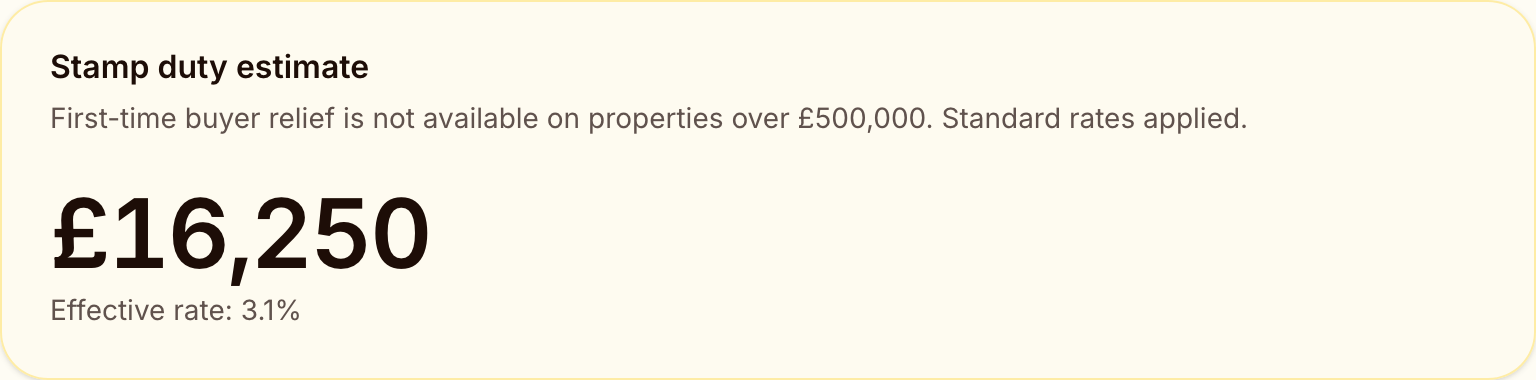
Notice what the calculator says under the heading. The buyer entered themselves as a first-time buyer and received no relief at all, because the £500,000 ceiling is a cliff rather than a taper. Ten thousand pounds more house costs £5,500 more tax at that boundary, and a first-time buyer who negotiates a £525,000 asking price down to £499,000 saves £6,300 in stamp duty on top of the £26,000 off the price.
The larger effect is indirect. A first-time buyer in a low-value area gets a large annual saving from the day they move in. A first-time buyer in London gets a stamp duty saving on the way in, then a considerably larger annual bill thereafter. Over a long ownership the annual charge dominates the one-off saving. The rent vs buy guide works through how much a change in annual ownership costs shifts the break-even year. A swing of a thousand pounds a year either way moves it noticeably.
There is also a price effect. Abolishing a buyer-side tax tends to raise prices, because buyers can afford more without it, so part of the saving is competed away at the point of purchase. Adding an annual charge pushes the other way. Which dominates depends on where you are buying, which is the same answer as everything else in this chapter.
13. The objections, and which of them hold up
Not every criticism of a property tax is serious, and not every defence of council tax is cynical. Here are the arguments actually being made, sorted by how well they survive contact with the evidence.
The objections that hold up
The rate is understated. Established beyond argument. 0.48% raises roughly £44.8 billion against the £48.3 billion of requirement Property Tax Lab costed it against, and about £51 billion on 2026/27 council tax figures. A revenue-neutral rate is 0.52% to 0.62%, and quoting the lower number materially overstates how many households gain.
The transitional cap creates a moving penalty. Also solid. A cap that ends on sale makes the most affected properties hard to sell, which reconstructs the mobility problem the reform was partly designed to solve, for the households facing the largest increases.
Asset-rich, cash-poor households have no way to pay. Real. Every proposal acknowledges it. Deferral is the answer and the arithmetic works. But take-up is low wherever it has been tried, and a scheme most eligible households turn down is not a functioning safety net.
Recent buyers get taxed twice. Real and unanswered in the Fairer Share design. Somebody who paid stamp duty last year and then starts paying an annual charge has funded the transition personally. Neidle's transitional credit fixes it at a cost of around £5 billion.
Councils need stable revenue and a market-value tax is not stable. Reasonable. Council tax has the considerable virtue of being predictable, because the base only changes when homes are built or demolished. A tax on current values falls when the market falls, which is exactly when demand for council services rises.
The valuation infrastructure does not exist. True today. Annual or near-annual automated valuation of 25 million dwellings is buildable but not built. It has to be accurate and trusted before anything can be charged on it. The Office for Budget Responsibility expects 20% of homeowners to appeal the mansion tax valuations, with a 40% success rate, on a scheme touching only 165,000 properties. Scale that appeal rate to the whole housing stock and the administrative problem is obvious.
The objections that are weaker than they sound
Property value does not indicate ability to pay. This is Mel Stride's argument and it is half right. It is a genuine problem for the specific households described earlier. As a general claim it is much weaker. Property value tracks wealth more closely than almost any other observable, and the current alternative is a band assigned in 1991 that tracks today's ability to pay considerably less well. The objection argues for deferral rather than for keeping 1991 values.
It is a tax on aspiration or on family homes. This is a framing rather than an argument. Every household already pays an annual property tax. The question on the table is whether the amount should track what the property is worth. Describing the existing tax as acceptable and a proportional one as an attack on families requires a reason why three-to-one compression is the right ratio. Nobody has offered one.
A land value tax is a tax on gardens. Rhetorically effective and technically true in the narrow sense that a larger plot has more land value. It does not establish that taxing land is worse than taxing the building on it. The real objection to a land value tax is valuation, a much stronger argument that this framing distracts from.
Landlords will simply pass it on to tenants. Plausible in the long run and overstated in the short run. Either way it is not a reason to keep charging the tax to the tenant directly. If pass-through were complete and instant, who is legally liable would not matter. The people arguing this generally also argue that the change would damage landlords, and both cannot be true.
The objection nobody makes out loud
Burnham gestured at the strongest practical argument against reform when he mentioned the manifesto. The losers are concentrated and articulate, and most of them live in London and the South East, including a great many marginal seats. The winners are scattered. Each gains a few hundred to a thousand pounds a year, and nobody notices a bill going down as vividly as they notice one going up.
Wales revalued once and a third of households saw their bill rise. England scheduled a revaluation for 2007 and cancelled it in 2005. Neither decision was about tax design.
14. What is already changing: the mansion tax, Wales, Scotland and Northern Ireland
While the wholesale replacement sits in abeyance, four separate things are actually happening. Three of them are already law.
The High Value Council Tax Surcharge
Rachel Reeves announced this in the Budget of 26 November 2025, and everyone calls it the mansion tax. It is a flat annual surcharge added to council tax bills on English homes worth more than £2 million. The House of Commons Library briefing sets out the detail.
| Property value | Annual surcharge |
|---|---|
| £2 million to £2.5 million | £2,500 |
| £2.5 million to £3.5 million | £3,500 |
| £3.5 million to £5 million | £5,000 |
| Over £5 million | £7,500 |
The mechanics matter. Valuations are based on April 2026 values. The Valuation Office Agency will carry them out over roughly two years, using recent sales data, aerial imagery and planning records rather than physical inspection. Collection starts in April 2028, alongside council tax. The owner is liable rather than the occupier, which is a first for council tax and a precedent for the proportional model that has gone largely unremarked. Revaluations are to run every five years. Improvements made after April 2026 will not affect the first five-year liability period.
The scale is modest. Fewer than 1% of English properties sit above the threshold on Treasury estimates. The OBR puts the number at around 165,000, and the yield at roughly £430 million a year from 2028/29. Around half the affected properties are in London and the great majority of the rest in the South East. The government consulted on a deferral scheme for those unable to pay, with details still to be confirmed.
The money is not what makes it significant. It establishes owner liability, VOA valuation at scale, a five-yearly revaluation cycle, and the political fact of a charge that varies with current market value. Every one of those is a component of the larger reform. Reports that the threshold might drop to £1.5 million, bringing in roughly 150,000 more households, are speculation, but the infrastructure to do it would already exist.
Wales
Wales revalued once, on 2003 values applied from April 2005. It has nine bands rather than eight. The Welsh Government legislated for a further revaluation in April 2025, then pushed it to April 2028 with five-yearly repeats thereafter. In June 2026 it confirmed it was reviewing whether to proceed at all. Its own modelling found bills falling or staying flat for 70% of households, while around 450,000 homes, about 30%, would pay more.
Wales is the closest thing the UK has to a natural experiment. The lesson it has taught every other administration is that revaluation is more dangerous politically than the status quo is unfair.
Scotland
Scotland kept 1991 valuations and eight bands, but adjusted its multipliers in April 2017. Bands E to H now pay more relative to Band D than in England, which makes Scottish council tax slightly less regressive than the English version without touching the valuations.
A consultation on the future of council tax closed on 30 January 2026. The 2026/27 Scottish Budget commits to revaluing properties worth over £1 million and introducing two new high-value bands from 1 April 2028, which is the same date England's surcharge begins and a broadly similar move from a different direction.
Northern Ireland, which never adopted council tax at all
Northern Ireland kept domestic rates. Your bill is your property's capital value multiplied by the sum of a regional poundage set by the Executive and a district poundage set by one of eleven councils. Capital values are assessed as at 1 January 2005, which is stale but a good deal fresher than 1991.
The important feature is that it is genuinely proportional. A Belfast home with twice the capital value pays twice the rates, with no bands and no compression. There is a cap, currently a maximum capital value of £400,000, above which no further rates are charged. The most expensive homes in North Down therefore pay the same as a comfortable detached house. Removing or raising that cap is under active discussion.
So the United Kingdom already contains a working proportional property tax on domestic property, administered by a valuation agency, that has been running for two decades. When people say the model is untested here, point at Belfast.
15. Worked example: better off under a property tax
Time to put a household through it, and to fix the flaw in most coverage of this debate before it can start. The two worked examples here are the same household. Same two incomes, same savings behaviour, same 25-year horizon, same investment return. Between this chapter and the next, exactly three dials move. The value of the home they own, the council tax band it sits in, and how many times they move house. Whatever flips the verdict, it cannot be the household.
One rule before the numbers, because it changes how to read every figure. Everything here is inflation-adjusted. Assume inflation of around 2.5% and strip it out of every return, so every output below reads as today's money. An investment return of 5% real is roughly 7.5% nominal, a reasonable long-run figure for a diversified portfolio. Council tax is held flat in real terms in the base case. That is generous to the current system, given that bills have outgrown inflation for years, and a sensitivity for it appears at the end of the next chapter. House prices are assumed to track inflation, so the property tax charge is also flat in real terms.
| Input | Value |
|---|---|
| Location | Manchester |
| Home value today | £247,000 |
| Council tax band | C |
| Council tax bill, 2026/27 | £2,055.15 |
| Proportional property tax rate | 0.48% |
| Investment return on any saving | 5% real (roughly 7.5% nominal) |
| Horizon | 25 years |
| Moves in that period | 1, the original purchase |
The home value is the Office for National Statistics (ONS) average for Manchester in May 2026. Band C is where a home at that price most likely sits. Divide today's price by the roughly 4.5 multiple North West prices have grown by since 1991 and you land at about £55,000 in 1991 money, just inside Band C's £52,001 to £68,000 bracket. The bill is Manchester City Council's published 2026/27 charge for that band.
The annual arithmetic
At 0.48%, this household would pay £1,186 a year instead of £2,055.15. That is a saving of £870 a year, or £72 a month.
In percentage terms they pay 0.83% of what their home is worth today, against the 0.48% the proposal would charge. That is comfortably the winning side of the half a percent line. Their home would have to be worth £428,156 before the two systems cost the same, so Manchester prices could rise 70% tomorrow and they would still gain.
The rate matters, though. At a revenue-neutral 0.52% they would pay £1,284 and save £771. At 0.62% they would pay £1,531 and save £524. They win under every version, which is what being well inside the break-even buys you.
The stamp duty half
Almost nothing. At £247,000 as first-time buyers they pay no stamp duty at all, since first-time buyer relief covers everything up to £300,000. Even as ordinary movers the bill would be £2,440. The transaction-tax half of the swap is close to worthless to this household. The same goes for most households in the North and Midlands.
That deserves saying plainly, because the two halves of the proposal help completely different people. Abolishing stamp duty is worth most to expensive, mobile households. A proportional charge instead of council tax is worth most to cheap, static ones. Selling them as a package means most of the country is being offered one benefit and told about two.
Over 25 years
The saving runs at £870 a year for 25 years, which is £21,739 of council tax not paid, in today's money. Invested rather than spent at 5% real, it compounds to £41,501 by year 25. At a cautious 3% real it is £31,703, and at 7% real it is £54,998.
That final figure is roughly a fifth of what the house is currently worth, produced entirely by changing the formula the tax bill comes out of.
16. Worked example: worse off under a property tax
Same household. Same incomes, same savings behaviour, same horizon, same 5% real return, same inflation adjustment. Now turn the three dials.
| Dial | Better off | Worse off |
|---|---|---|
| Location and home value | Manchester, £247,000 | Guildford, £750,000 |
| Council tax band | C | F |
| Moves in 25 years | 1 | 1 |
Guildford's average home was £525,000 in April 2026, so £750,000 buys a larger family house rather than an exotic one. Divide by the roughly five-fold growth in Surrey prices since 1991 and it comes out at about £150,000 in 1991 money, inside Band F's £120,001 to £160,000 bracket. Guildford Borough Council's published Band D charge for the town area in 2026/27 is £2,501.18, so Band F at thirteen-ninths is £3,612.82.
The annual arithmetic
At 0.48%, this household pays £3,600 a year against £3,612.82 today. They save £13 a year, which is a rounding error rather than a result.
In percentage terms they pay 0.48% of what their home is worth, against the 0.48% the proposal charges. They are not near the line, they are on it. The two systems agree to within thirteen pounds a year, and the direction they eventually fall depends entirely on details.
Push the rate to a revenue-neutral 0.52% and they pay £3,900, an increase of £287 a year. Push it to 0.62% and they pay £4,650, an increase of £1,037. Or hold the rate at 0.48% and let Guildford prices outpace the council tax cap by a couple of points a year, and they cross the line the other way.
This is roughly where a large slice of the South East and the outer London suburbs sits. Not obviously a winner or a loser, and entirely at the mercy of a rate nobody has set.
Where it becomes a clear loss
Move the same household to a £1.5 million flat in Westminster, Band G, and the picture changes completely. Their bill today is £1,746.42. At 0.48% it would be £7,200, an increase of £5,454 a year. Over 25 years that is £136,340 in today's money, before any cap.
The full grid
Every combination, always the same household, with the moves dial doing its own work. Each cell is the 25-year total of both taxes under the current system minus the 25-year total under a 0.48% charge with stamp duty abolished, in today's money. Positive means the household is better off under the reform.
| Home, band and value | No moves | 1 move | 3 moves |
|---|---|---|---|
| Hartlepool, Band A, £131,000 | £26,895 better | £26,895 better | £27,135 better |
| Manchester, Band C, £247,000 | £21,739 better | £21,739 better | £26,619 better |
| A Band D home at £410,000 | £10,600 better | £16,100 better | £37,100 better |
| Guildford, Band E, £525,000 | £13,425 better | £29,675 better | £62,175 better |
| Guildford, Band F, £750,000 | £320 better | £27,820 better | £82,820 better |
| Westminster, Band G, £1,500,000 | £136,340 worse | £42,590 worse | £144,910 better |
Read the dials one at a time.
The home value dial decides the annual flow, and it is nearly linear. Every row's no-moves column is just the 25-year council tax bill minus 25 years of 0.48% of the value. The Hartlepool and Manchester households win by a wide margin. The Guildford Band F household wins by almost nothing, and the Westminster household loses heavily.
The moves dial is the surprise, and it dominates at the top. The Westminster row swings by £281,250 between no moves and three, because stamp duty at £1.5 million is £93,750 a transaction. A household in an expensive home that moves often is a winner under the swap, despite paying five thousand pounds a year more. The transaction tax it stops paying is simply that large. A household in the same home that never moves is the biggest loser in the table. Nothing about the annual charge distinguishes them.
The moves dial does nothing at all at the bottom. Hartlepool and Manchester barely move between the columns, because first-time buyer relief already takes stamp duty to zero at those prices. Abolishing a tax they do not pay is worth nothing.
Note that the first purchase in every row uses first-time buyer relief and later purchases pay standard rates, which is why the one-move column matches the no-moves column at the two cheapest rows.
The realistic middle
The grid maps the corners. Here is a row closer to where most English households actually sit. It takes the England average Band D bill of £2,392, a home at roughly the England average price, and one move in 25 years, then prices it at the revenue-neutral rate rather than the campaign one.
| Home value | Council tax | At 0.48% | At 0.52% | At 0.62% | Stamp duty on one move |
|---|---|---|---|---|---|
| £292,000 | £2,392 | £1,402 | £1,518 | £1,810 | £4,600 |
This household saves £990 a year at the campaign rate. At 0.52% the saving is £874, and at 0.62% it is £582. Every version leaves it better off, and the £4,600 of stamp duty it stops paying is a bonus rather than the point. At 5% real over 25 years, the saving at the campaign rate compounds to £47,269 in today's money.
One bias in this model runs consistently in one direction, and it needs naming. Council tax is held flat in real terms throughout, and it has not been flat in real terms for fifteen years. Bills rose 4.9% in 2026/27 against inflation nearer 3%, and the referendum cap makes something similar the default every year. A property tax is a percentage of value, so if house prices track inflation its bill stays flat in real terms while council tax keeps climbing. The gap widens on its own.
Let council tax outgrow inflation by two percentage points a year, roughly its recent record. The tables above then understate the case for reform substantially. Below is the same set of households, with that one change.
| Home, band and value | Council tax held flat | Council tax growing 2% real | Property tax at 0.48% |
|---|---|---|---|
| Hartlepool, Band A, £131,000 | £42,615 | £54,598 | £15,720 |
| Manchester, Band C, £247,000 | £51,379 | £65,827 | £29,640 |
| A Band D home at £410,000 | £59,800 | £76,616 | £49,200 |
| Guildford, Band E, £525,000 | £76,425 | £97,917 | £63,000 |
| Guildford, Band F, £750,000 | £90,320 | £115,720 | £90,000 |
| Westminster, Band G, £1,500,000 | £43,660 | £55,938 | £180,000 |
The Guildford Band F row is the one that moves furthest. Held flat, it is a £320 dead heat over 25 years. Let council tax carry on doing what it has been doing and the same household is £25,720 better off under the property tax. Every row except Westminster becomes a comfortable win, and Westminster's loss narrows from £136,340 to £124,062. 2% real growth is not a forecast. The status quo simply has a built-in upward drift the reform does not, so anyone comparing the two on today's bills alone is comparing a moving number to a still one.
17. How to cut your council tax bill this year
None of the above requires any legislation. Four routes are available now, and between them they are worth more to most households than any plausible reform.
Challenge your band
England and Scotland's bands were assigned in minutes per property, by valuers who mostly did not stop the car. Errors are common. Nobody has ever gone back to correct them. The Valuation Office Agency will review a band on request, and 27% of resolved challenges in 2023/24 produced a reduction. A Which? survey of people who challenged found around 54% succeeded.
The method that works has two steps and both matter. First, check what band your neighbours are in, using the free VOA band search. If similar properties on your street sit a band lower, that is evidence. Second, estimate what your home was worth in 1991. Take a recent sale price for a comparable property, divide by the growth in your region's house price index since 1991, then check the answer against the band brackets. A challenge backed by both pieces of evidence stands on much stronger ground than one built on a feeling that the bill is too high.
There is a risk worth stating clearly. A review can move a band up as well as down, and it can move your neighbours' bands too. If your street is uniformly banded and your home is on the larger side, a challenge may not go the way you want.
Claim the single person discount
If you are the only adult living in the property, you are entitled to a statutory 25% reduction. It is set nationally and is identical in every billing authority in Great Britain. Some adults are disregarded when counting, including full-time students, apprentices on low pay, live-in carers, people who are severely mentally impaired, and 18 and 19 year olds still in full-time education. A household of two where one is disregarded qualifies for the 25%.
Nobody applies it for you. A council only knows your household has changed if you tell it, so the discount goes unclaimed by exactly the people who have just become a single-adult household.
Apply for Council Tax Reduction
Around 3.7 million English households receive it, and many more are eligible than claim. Since 2013 each council designs its own working-age scheme. The rules genuinely differ by address, so there is no substitute for checking your own council's. Pension-age claimants are protected by national rules and can receive up to a 100% reduction. Being on Universal Credit does not enrol you automatically, which is one of the most common reasons for missing out.
If you are already in arrears, ask specifically about section 13A discretionary relief, which lets a council reduce or write off a bill in cases of hardship. It exists in every authority and is almost never volunteered.
Check the disabled band reduction
A property adapted for a disabled resident can be charged at the band immediately below its actual band. The adaptation might be an extra bathroom or kitchen, a room used mainly by that person, or space for wheelchair use indoors. A Band A property moves to a specially created Band Z, below A. This one gets missed a lot, because the paperwork sits under adult social care rather than council tax.
18. How to decide what any of this means for you
The practical question underneath all of this is rarely what you think of the tax. It is whether a possible reform changes something you are about to do, usually a purchase, a move, or where to look.
Start with your own numbers
The first answer is the boring one, and it is the right one. Put your actual details into a UK-specialised financial calculator and work out your own position. Every household's is different, and the averages in this guide will be wrong for you in ways no amount of reading will predict. Get started with A Few Quid and you can put your salary, mortgage, savings and fixed outgoings into one projection. You then see what a change of a few hundred or a few thousand pounds a year actually does over the horizon you care about, rather than in the abstract.
That matters more here than in most tax debates, because the effect is a small annual number running for a very long time. Nobody's intuition handles that well. A £990 annual difference feels trivial and compounds to more than £47,000 over 25 years. A £5,454 annual difference feels catastrophic and may be entirely offset by the stamp duty a mobile household stops paying. Neither of those is obvious without running it.
Then the questions worth asking yourself
If you would rather interrogate the decision by hand, these are the ones that actually change the answer.
How much weight to give a tax that might not happen
Less than the coverage implies, for three reasons.
The wholesale swap has been ruled out for this Parliament by the Prime Minister who used to champion it. What is actually legislated is a surcharge on the top 1% of English homes from April 2028 and two new high-value bands in Scotland from the same date. Neither touches the vast majority of households.
Reform of this kind crawls even when governments want it. Wales has been working towards a second revaluation for years and has moved the date twice. England cancelled a revaluation in 2005 and has not rescheduled it in twenty-one years.
And the direction of any plausible reform is knowable even if the timing is not. Every serious proposal on the table moves the burden from cheap homes to expensive ones and from the North to London and the South East. If you are buying a modest home outside the South East, every version of reform helps you. If you are buying an expensive home in London and intend to stay in it, every version costs you. That is enough to inform a decision without needing to predict a Budget.
What is most likely to change your behaviour is not the reform at all. The four routes in the previous chapter are available today, and most households have never checked them.
About the author and this calculator
I am Mike Gallagher, and I built A Few Quid because every financial tool I could find either wanted to sell me something or assumed I was American. UK tax wrappers, UK property taxes and UK pension rules are specific enough that generic advice is close to useless. The specific advice usually arrives attached to a product.
A Few Quid is a projection engine. You put in your salary, pension, ISA, mortgage and fixed outgoings, and it shows you what your finances look like over the decades rather than the month. You can fork the plan and change one thing, then compare. That is all it does, and it is deliberate.
I am not a financial adviser and A Few Quid is not authorised by the FCA. Nothing here or in the app is a personal recommendation. The app is a calculator, not advice, and its output is only as good as the assumptions you feed it.
Which is the note to end this particular guide on. Every number in it, mine and everyone else's, rests on an assumption that could be wrong. The 0.48% rate does not raise enough money. Regional house price multiples used to place homes in bands are averages that will not describe your street. The 5% real return in the worked examples is a plausible long-run figure, not a promise. Treat all of them as inputs to test rather than facts to accept, and run your own.
FAQ
Why is council tax still based on 1991 property values?
Because no English government has been willing to revalue. A revaluation was scheduled for 2007 and postponed in September 2005 until after the next election, and it has never been rescheduled. Wales revalued once, on 2003 values applied in April 2005, and more than a third of Welsh homes moved up a band. That political memory is most of the answer. Scotland still uses 1991 values too, though its 2026/27 Budget commits to revaluing homes worth over £1 million and adding two new high-value bands from April 2028.
Is council tax regressive?
Yes, on every measure. A Band H home was worth at least eight times a Band A home in 1991 but pays exactly three times the tax, because the statutory band ratios run from six-ninths of Band D up to eighteen-ninths and stop there. Measured against income, the Resolution Foundation puts the poorest fifth of households at 4.8% of income and the richest fifth at 1.5%. Measured against current property value, a Band A home in Hartlepool pays about 1.3% a year while a Band G home in Westminster pays about 0.12%.
What is the proportional property tax and how much would I pay?
It is a proposal from the campaign group Fairer Share to scrap council tax and stamp duty on main homes and charge 0.48% of a home's current market value every year instead, with double the rate on second homes, empty homes and overseas-owned property. On a £300,000 home that is £1,440 a year. The quickest way to see which side you fall on needs no arithmetic. Work out roughly half a percent of what your home would sell for, which on a £400,000 home is £2,000. If your council tax bill is bigger than that, the proposal cuts what you pay. If it is smaller, your bill goes up.
Has Andy Burnham scrapped council tax and stamp duty?
No. He backed the idea before becoming Prime Minister and has called council tax highly regressive, but in his first broadcast interview as PM he ruled the swap out for now, saying it was not the case that plans on that scale were being brought forward at this moment in time. Number 10 separately denied that a 0.48% charge or a land value tax was under active consideration. The Autumn Budget on 28 October 2026 is the next decision point.
What is the mansion tax and when does it start?
The High Value Council Tax Surcharge was announced in the November 2025 Budget and applies to homes in England worth more than £2 million. It is a flat annual charge of £2,500, £3,500, £5,000 or £7,500 depending on which value band the property falls into, based on April 2026 values, collected alongside council tax from April 2028. The owner pays rather than the occupier. The Office for Budget Responsibility expects around 165,000 properties to be caught.
Would a property tax make my rent go up?
Possibly. Under the Fairer Share design the legal liability moves from the tenant to the owner, so a renter would stop receiving a council tax bill. Whether the economic cost moves with the legal liability is a separate question. In a tight rental market with more demand than supply, landlords tend to charge what the market bears rather than what their costs are, and analysts treat pass-through as a live risk rather than a settled one.
Would abolishing stamp duty make house prices go up?
Some of it would capitalise into prices, which is what happens with most buyer-side taxes and reliefs. The stronger effect is on the number of transactions. Removing stamp duty is modelled to increase sales by around 9%, roughly 72,500 extra transactions a year in England, and to free up around 15,000 additional long-distance moves, which is the labour-mobility argument. Dan Neidle's modelling puts the current long-run drag at about 2.6% of transactions, or 25,000 to 30,000 households a year who would move and do not.
Can I lower my council tax bill right now?
There are four routes worth checking. Challenge your band with the Valuation Office Agency if comparable neighbouring homes sit lower, since 27% of resolved challenges in 2023/24 produced a reduction. Claim the 25% single person discount if you are the only adult in the property. Apply for Council Tax Reduction if you are on a low income, which around 3.7 million households in England receive. And check the disabled band reduction, which moves an adapted property down one band.
What is a land value tax and why is it different?
A land value tax charges the value of the land alone, stripping out the building on it. The economic case is strong, because land cannot be created or moved in response to tax, so the levy does not discourage anything useful. The practical case is harder. Welsh Government research published in 2026 tested several methods for separating land value from building value and found none accurate enough to deploy in a live tax, and a revenue-neutral rate replacing council tax and residential stamp duty would need to be around 1.28%.
Glossary
- Council tax
- The annual charge on domestic property in England, Scotland and Wales, introduced in 1993 by the Local Government Finance Act 1992. Every home sits in a valuation band, and each billing authority sets a Band D rate that all the other bands are a fixed fraction or multiple of. It raised £46.8 billion across England in 2026/27.
- Valuation band
- The bracket a home is placed in for council tax. England and Scotland use eight bands, A to H, based on what the property was worth on 1 April 1991. Wales uses nine bands, A to I, based on 2003 values applied from April 2005. In England, Band A covers homes valued at up to £40,000 in 1991 and Band H covers anything above £320,000.
- Band D
- The reference band that every council tax bill is built from. A billing authority sets its Band D charge and the statutory ratios do the rest, running from six-ninths of Band D at Band A up to eighteen-ninths at Band H. The average Band D bill in England for 2026/27 is £2,392.
- Precept
- A charge added to your council tax bill by an authority that does not collect it directly. Police and crime commissioners, fire authorities, combined authorities, the Greater London Authority and parish councils all precept. The average Band D parish precept in England for 2026/27 is £100.
- Proportional property tax (PPT)
- The Fairer Share campaign's proposal to replace council tax and stamp duty on main homes with a flat annual charge of 0.48% of a home's current market value, doubled to 0.96% on second homes, empty homes and overseas-owned property. Legal liability would sit with the owner rather than the occupier.
- Land value tax (LVT)
- An annual charge on the value of land alone, excluding the buildings on it. Economists favour it because land supply is fixed, so the tax does not deter construction or improvement. Its weak point is valuation, since land under an existing building has no observable market price and has to be inferred.
- Stamp Duty Land Tax (SDLT)
- The tax on buying property in England and Northern Ireland, charged in slices. Since April 2025 the rates are 0% to £125,000, 2% to £250,000, 5% to £925,000, 10% to £1.5 million and 12% above that. First-time buyers pay nothing up to £300,000 on homes costing £500,000 or less. Scotland and Wales run their own equivalents.
- High Value Council Tax Surcharge
- The measure widely called the mansion tax, announced in the November 2025 Budget. From April 2028 it adds a flat £2,500 to £7,500 a year to homes in England worth over £2 million, assessed on April 2026 values and charged to the owner. Around 165,000 properties are expected to be caught.
- Council Tax Reduction (CTR)
- The means-tested help with council tax bills that replaced Council Tax Benefit in 2013. Each council designs its own scheme within national rules, so entitlement varies by address. Around 3.7 million households in England receive it, at a cost of roughly £4.2 billion a year.
- Single person discount
- A statutory 25% reduction for any property where only one adult lives. It is set by the Local Government Finance Act 1992 and is identical in every billing authority in Great Britain. Full-time students and some other groups are disregarded when counting the adults in a home.
- Regressive tax
- A tax that takes a larger share from those with less. Council tax is regressive against income (the poorest fifth of households pay 4.8% of income, the richest fifth 1.5%) and against property value (a modest home pays a far higher percentage of its worth than an expensive one).
- Deadweight loss
- The value destroyed by a tax beyond the revenue it collects, because it stops transactions that would otherwise have made both sides better off. Transaction taxes like stamp duty are unusually bad for this, since every sale they prevent removes a gain that nobody captures.
- Capitalisation
- The way a permanent annual charge on an asset gets absorbed into its price. A new yearly property tax lowers what a buyer will pay, so part of the burden lands on whoever owns the property on the day it is announced rather than on future owners.
- Referendum principle
- The cap on how far a council can raise council tax without holding a local vote. For 2026/27 it is 4.99% for authorities with adult social care responsibilities, made up of 3% general and 2% social care precept, and 2.99% for those without. Of 384 capped authorities, 274 used the maximum available.
Sources
- Council Tax levels set by local authorities in England 2026 to 2027 — GOV.UK
- Stamp Duty Land Tax: residential property rates — GOV.UK
- Challenge your Council Tax band — GOV.UK
- Apply for Council Tax Reduction — GOV.UK
- Council tax needs urgent reform, not being frozen in time in 1991 — Institute for Fiscal Studies
- Revaluation and reform: bringing council tax in England into the 21st century — Institute for Fiscal Studies
- Rising Council Tax bills and the spectre of the poll tax — Resolution Foundation
- Proportional Property Tax — Fairer Share Campaign
- The Proportional Property Tax: who wins and who loses — Property Tax Lab
- A Fairer Property Tax — Onward
- Why do we still have stamp duty? — Tax Policy Associates
- What would a land value tax actually do? — Tax Policy Associates
- High Value Council Tax Surcharge and homes over £2 million — House of Commons Library
- Council Tax Reduction Schemes — House of Commons Library
- Find out about how we are reforming Council Tax — GOV.WALES
- Future of council tax in Scotland: consultation — Scottish Government
- Council tax arrears across Britain hit record £9.3bn — Debt Justice
- Council tax debt collection — Shelter England
- What tax reforms would Britons support? — YouGov
- UK House Price Index — Office for National Statistics
- Martin Lewis: how to check and challenge your council tax band — MoneySavingExpert
- Council tax bands and charges 2026/27 — Manchester City Council
- Council Tax charges for 2026/27 — Hartlepool Borough Council
- Council tax charges 2026-27 — Guildford Borough Council
Related reading
- Rent vs buy in the UK: When buying wins, when renting wins, and how to tell for your own numbers.
- How much do you need to retire in the UK? PLSA benchmarks, withdrawal rates and the state pension, worked through in detail.