Investing and Retiring in the UK vs France: Tax, Property and Pensions Compared
How the UK and France compare for investing and retirement, from ISAs and the PEA to property taxes, state and private pensions, and the pot size you need.
A long-read comparison briefing, roughly an hour
A Few Quid is not authorised or regulated by the FCA. This article is general information, not advice.
Cross the Channel and a saver asks the same questions. Where do I put my money so it grows without the taxman taking a slice. How much do I need before I can stop working. Will the state pension be there, and how much of it. But the answers come out completely differently, because the UK and France have spent decades building retirement systems that pull in opposite directions. Britain hands you a small flat state pension and a set of powerful tax wrappers to fill yourself, then mostly leaves you to it. France runs a generous state pension paid for by heavy compulsory contributions. It wraps investing in insurance and social charges, and treats property as the family's store of wealth. Neither is obviously better. They are two answers to the same problem, and which one flatters you depends on what you earn, what you own and how long you plan to live off it.
This article is general information, not advice. Nothing in it is a personal recommendation about where to live, save or invest. A Few Quid is not regulated by the Financial Conduct Authority (FCA), so it is not FCA-authorised. For choices with real money and tax consequences behind them, and cross-border ones above all, a regulated adviser who knows both regimes is worth the fee.
How to read this guide
This is a long comparison, so a quick map before you start. It runs from how the two systems are built, through the taxes, wrappers and property rules that decide where money grows, to the pensions and the pot you actually need to retire on either side.
We open with two systems, two philosophies of building wealth, the single idea that explains every difference that follows. Then the money mechanics. Income tax and the social charges that catch your investments sets out what each country takes before you have invested a penny, and where France's hidden layer bites. The tax-free wrappers puts the ISA head to head with the PEA and assurance-vie, the accounts that decide how much of your growth you keep.
From there we widen to behaviour and assets. How each country invests asks why the British buy shares and the French buy property and safe savings, on the same markets. Buying a home weighs the cost of buying property in each country, then owning and selling it.
Then the heart of it, retirement. The state pension compares the age, the amount and the machinery behind each government pension. Private and workplace pensions covers the second and third pillars, and the funded-versus-promise difference that decides which system is more fragile. What the international studies say brings in the OECD, the Mercer index, the wealth surveys and the peer-reviewed work that compare the two directly.
Finally, the numbers you came for. Cost of living and what a pension actually buys sets up the currency and price adjustment. Then two worked examples, the pot a UK saver needs for a comfortable retirement and the same retirement funded in France, answer the million-in-the-bank question in both currencies. The horizon and what a snapshot leaves out names the risks the tidy comparison hides. Then who each country suits turns the whole comparison into a straight answer on which country fits which saver, and how to decide, and how to model your own number turns it into something you can act on. Read it straight through if you have the hour. If not, the contents box will drop you where you need to be.
1. Two systems, two philosophies of building wealth
Almost every difference in this guide traces back to one choice each country made about who carries the weight of your old age. Get that idea straight and the rest stops looking like a jumble of unfamiliar acronyms. It starts to look like two coherent, opposite designs.
The UK runs what pension economists call a low-replacement, high-private model. The state promises a modest flat pension, the same for a cleaner and a chief executive with a full record alike, and deliberately leaves a large gap above it for you to fill. To help you fill it, Britain hands out unusually generous personal tax shelters. Money in an ISA grows and comes out entirely tax-free, and a pension gives tax relief on the way in. The bargain is clear enough. The state does less, so it hands you strong tools and expects you to do more. Britain also has a deep equity culture by European standards, a legacy of privatisations, wide share ownership and a big funded-pension industry, so the default British instinct for long-term money is the stock market.
France made the opposite choice. Its state pension is earnings-related and generous, built to replace most of a typical worker's income on its own. It is funded by some of the highest compulsory social contributions in the developed world. Because the state promises so much, the French household has historically needed to save less privately for retirement, and what it does save leans toward property and insurance-based products rather than direct shares. Investing outside a wrapper is taxed heavily, through a second layer of social charges with no real British equivalent. The French bargain is the mirror image. The state does a great deal, you pay a great deal for it through your working life, and the private tools are narrower and more taxed because they matter less.
Three pillars, stacked differently
Both countries rest retirement on three pillars, but the pillars carry very different loads. The first pillar is the state pension. In the UK it is small and flat. In France it is large and earnings-related. The second pillar is the workplace or compulsory top-up. In the UK this is auto-enrolment, a funded pot you own, only made compulsory in 2012 and still minimal at its default rate. In France it is AGIRC-ARRCO, a compulsory, decades-old points-based scheme that pays out a large slice of a private-sector pension. The third pillar is voluntary personal saving, the ISA and personal pension in the UK, the PER (Plan d'Épargne Retraite) and assurance-vie in France.
The single most important structural fact in the whole comparison is simple. The UK's heavy lifting happens in funded pots, money that exists, invested in real assets you own. Much of France's happens in pay-as-you-go promises, where today's contributions pay today's pensioners and your entitlement is a claim on tomorrow's workers. That one difference decides which system builds a visible pot and which is more exposed to an ageing population, and it is why the two score so differently when analysts grade them, a thread picked up in the chapter on the international rankings.
What this means for a saver deciding where to plant money
For anyone with a genuine choice about where to build wealth, the philosophies point in different directions depending on what you value. If you want maximum control, low tax on growth and a pot you can see and touch, the UK is built for you. Its wrappers rank among the best in Europe for a self-directed investor. If you would rather the state carried more of the risk while you paid for certainty through your payslip, France offers a pension most British workers would envy. They just never see the price, because it is deducted before the money reaches them. The rest of this guide puts numbers on that trade, one domain at a time.
2. Income tax and the social charges that catch your investments
Before you compare where investments grow best, you have to compare what each state takes off the top, because the two countries tax income in shapes that are hard to line up. The headline rates look broadly similar. What differs is the machinery around them, and one French layer in particular that changes the maths on every investment.
Start with income tax on earnings. The UK taxes the individual. You get a personal allowance of £12,570, then pay 20% up to £50,270, 40% up to £125,140, and 45% above that, with the allowance tapering away once income passes £100,000. These thresholds are frozen until April 2028, so more of a rising salary is dragged into higher bands each year. France taxes the household, not the person, through the quotient familial. Your family's income is divided into parts, a single person counting as one, a couple as two, with half-parts added for children, and the progressive scale is applied to the per-part figure before the tax is multiplied back up. The 2026 scale runs 0% up to €11,600, 11% to €29,579, 30% to €84,577, 41% to €181,917, and 45% above.
The practical effect of the quotient familial is that a single-earner French couple, especially with children, can pay strikingly little income tax, because the earner's income is spread across several parts before the rates apply. A UK couple gets no such splitting. Two people are simply two taxpayers. So a straight comparison of the top rates misses that France's system is far kinder to households with one main earner and dependants, and the UK's is more neutral between household types.
The layer that has no British equivalent
The two systems part company here. On top of income tax, France charges social charges, the prélèvements sociaux, and they fall not just on earnings but on almost all investment income, from rents to capital gains. The main component is the CSG (Contribution Sociale Généralisée). On 1 January 2026 the CSG rose, taking social charges on most investment income to 18.6%, up from 17.2%. No line on a UK payslip or tax return does the same job. National Insurance falls on earnings, not on your dividends or your fund gains.
That single layer reframes French investing. When you sell shares held outside a wrapper in France, the default tax is the PFU, the flat tax, and from 2026 it is 31.4%, made up of 12.8% income tax and 18.6% social charges. A UK investor selling the same shares outside a wrapper pays capital gains tax at 18% or 24% after a £3,000 annual exemption, and dividends are taxed at 10.75%, 35.75% or 39.35% after a £500 allowance. The rates are in the same rough territory, but the French social-charge floor means France reaches for a larger, more uniform slice, and reaches it even on gains that a UK investor would shelter with allowances.
| Tax on investing outside a wrapper | United Kingdom (2026/27) | France (2026) |
|---|---|---|
| Capital gain on shares | 18% or 24%, after £3,000 exempt | 31.4% flat tax (12.8% income tax plus 18.6% social charges) |
| Dividends | 10.75% / 35.75% / 39.35%, after £500 allowance | 31.4% flat tax, or the progressive scale by election |
| Bank interest | income tax at your band, after savings allowance | 31.4% flat tax |
| A distinct social-charge layer | none | 18.6% on most investment income |
The table shows why the wrapper matters even more in France than in the UK. A UK investor can do a great deal outside any wrapper before tax bites, using the capital gains and dividend allowances. A French investor faces the 18.6% social-charge floor almost immediately, which is exactly why the French wrappers covered next are so central to how the country invests.
3. The tax-free wrappers: the ISA against the PEA and assurance-vie
If social charges are the reason French investing is taxed harder, the wrappers are how each country lets you escape that tax. This is the domain where the UK's design is at its strongest, and where a British saver, comparing like for like, tends to come out ahead. The ISA is one of the cleanest tax shelters in the world. France's equivalents are useful, but each comes with strings the ISA does not.
The ISA is almost aggressively simple. You can put in £20,000 a year. Inside it, nothing is taxed. Growth, dividends and interest are all tax-free, and when you take the money out, at any age, for any reason, that is tax-free too. There is no lock-in and no minimum holding period, and no withdrawal ever triggers a tax event. A stocks and shares ISA can hold shares and funds from anywhere in the world. Over a long investing life this compounds into an enormous advantage, because you never lose a slice to tax on the way, and the rules on it have stayed broadly stable for years. One change is coming. From 6 April 2027 the amount you can put into a cash ISA drops to £12,000 for the under-65s, though the stocks and shares allowance and the overall £20,000 limit are unaffected, so a long-term investor barely notices.
France's closest match to a stocks and shares ISA is the PEA. It shelters European shares and funds and caps contributions at €150,000 over your lifetime. The tax break is real, but conditional. Sell within five years and the gain is taxed at the full 31.4% flat tax. Hold for five years and the gain becomes exempt from income tax, which is the headline benefit. Yet even after five years, the social charges of 18.6% still apply to the gain. So the PEA is never fully tax-free the way an ISA is. It is income-tax-free after a wait, on a smaller and more European menu of investments, with the social-charge layer always taking its cut.
The French favourite, assurance-vie
The account most French households actually reach for is not the PEA but assurance-vie, a life-insurance wrapper that holds funds and doubles as an inheritance tool. Its tax advantage builds with time. After eight years, the income-tax rate on gains you withdraw drops to 7.5% on the portion linked to premiums up to €150,000, and you get an annual tax-free allowance on the gain of €4,600 for a single person or €9,200 for a couple. Social charges of 17.2% still apply throughout. Assurance-vie is genuinely powerful, but for different reasons than the ISA. Its real strengths lie elsewhere. The eight-year tax taper and the flexibility of what it can hold both help, but the standout is its treatment on death, where it can pass large sums to beneficiaries outside the normal French inheritance rules. It is less a pure investment shelter than a Swiss-army wrapper for saving, drawing income and estate planning at once.
| Feature | UK stocks and shares ISA | French PEA | French assurance-vie |
|---|---|---|---|
| Annual or lifetime cap | £20,000 a year | €150,000 for life | no legal cap |
| Tax on growth inside | none | none | none until withdrawal |
| Tax on withdrawal | none, at any age | income-tax-free after 5 years, 18.6% social charges always | reduced rate after 8 years, plus an annual allowance, 17.2% social charges always |
| What it can hold | global shares and funds | mainly European shares and funds | insurer funds, including a guaranteed-capital fund |
| Lock-in | none | 5 years for the break | 8 years for the best rate |
Read across the table and the pattern is clear. The ISA wins on simplicity, on being genuinely tax-free rather than tax-reduced, on reachability at any age, and on the breadth of what it holds. The French wrappers win on other things the ISA does not attempt, a guaranteed-capital option inside assurance-vie, and its inheritance treatment. For the specific job of sheltering long-term stock-market growth and taking it out tax-free, the ISA is hard to beat, and it is one of the clearest points in the UK's favour in this whole comparison.
4. How each country invests: shares against property and safe savings
Give a British saver and a French saver the same spare money and the same global markets, and they tend to do different things with it. The British instinct reaches for shares and funds. The French instinct reaches for property and for guaranteed savings. That divergence is not about one being smarter. It grows out of the tax systems, the pension promises and the financial cultures set out already, and it shapes how wealth actually accumulates in each country.
The clearest symbol of the French approach is the Livret A, a state-regulated savings passbook that most French households hold. It is tax-free, entirely safe, capped at €22,950, and its rate is set by the government. In mid-2026 that rate was 1.5%, rising to 1.7% from 1 August 2026. As a home for cash it is excellent, tax-free and instant-access. As a long-term wealth builder it is modest, because a rate near inflation preserves money rather than growing it. The Livret A captures something real about French financial culture, a strong preference for capital safety and simplicity over market returns. Assurance-vie reinforces it, since a large share of assurance-vie money sits in the fonds en euros, a guaranteed-capital fund that behaves more like a savings account than an investment.
The British picture is different. A deeper equity culture, the wide reach of funded workplace pensions invested in shares, and the tax-free growth of the ISA all push British savers toward the stock market. That is a genuine advantage over a full career, because shares have beaten cash and bonds by a wide margin over the long run. But it carries volatility the Livret A never has. The point is not that one country picks better investments. The same global index fund sits in a French PEA and a British ISA. What differs is that the systems nudge their savers toward different default risks, and those defaults compound into very different outcomes over thirty years.
The returns are the same, the wrappers and behaviour are not
Be precise about what does and does not differ. The underlying investment returns are not a UK-versus-France question at all. A global equity fund returns what global equities return, whether it sits in an ISA or a PEA. Over the long run that has been about 5% a year above inflation for a diversified equity portfolio, and neither country changes the market. What each country changes is how much of that return you keep after tax, which the wrappers decide, and how much of your money you point at equities in the first place, which culture and defaults decide.
So the fair summary is that a disciplined investor can build the same portfolio in either country. The French saver keeps slightly less of the growth, because of social charges even inside the PEA, and is nudged by culture toward safer, lower-returning assets. The British saver keeps all of it inside an ISA and is nudged toward shares. Over a career, the combination of a fully tax-free wrapper and an equity default is a meaningful edge for the British system at building a large private pot, which is precisely what a low state pension forces British savers to do.
5. Buying a home: purchase costs, yearly taxes and capital gains
Property is where the French store their wealth, and it is where the two tax systems diverge most visibly. A home costs more to buy in France and carries taxes the UK does not have. But your main residence is taxed gently in both countries. For anyone weighing property either side of the Channel, the differences are large enough to change the sums.
Start with the cost of getting in. In the UK, the main purchase tax is Stamp Duty Land Tax (SDLT), and for a standard buyer it is zero up to £125,000, then 2% to £250,000, 5% to £925,000, 10% to £1.5 million and 12% above. A first-time buyer pays nothing up to £300,000. In France, the equivalent cost is bundled into the frais de notaire, which despite the name are mostly transfer taxes rather than the notary's fee. On an existing property they run about 7% to 8% of the price, pushed toward the top of that band since départements were allowed to raise their transfer duty in 2025. On a new build they are far lower, around 2% to 3%. So a French buyer of an ordinary existing home faces a heavier, more uniform upfront hit than a UK buyer, who pays little or nothing at the lower end and only reaches French-style percentages on expensive homes.
Holding and selling
Once you own, France charges an annual property tax, the taxe foncière. Whoever owns the property on 1 January pays it, worked out from a notional rental value and a locally set rate, so it varies widely by commune. The UK's nearest equivalent, council tax, is a local charge too, but it funds local services rather than being a pure property levy. France then adds something the UK genuinely lacks, a property wealth tax. The IFI (impôt sur la fortune immobilière) applies to households whose net taxable property is worth more than €1.3 million, taxing property wealth alone, not financial assets. A UK homeowner with a valuable house pays no annual tax on its value beyond council tax. A French one above the threshold pays a yearly wealth tax on it.
Selling is where the two converge, at least for your own home. In both countries the sale of your main residence is exempt from capital gains tax, however large the gain. The gap opens on second homes and investment property. The UK charges capital gains tax at 18% or 24% on the gain above the £3,000 allowance. France charges 36.2% on the gain, being 19% income tax plus 17.2% social charges, with a surtax on large gains, but then applies a taper that fully clears the income-tax portion after 22 years and the social charges after 30. So France taxes a quick second-home sale harder than the UK, but a very long-held one can escape the tax almost entirely, a patience the UK system does not reward.
| Property tax | United Kingdom | France |
|---|---|---|
| Buying an ordinary existing home | SDLT, 0% below £125,000 rising in bands | notaire fees about 7% to 8% |
| Buying a new build | same SDLT bands | notaire fees about 2% to 3% |
| Annual tax while owning | council tax (funds local services) | taxe foncière, plus IFI wealth tax above €1.3m property |
| Selling your main home | exempt from capital gains tax | exempt from capital gains tax |
| Selling a second home | 18% or 24% on the gain | 36.2%, tapering to nil after 22 to 30 years |
The homeownership numbers reflect these systems. Despite the heavier purchase costs, France is not far behind, though the UK is higher. On the OECD's comparable 2022 figures, 68.4% of UK households owned their home against 60.5% in France, with the UK a little ahead on both outright ownership and mortgaged ownership. Property is central to wealth in both countries, but the UK edges it on how many people get onto the ladder at all.
6. The state pension: age, amount and how it is worked out
This is the chapter that decides the whole comparison, because the state pension is where France's generosity and the UK's restraint show up in hard numbers. The two governments pay retirement pensions built on completely different logic, and the gap between them is the main reason a French saver needs a smaller private pot.
The UK pension is flat and simple. The full new state pension is £241.30 a week, about £12,548 a year in 2026/27, and everyone with a full record gets the same amount regardless of what they earned. To get it in full you need 35 qualifying years of National Insurance, with a minimum of about 10 years to get anything at all. It is paid from state pension age, currently 66, rising to 67 between 2026 and 2028 and legislated to reach 68 in the mid-2040s. Its virtue is that it is predictable and redistributive, doing most for the lowest earners. Its limitation is that it is modest, covering the basics and little more, which is the whole reason the UK leans so hard on private saving.
The French pension is earnings-related and paid in two compulsory parts. The base pension aims to replace 50% of the average of your best 25 years of salary, capped at the social-security ceiling, which for 2026 caps the base at about €2,002 a month. On top of that sits AGIRC-ARRCO, the compulsory supplementary scheme for private-sector employees, which adds a substantial further amount through a points system. Together, base plus supplementary, the French system replaces far more of a typical worker's income than the UK flat rate does. The average total pension actually paid in France was about €1,666 a month gross, roughly €20,000 a year, at the end of 2023, against the UK's £12,548 flat maximum.
The age puzzle, after the 2023 reform was suspended
Retirement age is where recent French politics muddies a clean comparison. The 2023 reform raised the legal minimum age toward 64, but that rise was suspended until 2028. As things stand, the legal minimum age is phasing between 62 years 9 months and 63 years 9 months depending on birth year, and the full move to 64 now applies only to those born from 1969. There is a second age that matters, the age at which you get the full rate automatically regardless of contribution years, and that is 67, the same as the UK is heading toward. And there is a contribution condition. To draw a full French pension before 67 you need 43 years of contribution quarters for anyone born from 1966.
So the age comparison has more than one layer. France lets most people start earlier, in their early sixties, but only with a full 43-year contribution record, and it applies the same automatic full-rate age of 67 as the UK. The UK has no early option at all through the state system. Its pension simply does not start until 66, soon 67. France offers earlier access in exchange for a long contribution history, while the UK offers a single later date for everyone.
| State pension | United Kingdom (2026/27) | France (2026) |
|---|---|---|
| How it is calculated | flat rate, same for all | earnings-related, base plus AGIRC-ARRCO |
| Full amount | £12,548 a year | average about €20,000 a year gross, more for higher earners |
| Years needed | 35 National Insurance years for the full flat rate | 43 contribution years for a full pension (born from 1966) |
| Earliest start | 66, rising to 67 by 2028 | about 62 years 9 months to 64 by birth year |
| Automatic full rate | at state pension age | 67 |
| Net replacement of average earnings | 54% | 70% |
The bottom line of the table is the OECD's replacement-rate figures. France's mandatory system replaces 70% of an average earner's income, the UK's 54%, against an OECD average of 63%. That 16-point gap is the single biggest driver of everything in the worked examples later. It is why the French private pot can be so much smaller, and why French payslips are so much lighter, since somebody has to pay for a pension that generous, and that somebody is the French worker throughout their career.
7. Private and workplace pensions on each side of the Channel
The state pension is only the first pillar. What sits on top of it, and how it is built, is where the funded-versus-promise difference from the opening chapter turns concrete, and where the question of which system is more durable gets its answer.
In the UK, the second pillar is auto-enrolment. Since 2012, employers have had to enrol eligible workers into a workplace pension, with a minimum total contribution of 8% of qualifying earnings, at least 3% of it from the employer. This is a funded, defined-contribution (DC) pot. The money is real. It is invested in markets and owned by you. It moves with you between jobs and can be inherited, and what you get out depends on what went in and how it grew. The third pillar is voluntary personal saving on the same funded basis, through a personal pension or a self-invested personal pension (SIPP), topped up by the ISA for tax-free flexibility. The whole British edifice above the state pension is money you can see, invested in assets you own.
France's second pillar, AGIRC-ARRCO, is built on the opposite principle. It is compulsory, large and pay-as-you-go. You earn points during your career, and at retirement those points convert into an income, but the contributions you paid did not buy an invested pot with your name on it. They paid the pensions of the retirees of your working years, and your points are a claim on the contributions of the workers who come after you. It is a promise backed by the state and the social partners, not a fund. On top of it, France has a genuine funded voluntary pillar too, the PER, introduced in 2019, where contributions are deductible from taxable income within limits and the money is locked until retirement, plus assurance-vie doing double duty as a retirement and inheritance vehicle.
Why funded versus pay-as-you-go decides durability
The distinction sounds academic until you look at demographics. A funded pot does not care much how many workers there are in thirty years, because the money already exists and is invested. A pay-as-you-go promise cares enormously, because it depends on a future workforce large enough to pay the pensions it has promised. As both countries age, that is the pressure point. That is why analysts consistently score France high on how good its pensions are today and low on whether it can keep paying them, and the UK the reverse, a contrast the international rankings make explicit.
For an individual, the practical differences are worth naming. A UK worker changing jobs carries their pension pot along and can consolidate it. The French worker's AGIRC-ARRCO points travel too, but there is no pot to move, only a record. In the UK, an unused DC pension can pass to heirs, though the tax treatment of that is changing from April 2027. A French AGIRC-ARRCO entitlement largely dies with the retiree, aside from survivor pensions. The UK system gives more ownership and control. The French system gives more certainty and asks less active management, because most of the work is done compulsorily before the money reaches you.
8. What the international studies say
Enough of the mechanics. When independent bodies grade the two systems and measure their outcomes, what do they actually find. The comparisons converge on a consistent story, and reading them together is more useful than any single headline, because each catches a different facet of the same trade-off.
Start with the measure that matters most for a retiree, how much of your working income the pension replaces. The OECD's Pensions at a Glance 2025 puts France's net replacement rate for an average earner at 70% and the UK's at 54%, against an OECD average of 63%. The UK figure already counts auto-enrolment as quasi-mandatory, so it is not state-pension-only. On this measure France simply delivers more retirement income for a given career, which fits everything in the pension chapters.
Then the most-cited overall grade, the Mercer CFA Institute Global Pension Index 2025, which scores 52 systems on adequacy, sustainability and integrity. Here the ranking flips in a revealing way. The UK scores 72.2, a grade B, and lands around 12th. France scores 70.3, also a grade B, and lands around 18th. So overall the UK edges ahead, despite its stingier pension, and the reason is buried in the sub-scores. France beats the UK handsomely on adequacy, 85.2 against 75.9, exactly as the replacement rates predict. But France trails badly on sustainability, 48.6 against 63.2, because a pay-as-you-go system facing an ageing population is harder to keep affordable. The index captures the whole trade in two numbers. France's pensions are better for today's retiree and more doubtful for tomorrow's, and the UK's are the other way round.
Wealth, homes and how long the money must last
Beyond pensions, the wealth surveys add texture, with a large caveat. Household wealth figures are hard to compare because the two countries run different surveys with different definitions. Taken at face value, French median household net wealth was about €125,700 in the European Central Bank's survey, while UK median total wealth was about £293,700 on the Office for National Statistics (ONS) figures. But those numbers are not like for like. The UK figure includes private and workplace pension wealth, which is a huge slice of British wealth, while the French figure largely excludes pension entitlements. Put more simply, a lot of a British household's wealth is the funded pension pot that a French household does not have, because its pension is a promise rather than a pot. Strip pensions out and the gap narrows sharply. The wealth comparison is really another view of the funded-versus-pay-as-you-go difference.
Two further facts round out the picture. On homeownership, the UK leads, 68.4% against 60.5% on comparable 2022 figures. And on life expectancy, France leads clearly. A French man reaching 65 can expect about 20 more years and a French woman about 23.6, against roughly 18.7 and 21.2 in the UK. That matters for retirement planning, because a French pension has to stretch over a longer average retirement, which is one reason the French system is designed to pay a steady lifelong income rather than hand over a pot.
| What the studies find | United Kingdom | France |
|---|---|---|
| Net replacement rate, average earner (OECD 2025) | 54% | 70% |
| Mercer pension index 2025, overall | 72.2, grade B, about 12th | 70.3, grade B, about 18th |
| Mercer adequacy sub-score | 75.9 | 85.2 |
| Mercer sustainability sub-score | 63.2 | 48.6 |
| Homeownership rate (2022) | 68.4% | 60.5% |
| Life expectancy at 65 (men / women) | 18.7 / 21.2 years | 20.0 / 23.6 years |
The academic verdict
Peer-reviewed research that pits the two countries directly against each other is thinner than you might hope, and for a structural reason. France sits inside the euro-area survey families that economists use for cross-country work, while the UK sits outside them in its own surveys, so head-to-head studies of only these two are rare. Where both appear together is inside broader harmonised studies. The cleanest direct comparison is Blundell, Bozio and Laroque (2013) in Fiscal Studies. It sets UK, French and US labour supply and retirement behaviour side by side, and shows how differently the two countries' pension incentives shape when people stop working. Others, such as Christelis, Georgarakos and Haliassos in the Review of Economics and Statistics, compare household investment portfolios across countries including France and England, and find national differences in what households hold that owe more to the systems around them than to the households themselves. The academic thread agrees with the institutional one. The gap between British and French savers is mostly the gap between the systems they live inside.
9. Cost of living and what a pension actually buys
A pension number means nothing until you know what it buys, and that is where currency and cost of living come in. A pot of euros in France and a pot of pounds in the UK do not translate at the exchange rate you see on the news, because the same money buys a different amount of real life in each country. Before the worked examples, this chapter fixes the two adjustments that make a cross-Channel comparison fair.
The first is the price level. On Eurostat's comparative price index, where the EU average is 100, the UK sat at 123.3 in 2025 and France at 110.3. In plain terms, the same basket of household goods and services costs roughly 11% to 12% more in the UK than in France. The crowd-sourced Numbeo data points the same way and puts the rent gap wider still, with French rents well below British ones. So a given real standard of living is cheaper to buy in France, which means a French retiree needs fewer euros for the same comfort than a British one needs pounds, before any pension even enters the picture.
The second adjustment is the exchange rate, and the trap is using the wrong one. The market rate in mid-July 2026 was about €1.18 to the pound. But for comparing living standards rather than converting money for a transaction, the right rate is purchasing power parity (PPP), which equalises what a currency actually buys. On the OECD's 2024 figures, PPP implied about €1.03 to the pound. The difference between the two is the whole point. Sterling trades well above its purchasing-power level against the euro, which is another way of saying euro-area prices are lower, so a pound converted at the market rate buys more real goods in France than a naive conversion suggests. When the worked examples price a UK lifestyle in France, they use PPP, because the question is how much it costs to live the same way, not how many euros you get at the bureau de change.
There is a catch that cuts the other way, and it belongs here for balance. The French cost of living is lower partly because French wages are lower. On the OECD's 2024 average-wage figures, the UK average was about £46,190, roughly $65,800 in purchasing-power terms, against France's €43,851, about $59,900. So UK pay runs about 10% higher than French pay even after adjusting for prices. A British worker earns more and pays more for daily life. A French worker earns less and pays less. Neither is straightforwardly richer. What changes is how far a given retirement pot stretches once you stop earning, and there France's lower prices genuinely help.
| Adjustment | United Kingdom | France |
|---|---|---|
| Consumer price level (Eurostat, EU = 100, 2025) | 123.3 | 110.3 |
| Market exchange rate (mid-2026) | £1 buys about €1.18 | |
| Purchasing power parity (OECD 2024) | £1 of purchasing power equals about €1.03 | |
| Average annual wage (OECD 2024, PPP) | about $65,800 | about $59,900 |
The takeaway for the worked examples is a rule. To convert an actual transfer of money, use the market rate near €1.18. To ask how much the same lifestyle costs in the other country, use PPP near €1.03, because that strips out the fact that France is simply cheaper. The two numbers are 15% apart, and using the wrong one would either flatter or punish France by that margin.
10. Worked example: the pot a UK saver needs for a comfortable retirement
Rules stay abstract until a real person runs through them, so take one. Every figure is in today's money, and every calculation traces to the same script that powers the projections in A Few Quid. This example builds the UK number, the pot a British saver needs for a comfortable retirement. The next rebuilds the identical lifestyle in France, so the two are strictly comparable.
One rule governs how to read the figures. Everything is in today's money, with inflation stripped out, so the 5% real return used here is roughly 7% in the nominal terms a fund factsheet shows. The target is the Pensions and Lifetime Savings Association (PLSA) comfortable standard for a single person, which its 2026 modelling puts at £45,400 a year, excluding housing costs, on the assumption the home is owned outright by retirement. The full new state pension covers £12,548 of that, leaving a gap of £32,852 a year for the private pot to fund. At a UK-conservative 3.5% safe withdrawal rate, that gap needs a pot of about £938,600. That is the number that hovers just under the mythical million, and it is real.
| Input | Value |
|---|---|
| Target lifestyle | PLSA comfortable single, £45,400 a year, home owned outright |
| Full new state pension | £12,548 a year |
| Income gap for the private pot | £32,852 a year |
| Safe withdrawal rate | 3.5% |
| Private pot needed | about £938,600 |
So the answer to whether you need a million to retire comfortably in the UK is close to yes, for a single person wanting the full comfortable standard with no other income. It is less for a moderate lifestyle. Drop the target to the PLSA moderate standard of £32,700, and the gap above the state pension falls to £20,152, needing a pot of about £575,800, well under half the comfortable figure. The distance between moderate and comfortable is enormous, which is why pinning your real target matters more than any rule of thumb.
Building the pot
Knowing the target is one thing. Reaching it is another, and it takes an early start and a steady rate. Take a 35-year-old with £80,000 already saved across a workplace pension and an ISA, aiming to stop at the state pension age of 67, a 32-year run. Pay in about £7,000 a year, roughly 15% of a £46,000 salary once you count the employer's contribution, and earn 5% real. The pot reaches about £939,000 in today's money, landing right on the comfortable target. The picture underneath that number is the real lesson.
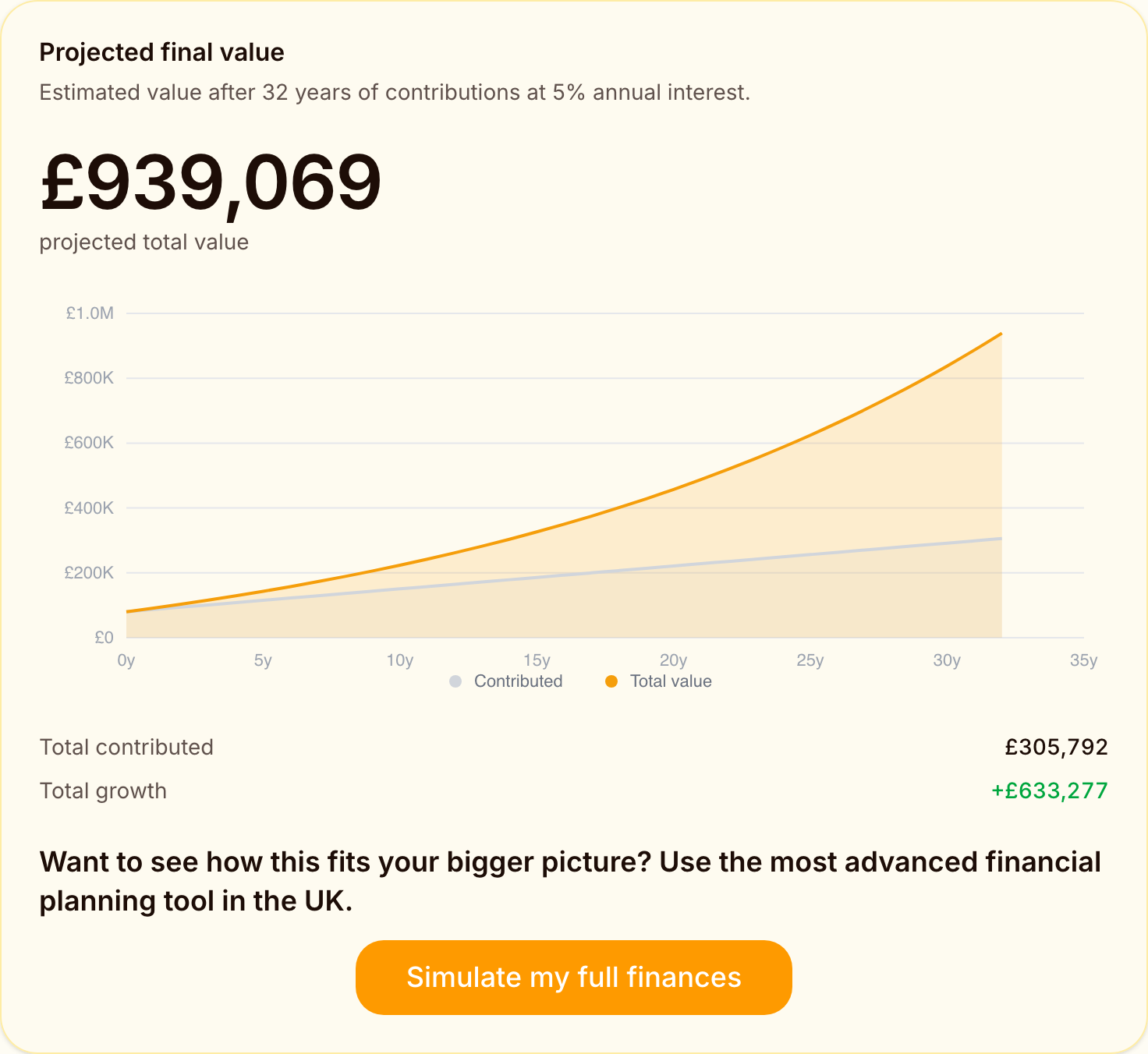
The chart shows the pot pulling away from the money actually paid in. Over the full run the saver contributes about £306,000 and the growth adds about £633,000, so more than two-thirds of the final pot is compounding rather than saving. That is why the start age does more work than almost any later adjustment. Begin the same plan at 45 instead of 35, and the shortened run means the same target needs a far higher rate, often more than double, because the lost decade was the decade the money would have compounded hardest. The comfortable pot is reachable on an ordinary salary, but mostly for those who start it early.
The caveat worth naming, because it cuts against the buyer, is tax. Expressing the target as the income gap divided by a withdrawal rate ignores the income tax due on pension drawdown. Since the state pension uses up almost all of the £12,570 personal allowance, much of the private drawdown is taxable. So the real gross pot needed is somewhat larger than £938,600, unless a good slice of it sits in an ISA, whose withdrawals are tax-free. A plan that leans on the ISA for the taxable top of the income needs a smaller pot than one drawing everything from a pension. The wrapper mix, not just the total, shapes the number.
11. Worked example: the same retirement funded in France
Now take the identical person and the identical lifestyle, and move the retirement to France. Same comfortable standard, same 3.5% withdrawal rate, same real return. Three dials change between this example and the last, and only three. They are the cost of living, the state pension, and the currency. Watch how far they move the pot needed, because the answer is the whole point of the comparison.
First the cost of the same lifestyle. The UK comfortable standard of £45,400 buys a particular real basket. Priced in France, where living costs about 11% less, that same basket costs about €46,600 a year, converting at purchasing power parity rather than the market rate for the reasons set out in the cost-of-living chapter. Then the pension. A French average earner's mandatory pension, base plus AGIRC-ARRCO, replaces about 70% of average earnings, roughly €30,700 a year, against the UK flat rate's €14,780-equivalent. So in France the state and compulsory system covers two-thirds of the comfortable lifestyle on its own. The gap left for the private pot is only about €15,900 a year, and at 3.5% that needs a pot of about €454,000, which is roughly £385,000 at the market rate.
| The comfortable single retirement | United Kingdom | France |
|---|---|---|
| Cost of the same lifestyle | £45,400 | about €46,600 |
| State or mandatory pension | £12,548 | about €30,700 |
| Gap for the private pot | £32,852 | about €15,900 |
| Private pot needed | about £938,600 | about €454,000, or £385,000 |
The headline is stark. The private pot a French saver needs for the same comfortable retirement is under half the British one, about £385,000 against £938,600. But the reason matters more than the number, so the grid below isolates each dial in turn, holding the comfortable lifestyle fixed and changing one thing at a time.
| Which dial changes | Private pot needed |
|---|---|
| UK prices, UK flat pension | about £938,600 |
| French prices, but only a UK-style flat pension | about €963,000, or £817,500 |
| French prices and the French mandatory pension | about €454,000, or £385,000 |
Read the grid one row at a time and the lesson is unmistakable. Cheaper living helps, but only modestly. Moving from UK prices to French prices while holding the pension at the UK flat level takes the pot from £938,600 to about £817,500, a useful but not dramatic saving of roughly an eighth. The mandatory pension is the real lever. Add France's generous earnings-related pension on top of the cheaper prices, and the pot collapses from £817,500 to £385,000. In other words, the French saver needs less because France pays them more from the state, far more than because France is cheaper to live in. The cost of living is a supporting act. The pension is the whole show.
The catch the number hides
A private pot less than half the size sounds like France wins the comparison outright. It does not, and the reason is the money you never see. That generous French pension is paid for by some of the highest compulsory social contributions in the developed world, deducted from French salaries throughout a career. The French worker does not save a smaller pot because saving is easier there. They save less because a large chunk of what a British worker keeps and invests themselves has already been taken from the French payslip to fund the pension. The cost is the same order of magnitude, just collected differently. France takes it compulsorily and out of sight. The UK leaves it to you, in plain view.
Two further cautions matter here. The 3.5% withdrawal rate is a UK-derived figure applied to both countries for a clean comparison, and a euro-area retiree's safe rate could differ, though for a global equity portfolio the two are in the same broad range. And you cannot simply move to France to collect that pension. A French pension is earned by working and paying French contributions, so a British saver arriving near retirement brings their British pots and their British state pension, not the French one. The comparison is a lesson in how two systems differ, not an arbitrage a UK saver can execute.
12. The horizon and what a snapshot leaves out
Every number so far is a snapshot of the rules as they stand in 2026, and a snapshot flatters whichever system looks better today. Stretch the time horizon out to a full retirement, and add the risks a clean comparison sets aside, and the picture gets truer and less tidy. This chapter names what the worked examples leave out, because those omissions can change the answer.
Start with durability, the thing the Mercer index already flagged. France's pension is more generous now but rests on a pay-as-you-go base that an ageing population strains, which is exactly why the 2023 reform tried to push the age to 64 before politics suspended it. A saver retiring in 2026 gets today's generous French deal. A saver retiring in 2050 is betting that a shrinking workforce will still fund it, and the pressure to trim benefits or lift the age further is structural, not a scare. The UK's leaner, more funded system is less exposed to that particular risk, because a funded pot does not depend on the next generation's numbers. Over a thirty-year horizon, the sustainability gap the studies measure is not abstract. It is the risk that the French deal you model today is not the French deal you retire on.
Then the moving tax rules, which both countries have. The UK's headline change is the pension inheritance-tax reform from April 2027, which brings unused pension pots into the estate and reverses a long-standing planning logic. France keeps adjusting the social-charge rate, as the 2026 CSG rise showed, and periodically revisits assurance-vie and property taxation. A plan built on either country's current rules and left untouched will drift, and the longer the horizon, the more it drifts.
The things a money comparison ignores entirely
Some of the biggest differences between retiring in the two countries never show up in a pot calculation at all. Healthcare is the clearest. The UK's National Health Service is free at the point of use and funded from general taxation. France runs a social-insurance system with generally excellent outcomes, but co-payments that many top up with a mutuelle, a private complementary insurance. Neither is captured by a pension figure, yet both shape the real cost of old age. Long-term care, the expensive tail of late life, works differently again in each country, and is a genuine cost the tidy comparison omits.
Currency risk is another. A British retiree living in France on sterling income watches their spending power swing with the exchange rate, which the worked examples freeze at a single day's number. Over thirty years the rate can move a long way, and a pension fixed in one currency spent in another carries a risk a same-country retiree never faces. Residence, tax treaties and succession law add more. France's inheritance rules are far more rigid than the UK's, with forced heirship that limits who you can leave assets to, and cross-border retirement runs into two tax systems at once. None of this fits in a spreadsheet cell, and all of it can matter more than the pot size the comparison focuses on.
The fair conclusion is that the money comparison is necessary but not sufficient. On the pure numbers, France's generous pension means a smaller private pot for the same lifestyle, and cheaper living helps a little more. But the durability of that pension, the healthcare and care systems, the currency exposure of a cross-border life, and the succession rules are all real, and they are exactly the parts a pot-size headline cannot see. A decision that turns only on the pot is a decision made on a third of the information.
13. Who each country suits
Everything so far has compared the two systems piece by piece. Pull it together and a simpler question remains. Which country actually suits which kind of saver. There is no single winner, because the two systems reward opposite things. The UK rewards the person who will build and manage wealth themselves. France rewards the person who would rather the state did it for them. The table below sorts the main situations onto one side or the other, weighing tax, wrappers, pensions, cost of living and control together.
| Your situation or priority | Tends to favour |
|---|---|
| A higher earner who will save diligently and wants to control a large pot | The UK |
| An average or lower earner who would struggle to build a big private pot alone | France |
| You want maximum control and flexibility, and money you can see and move | The UK |
| You would rather the state carried the risk while you paid for certainty | France |
| A single-earner household, especially with children | France, through the quotient familial |
| A single person or a dual-earner couple with no children | The UK, whose flat system is neutral |
| You are comfortable with equity risk and want decades of market growth | The UK |
| You are risk-averse and prefer guaranteed, capital-safe savings | France |
| You want to reach your money in your forties or early fifties and retire early | The UK, using the ISA as a bridge |
| You are content to start a pension in your early sixties | France |
| You doubt a pay-as-you-go promise can last a thirty-year retirement | The UK, with its funded pots |
| You want lower living costs and a longer retirement to enjoy them | France |
Read down the table and a pattern falls out. The UK is the stronger wealth-builder for someone with the income and the discipline to fill its excellent tax wrappers and carry investment risk. France is the stronger safety net for someone who wants a comfortable retirement without assembling a large pot themselves, and who prizes certainty over control. A high-earning, self-directed saver keeps more and controls more in the UK. A median earner who would never build a £900,000 pot ends up better protected by France's mandatory 70% replacement, even though they pay for it heavily along the way.
The catch that stops you cherry-picking
The obvious wish is for the best of both, the UK's wrappers and the French pension. You cannot have it. A French pension is earned only by working and paying French contributions across a career, so a UK saver who moves to France near retirement arrives with British pots and the British state pension, not the French one. The generous French deal belongs to the people who spent their working lives inside the French system, and its high contributions. The UK's control cuts the same way. The freedom to build and manage your own pot is worth nothing if you save the auto-enrolment minimum and stop, which is exactly the person France's compulsion protects and the UK leaves behind. Neither country hands you its upside without the duty attached to it.
14. How to decide, and how to model your own number
The first answer is the practical one. Put your real numbers into a thorough, UK-specialised financial calculator and work out your own position, because every situation is different. The comparison in this guide is built on national averages, and you are not the average of anything. Your salary, your existing pots, your target lifestyle, your retirement age and where your income sits across pensions, ISAs and property will move the answer far more than the border does. A good tool holds all of that and understands the UK state pension, the tax wrappers and the withdrawal-rate arithmetic, so in an evening it settles what a country-versus-country headline never can. Get started with A Few Quid.
If you would rather interrogate the decision yourself first, the whole comparison reduces to a handful of questions. Answer them straight and most of the planning follows.
What lifestyle are you actually aiming for, in today's money? Start from your real spending, not a round number, then check it against a recognised standard. The difference between a moderate and a comfortable target nearly doubles the pot you need, and it dwarfs any UK-versus-France effect. Fix this before anything else.
How much of it will a state or mandatory pension cover? This is where the two countries diverge most. The UK's flat £12,548 covers the basics and leaves a large private gap. France's earnings-related pension covers most of a typical lifestyle. Whichever system you are planning under, subtract the guaranteed income first, because your pot only has to fund the gap above it.
Where is your money, and how is it taxed on the way out? A pound in an ISA and a pound in a pension come out taxed very differently, and a euro in a PEA carries social charges an ISA never would. The wrapper mix changes the pot you need, not just the headline total, so plan the drawdown, not only the accumulation.
How long must the money last, and in which currency? France's longer life expectancy means a longer average retirement to fund, and a cross-border life means currency risk on top. A pot that works for a 25-year retirement in one currency can fall short over 35 years spent in another.
What could change the rules underneath you? Both countries move pension and investment tax often, from the UK's April 2027 pension inheritance-tax change to France's rising social charges. Keep a balance between wrappers and revisit the plan yearly, treating today's rules as an assumption to test rather than a fixed floor.
Then run it, on your numbers, stressed both ways. The what-if simulator prices a single change in minutes, the optimiser ranks how to split UK money between pension, ISA and debt, and the dashboard keeps the whole projection alive as your salary, your savings and the rules around them shift. Comparing two countries is interesting. The projection of your own retirement is the one that decides anything.
About the author and this calculator
I am Mike Gallagher, based in the UK, and I built A Few Quid because the tools I could find for a question like this one handed out a verdict and called it guidance. France is better, one would say. The UK wins, said another. Neither knew what I earned, what I had saved, what I wanted my retirement to look like, or whether I was even planning to leave the country. The real answer to "where does my money build a better retirement" is another question, "for whom, on what income, aiming at what," and no country-versus-country league table can ask it.
A Few Quid is the tool I wanted for the UK side of that question. It runs UK-specific projections on your real inputs, models the what-if scenarios a static comparison cannot, and ranks how to split your money by projected outcome rather than telling you what to do. I am not a financial adviser, and A Few Quid is not authorised by the FCA, which I state plainly because it matters. That goes double for anything cross-border, where two tax systems meet and the stakes are high enough that a regulated adviser who knows both is worth every penny.
If you take one habit from this guide, make it this. Treat every national average here, France's 70% and the UK's £938,600 alike, as a backdrop and not a verdict. The figures are accurate as of July 2026 and sourced below, but tax rules move, currencies drift, and your life is not the worked example. Build your own number from your own parts, decide with your eyes open to the risks a pot size cannot show, and keep it current. That is the only version of the comparison worth trusting.
FAQ
Is it cheaper to retire in France than the UK?
On the cost of living, yes. Eurostat's price-level index puts UK consumer prices about 11% to 12% above France's in 2025, and rent lower still in France. The bigger difference is the pension. France's mandatory system replaces about 70% of an average earner's income against the UK's 54%, so a French worker needs a much smaller private pot for the same lifestyle. The catch is that the larger French pension is paid for through far higher compulsory contributions across a career, and you only build the entitlement by working and contributing in France.
Is the ISA better than the French PEA?
For most savers the ISA (Individual Savings Account) is simpler and more generous. It shelters £20,000 a year with no tax on growth, dividends or withdrawals at any age. The French PEA (Plan d'Épargne en Actions, a tax-advantaged equity plan) caps at €150,000 over a lifetime, needs five years before its income-tax break applies, and even then still charges 18.6% social charges on the gain. The PEA is a real tax advantage, but it is narrower and never fully tax-free the way an ISA is.
How much do you need to retire in France compared with the UK?
For a comfortable single retirement, a UK saver needs a private pot of roughly £939,000 on top of the state pension, using a 3.5% withdrawal rate and the 2026 PLSA comfortable standard of £45,400 a year. The same real lifestyle in France needs a private pot nearer £385,000, because France's mandatory pension covers far more of the bill and living costs are lower. Both numbers are averages, so model your own from your salary, pots and target age.
What is the state pension in France compared with the UK?
They are built differently. The UK pays a flat full new state pension of £241.30 a week, about £12,548 a year in 2026/27, after 35 qualifying National Insurance years. France pays an earnings-related pension, a base of up to 50% of the average of your best 25 years capped at the social-security ceiling, plus a compulsory top-up called AGIRC-ARRCO. The average French pension was about €1,666 a month gross at the end of 2023. France replaces a much higher share of prior earnings than the UK flat rate does.
At what age can you retire in France versus the UK?
France's legal minimum age is currently phasing between 62 years 9 months and 63 years 9 months by birth year, after the 2023 reform's move to 64 was suspended until 2028. The age of 64 now applies only to those born from 1969. The automatic full-rate age is 67. The UK state pension age is 66, rising to 67 by 2028 and to 68 in the mid-2040s. France still lets most people start earlier, but needs 43 years of contributions for a full pension.
Do you pay more tax on investments in France or the UK?
France, in most cases. France layers social charges (prélèvements sociaux) on top of income tax, and they rose to 18.6% on most investment income on 1 January 2026, taking the headline flat tax (the PFU) to 31.4%. A UK ISA charges nothing, and outside an ISA the UK still has a £20,000 ISA allowance, a £500 dividend allowance and a £3,000 capital gains allowance to use first. France's wrappers soften its higher rates, but the baseline is heavier.
Can a UK citizen get a French state pension?
Only by working and paying French social contributions. A French pension is earned through contribution quarters recorded during years worked in France, not by residence or citizenship alone. Years worked in the UK and France can be aggregated for qualifying purposes under the UK-EU social security rules, but each country pays a pension based on the contributions made to it. You cannot move to France near retirement and collect the full French pension without a French contribution record.
Glossary
- ISA (Individual Savings Account)
- A UK tax wrapper where growth, dividends, interest and withdrawals are all tax-free, with a £20,000 annual allowance in 2026/27. A stocks and shares ISA is the version used for long-term investing, and its money can be drawn at any age with no tax.
- PEA (Plan d'Épargne en Actions)
- A French tax-advantaged equity savings plan, capped at €150,000 of contributions. Gains are exempt from income tax after five years but still carry 18.6% social charges. It mainly holds European shares and funds, a narrower universe than a UK stocks and shares ISA.
- Assurance-vie
- The most popular French investment wrapper, a life-insurance contract holding funds. After eight years it gives a reduced income-tax rate on gains and an annual tax-free allowance of €4,600 for a single person, though 17.2% social charges apply throughout. It is also central to French inheritance planning.
- Social charges (prélèvements sociaux)
- A layer of French levies on income and investment gains, on top of income tax, funding social security. The main component is the CSG (Contribution Sociale Généralisée), which rose on 1 January 2026 so that social charges reach 18.6% on most investment income, and 17.2% on assurance-vie, rental income and property gains.
- PFU (prélèvement forfaitaire unique)
- France's flat tax on investment income, often called the flat tax. From 1 January 2026 it is 31.4%, made up of 12.8% income tax and 18.6% social charges. A saver can instead elect to be taxed at the progressive income-tax scale if that is lower.
- Livret A
- A French state-regulated, tax-free savings passbook with a €22,950 cap. Its rate is set by the government, and stood at 1.5% in mid-2026, rising to 1.7% from 1 August 2026. It is the default safe savings account in France, held by most households.
- State pension
- The UK government pension, a flat full new rate of £241.30 a week (about £12,548 a year in 2026/27) after 35 qualifying National Insurance years. It is paid from state pension age, currently 66 and rising to 67 by 2028 and 68 in the mid-2040s.
- AGIRC-ARRCO
- France's compulsory supplementary pension for private-sector employees, on top of the state base pension. It is a points-based, pay-as-you-go scheme, funded by current workers' contributions rather than an invested pot, and it makes up a large share of a French private-sector pension.
- PER (Plan d'Épargne Retraite)
- France's voluntary individual retirement savings plan, introduced in 2019 to replace older products. Contributions are deductible from taxable income within annual limits, and the money is broadly locked until retirement, making it the closest French equivalent to a UK personal pension or SIPP.
- Quotient familial
- The French method of taxing a household by its size. Taxable income is divided into parts (a single person is one part, a couple two, with extra half-parts for children), the scale is applied to the per-part figure, and the tax is multiplied back up. It softens progressivity for larger households.
- IFI (impôt sur la fortune immobilière)
- France's real-estate wealth tax, charged on net taxable property assets above €1.3 million valued each 1 January. It taxes property wealth only, not financial assets, and has no direct UK equivalent.
- Net replacement rate
- The share of your pre-retirement earnings that your pension income replaces after tax. The OECD's 2025 figures put France at 70% and the UK at 54% for an average earner, against an OECD average of 63%. The UK figure counts auto-enrolment workplace pensions as quasi-mandatory.
- Safe withdrawal rate
- The percentage of a pot you can withdraw in the first year of retirement, then raise with inflation, without running out over a set horizon. UK analysis puts it near 3.1% to 3.5%, lower than the American 4% because UK inflation has been higher and more volatile.
- Purchasing power parity (PPP)
- An exchange rate that equalises what a currency buys in each country, rather than the market rate. In 2024 it implied about €1.03 to the pound, against a market rate near €1.18, meaning euro-area prices are lower, so a pound converted at the market rate buys more real goods in France.
- Notaire fees (frais de notaire)
- The costs of buying a French property, mostly transfer taxes rather than the notary's own fee. They run about 7% to 8% of the price on an existing home and 2% to 3% on a new build, and are the rough French equivalent of UK stamp duty.
Sources
- The new State Pension: what you'll get — GOV.UK
- State Pension age timetable — GOV.UK
- Individual Savings Accounts (ISAs) — GOV.UK
- Income Tax rates and Personal Allowances — GOV.UK
- Tax on dividends — GOV.UK
- Capital Gains Tax rates and allowances — GOV.UK
- Stamp Duty Land Tax: residential property rates — GOV.UK
- Inheritance Tax on unused pension funds (from April 2027) — GOV.UK
- Barème de l'impôt sur le revenu 2026 — service-public.gouv.fr
- Le prélèvement forfaitaire unique passe à 31,4 % au 1er janvier 2026 — service-public.gouv.fr
- PEA: fiscalité des retraits — impots.gouv.fr
- Assurance-vie: fiscalité des retraits — impots.gouv.fr
- Livret A: taux et plafond — service-public.gouv.fr
- Impôt sur la fortune immobilière (IFI) — service-public.gouv.fr
- Plus-value immobilière — service-public.gouv.fr
- Réforme des retraites: âge de départ suspendu — service-public.gouv.fr
- Calcul de la retraite de base — service-public.gouv.fr
- Plan d'Épargne Retraite (PER) — service-public.gouv.fr
- Les retraités et les retraites, édition 2025 — DREES
- Pensions at a Glance 2025, net replacement rates — OECD
- Mercer CFA Institute Global Pension Index 2025
- Comparative price levels (tec00120) — Eurostat
- Average annual wages — OECD
- National life tables, UK 2022 to 2024 — Office for National Statistics
- Total wealth in Great Britain, April 2020 to March 2022 — Office for National Statistics
- Extensive and Intensive Margins of Labour Supply: US, UK and France — Blundell, Bozio and Laroque, Fiscal Studies 2013
- Retirement Living Standards (2026 figures) — PLSA / Pensions UK
- What is the UK safe withdrawal rate? — Monevator
Related reading
- How much do you need to retire in the UK? — PLSA benchmarks, withdrawal rates and the state pension, worked through in detail.
- What percentage of your salary to save for retirement — The UK numbers behind the rules of thumb, by age and starting point.
- Living paycheck to paycheck in the UK — How many people have no buffer, and why British savers hold so much cash.