How much difference does it make to start investing at 18, 30, 45 or 65?
What £100 a month from 18, 30 or 45 grows to by 65, what investing at 65 is for, and what tax and the £20,000 ISA limit cost people who start late.
A long-read planning briefing, roughly an hour
A Few Quid is not authorised or regulated by the FCA. This article is general information, not advice.
Imagine you put £100 a month into a stock market fund from your 18th birthday and left it there. On long-run returns you'd have about £224,000 by the time you're 65, measured in today's money. If you started the same habit at 30, you'd end up with about £114,000. If you waited until 45, it would be about £42,000. Waiting doesn't save the later starters much. The 30-year-old pays in £14,400 less over a lifetime and ends up with half the pot.
That gap is the usual argument for starting early. The arithmetic is sound, but the argument skips over everything the number depends on. The number changes with the return you assume, and with how much of that return inflation takes away. Charges eat into it. So does tax, if the money sits outside an Individual Savings Account (ISA). Outside one, the tax bill grows as the balance grows. Inside one, the money is never taxed. And the usual argument has nothing to say to someone who reaches 65 with their savings in cash and wonders whether investing is still worth it.
This guide puts numbers on all of that. It compares starting at 18, 30 and 45 at the returns most people carry around in their heads, 5% a year for bonds and 10% for shares. Then it runs the same comparison at the return UK shares have actually made over the long run, once inflation is taken out. You'll see what catching up costs at 30 and at 45, and why the £20,000 yearly ISA limit bites hardest on late starters. Starting at 65 gets a chapter of its own, since money invested then has to last a retirement. Last, it looks at what a Junior ISA paid into from birth is worth at 18, just as university comes into view. Every figure comes from a calculation anyone could repeat, with the assumptions set out beside the numbers.
This article gives general information only and is not advice. Nothing here is a personal recommendation about what to do with your money. A Few Quid is a calculator and does not act as an adviser. It is not FCA-authorised, meaning it is not regulated by the Financial Conduct Authority (FCA). Investments can fall as well as rise. Past returns tell you nothing certain about future ones.
How to read this guide
This is a long piece, so here is the shape of it before you start.
The first three chapters cover the arithmetic of time. What starting at 18, 30 or 45 adds up to by 65 sets out the headline comparison, with the paid-in money and the final pot side by side. How much each year of waiting costs breaks it down to what a single pound becomes, and works out what catching up costs at 30 and at 45. It also tests the famous "invest for ten years then stop" example, which turns out to hinge entirely on the return. What 5% for bonds and 10% for shares mean after inflation explains where those numbers come from and how much of any projection rests on an assumption about inflation.
The next four take each starting age in turn. Starting at 18 covers what opens up on the 18th birthday and why so few people use it. Then Starting at 30 looks at the age most people actually begin, usually with a workplace pension already running. Starting at 45 deals with catching up, and with the point where the limits on tax-free saving start to get in the way. Last, Starting at 65 treats investing at retirement as the separate question it is, with the money spent gradually over twenty or thirty years.
Three chapters then deal with the accounts. What a general investment account pays in tax that an ISA does not puts a figure on the tax over a working life. Why the £20,000 ISA limit makes an early start worth more shows how the yearly limit on ISA payments turns starting late into a tax question. Pensions against ISAs, and the Lifetime ISA sets the ISA against the accounts that get a top-up from the government on the way in.
Families get a block of their own. How much a Junior ISA builds by 18 runs the numbers on saving from birth, starting from what families actually pay in. Using a Junior ISA to pay for university tests whether paying fees up front beats taking the student loan. What can go wrong covers market falls and high-risk products, along with the charges that eat small pots.
Three practical chapters close the guide. Two worked examples, starting at 30 and starting at 45, follow one saver through the calculator, setting out every figure entered. They end with a table covering every combination of starting age, return and type of account. How to work out your own figures sets out the questions to answer first, and a few things to check this week.
1. What starting at 18, 30 or 45 adds up to by 65
Each row of the table below is someone who puts £100 a month into a fund. Each year they pay in a little more to keep up with inflation, so the payment always buys what £100 buys today. At 2% inflation that means about £102 a month next year and about £110 a month five years from now. They never touch the money. It sits in an ISA, where no tax comes out along the way. The only thing that differs from one row to the next is the birthday they start on.
Each saver stops at their 65th birthday, the age most people still picture as retirement. It's also close to when people really do stop work. In 2026 the average age of leaving the labour market reached 65.8 for men and 65.1 for women, according to the Department for Work and Pensions (DWP). The state pension comes later. Under current law it starts at 68 for anyone born after 5 April 1978, which covers all three savers here. Savings like these fill the gap between stopping work and the state pension starting. Someone who only starts investing at 65 is a different case, which the chapter on starting at 65 deals with on its own terms.
Three returns run through this guide. Bonds at 5% a year and shares at 10% a year are figures before inflation, the kind a fund factsheet might quote, or a relative at a barbecue. The third comes from long-run history. Since 1899, UK shares have returned about 5% a year above inflation. Inflation is assumed at 2% a year throughout, the Bank of England's target, which puts the long-run figure at roughly 7.1% a year before inflation. Every result is then shown in today's money, meaning what it would buy at today's prices. So a figure of £100,000 at 65 buys what £100,000 buys now, even though the balance on the statement by then will be much larger.
| Start age | Years invested | Total paid in | Bonds, 5% before inflation | Shares, long-run 5% after inflation | Shares, 10% before inflation |
|---|---|---|---|---|---|
| 18 | 47 | £56,400 | £122,036 | £224,430 | £557,262 |
| 25 | 40 | £48,000 | £91,910 | £152,208 | £321,708 |
| 30 | 35 | £42,000 | £73,843 | £113,804 | £215,358 |
| 35 | 30 | £36,000 | £58,213 | £83,713 | £142,450 |
| 40 | 25 | £30,000 | £44,692 | £60,136 | £92,467 |
| 45 | 20 | £24,000 | £32,995 | £41,663 | £58,202 |
| 50 | 15 | £18,000 | £22,876 | £27,189 | £34,712 |
| 55 | 10 | £12,000 | £14,123 | £15,848 | £18,608 |
All figures are in today's money at 65, with 2% inflation assumed and each year's money paid in at the start of the year.
The "total paid in" column shrinks steadily, from £56,400 for the 18-year-old to £24,000 for the 45-year-old. The return columns fall much faster. In the long-run share column, the pot at 65 drops from £224,430 to £41,663. The second figure is less than a fifth of the first.
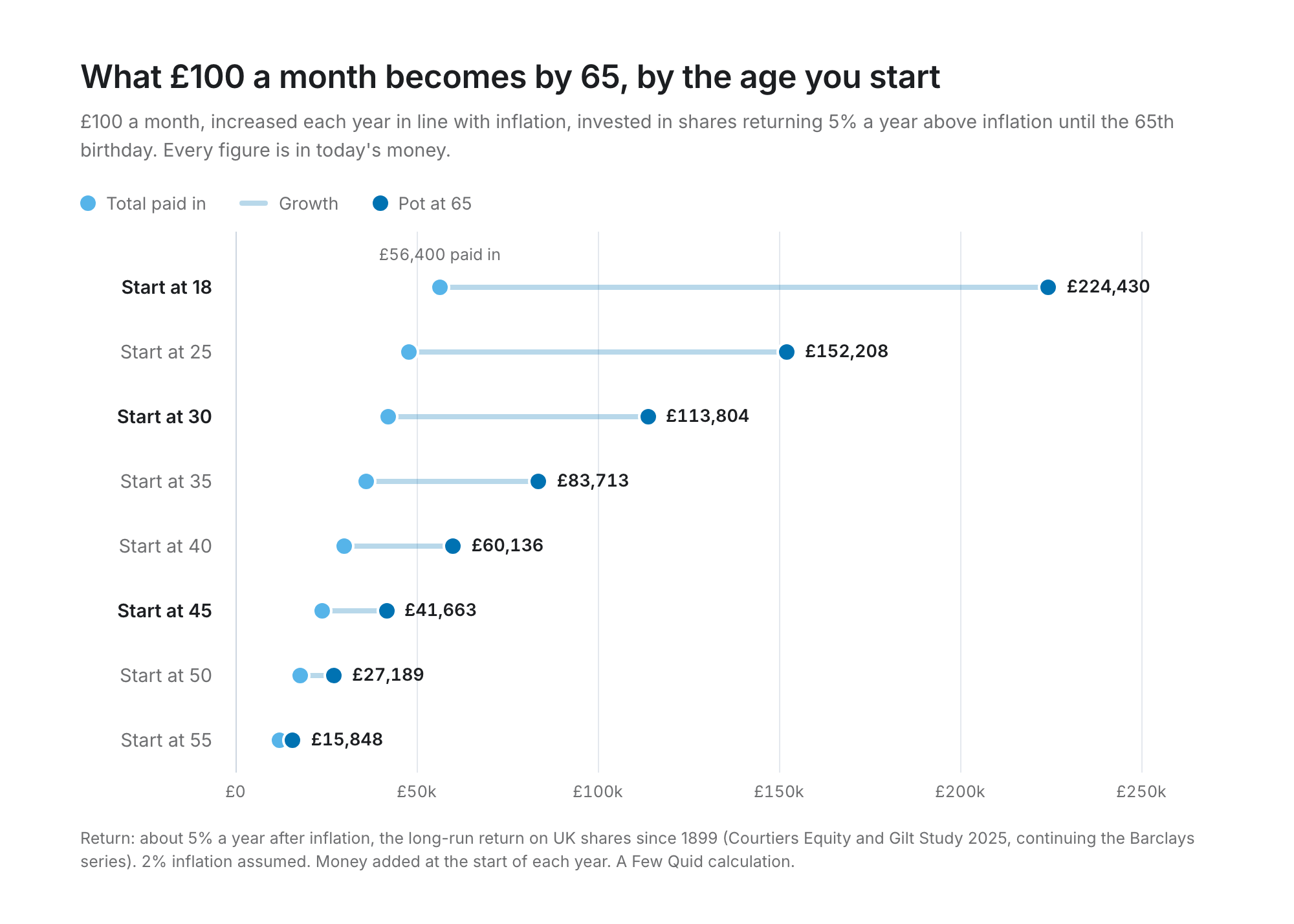
Three of those rows carry this guide's main comparison. Starting at 18 rather than 30 means paying in £14,400 more over a lifetime. On long-run returns it leaves £110,626 more at 65, nearly eight times what it cost. Moving the start from 45 back to 30 costs £18,000 and is worth £72,141, four times its cost. At the optimistic 10% the gaps get silly. There, the twelve years between 18 and 30 are worth £341,904, or 24 times their cost.
Why the early money does so much work
Every pound put in at 18 has 47 years to grow. A pound put in at 45 has 20. Each year's growth is added to the pot and then earns growth of its own, so a pound with 47 years ahead of it ends up worth nearly four times a pound with 20. The next chapter works through it one pound at a time.
Most of the 18-year-old's pot is growth. On the long-run return, £168,030 of their £224,430 never came out of their pocket. That's 75% of the balance. Growth makes up 63% of the 30-year-old's pot and 42% of the 45-year-old's. Nothing else differs between the three savers, so the years alone explain the gap.
What the table leaves out
That's the tidiest version of the story, and real life is messier in three ways. Almost nobody saves the same amount, adjusted for inflation, for 47 years. What people pay in usually rises with their pay. Someone who starts at 30 or 45 tends to put in far more than £100 a month, so the worked examples later use £500. Returns arrive in lumps, with years of 20% falls between the good ones. And the table assumes the money never leaves the ISA or gets taxed, let alone spent. Later chapters take each of these in turn. In the meantime the compound interest calculator will run any row of the table on your own figures.
2. How much each year of waiting costs
That first table compares whole lifetimes. Looking at a single pound is often more useful, because that's closer to the size of the decision people actually face. Nobody decides to invest for 47 years. They decide whether this month's money goes in now or waits.
| Age the £1 goes in | Bonds, 5% before inflation | Shares, long-run 5% after inflation | Shares, 10% before inflation |
|---|---|---|---|
| 18 | £3.91 | £9.91 | £34.77 |
| 25 | £3.19 | £7.04 | £20.50 |
| 30 | £2.76 | £5.52 | £14.05 |
| 35 | £2.39 | £4.32 | £9.63 |
| 40 | £2.06 | £3.39 | £6.60 |
| 45 | £1.79 | £2.65 | £4.53 |
| 50 | £1.54 | £2.08 | £3.10 |
| 55 | £1.34 | £1.63 | £2.13 |
| 60 | £1.16 | £1.28 | £1.46 |
Each cell is what a single £1 becomes by 65, in today's money.
On the long-run return, a pound invested at 18 is worth £9.91 at 65. Invested at 30 it's worth £5.52, and at 45 only £2.65. So a pound at 18 does about the same work as two pounds at 30, or nearly four at 45.
The bond column makes sober reading. Even over 47 years, a return three percentage points above inflation turns a pound into less than four pounds. Back in the first table, the gap between the earliest starter's bond and long-run share pots is almost as big as the gap between starting at 18 and starting at 30, a point the worked examples come back to.
The first years carry the pot
If you split the 18-year-old's pot by when the money went in, it looks lopsided.
| Money paid in during | Part of the total paid in | Part of the pot at 65, bonds | Part of the pot at 65, long-run shares | Part of the pot at 65, shares at 10% |
|---|---|---|---|---|
| First 5 years, ages 18 to 22 | 10.6% | 18.1% | 24.1% | 32.4% |
| First 12 years, ages 18 to 29 | 25.5% | 39.5% | 49.3% | 61.4% |
| First 27 years, ages 18 to 44 | 57.4% | 73.0% | 81.4% | 89.6% |
| Last 20 years, ages 45 to 64 | 42.6% | 27.0% | 18.6% | 10.4% |
On the long-run return, the twelve years of saving between 18 and 29 produce about half the pot at 65 from a quarter of the money. Money paid in over the last twenty years, from 45 to 64, makes up 43% of the money but only 19% of the pot. In effect, that last row is all a 45-year-old starter gets.
Catching up costs more the later you leave it
Catching up is still possible, at a price. This table shows what a later starter has to pay each month, in place of the £100, to finish level with someone who started earlier.
| Starting at | To match someone who started at | Bonds, 5% before inflation | Shares, long-run 5% after inflation | Shares, 10% before inflation |
|---|---|---|---|---|
| 30 | 18 | £165 a month | £197 a month | £259 a month |
| 45 | 30 | £224 a month | £273 a month | £370 a month |
| 45 | 18 | £370 a month | £539 a month | £957 a month |
Monthly amounts in today's money, each increased every year in line with inflation.
On the long-run return, the 30-year-old draws level by paying about £197 a month, roughly double. A 45-year-old needs about £273 to match the 30-year-old. Matching the 18-year-old takes about £539 a month, more than five times the original £100. Catching up at 30 means saving a bit harder. At 45 it means saving several times as much. Sums that size start to run into the yearly limits on tax-free saving, covered in the chapters on starting at 45 and on the ISA limit.
Working longer is the other route. Money keeps growing for as long as it's left invested, so the 30-year-old would match the 18-year-old's pot by carrying on saving until 77. For the 45-year-old it would take until 92. You can see what either route does to your own plan in the what-if simulator.
The famous "invest for ten years then stop" example
Personal finance writing loves this comparison. One person invests from 18 to 27 and then stops for ever. Another starts at 30 and keeps going until 65. Supposedly the early starter ends up richer, despite paying in a fraction of the money. Work it through with the same £100 a month and it turns out that which of them ends up richer depends entirely on the return.
| Return | Invest 18 to 27, then stop (£12,000 paid in) | Invest 30 to 64 (£42,000 paid in) | Bigger pot at 65 |
|---|---|---|---|
| Bonds, 5% before inflation | £41,278 | £73,843 | Starting at 30 |
| Shares, long-run 5% after inflation | £96,379 | £113,804 | Starting at 30 |
| Shares, 10% before inflation | £304,108 | £215,358 | Stopping at 27 |
That story only holds when returns are high. With these contributions, the person who invests early and then stops only comes out ahead if returns beat 5.88% a year after inflation, which is about 8% before inflation at 2% inflation. At the long-run historical return the later starter finishes about £17,400 ahead, having paid in three and a half times as much. That's still a remarkable result for someone who stopped at 27. It just falls short of what the example usually claims.
3. What 5% for bonds and 10% for shares mean after inflation
A return quoted before inflation counts pounds. To see what those pounds will buy, you need the return after inflation. The difference sounds like a technicality until you watch it play out over a working life.
The saver in the first table starts at 18 with £100 a month and increases it each year in line with inflation. By the final year prices are about two and a half times what they are now, so the payment has grown to about £250 a month in actual pounds. The table below puts the balance on the statement at 65 next to what that money would buy at today's prices.
| Return | What the statement shows at 65 | What it buys in today's money | Total pounds actually paid in |
|---|---|---|---|
| Bonds, 5% before inflation | £309,524 | £122,036 | £92,181 |
| Shares, long-run 5% after inflation | £569,233 | £224,430 | £92,181 |
| Shares, 10% before inflation | £1,413,409 | £557,262 | £92,181 |
At 2% inflation, prices end up 2.54 times as high after 47 years. A statement reading £569,233 in the 2070s therefore buys what £224,430 buys now. Both numbers are correct. Only the second tells you what kind of life the money will pay for, so the tables in the rest of this guide use today's money unless they say otherwise.
Where 5% and 10% come from
Britain's longest record of investment returns began as the Barclays Equity Gilt Study. It starts in 1899, and the investment firm Courtiers now keeps it going in public. On the Courtiers figures for 1899 to 2024, UK shares returned 4.95% a year after inflation. UK government bonds, known as gilts, returned 1.34% and cash 0.52%. Over those 125 years, inflation on the Retail Prices Index averaged 3.91% a year. With inflation added back, UK shares made roughly 9% a year, with gilts on about 5.3%.
So the two figures in most people's heads aren't plucked from the air. A 5% bond return is close to what gilts delivered before inflation over the last 125 years. For shares, 10% is near what world shares have made, measured in pounds, since the end of 1987, 9.99% a year on figures from the index provider MSCI. According to the Swiss bank UBS, in its Global Investment Returns Yearbook, the American market made 9.8% a year from 1900 to 2025.
The catch is the inflation that came with them. Those returns were earned while prices rose faster than the Bank of England's 2% target. UK consumer prices have risen by about 2.4% a year since 1997, and much faster earlier in the century. With inflation at 2%, a 10% return would mean nearly 8% a year above inflation. UK shares have managed nothing like that over the long run. Such a return would also sit well above the 5.2% a year after inflation that world shares have returned since 1900. The bond figure is just as flattering. At 5% before inflation and 2% inflation, bonds would earn almost 3% a year after inflation, more than double their long-run average after inflation.
Each of the three columns therefore plays a different part in this guide. The long-run column, at 5% after inflation, is the main estimate. The 10% column is a very good outcome. The 5% bond column works as a floor, roughly what a cautious, bond-heavy portfolio could plausibly earn.
How much the inflation assumption matters
Even with the return before inflation fixed, a change in the inflation rate alone moves the result a long way.
| Inflation | Bonds at 5% become | Pot at 65 | Shares at 10% become | Pot at 65 |
|---|---|---|---|---|
| 2% | 2.94% after inflation | £122,036 | 7.84% after inflation | £557,262 |
| 2.5% | 2.44% after inflation | £106,025 | 7.32% after inflation | £468,748 |
| 3% | 1.94% after inflation | £92,556 | 6.80% after inflation | £395,698 |
The same saver as before, starting at 18. Pots are in today's money.
One extra percentage point of inflation takes about 29% off the share pot. Any projection that quotes returns before inflation, without saying what it assumes about inflation, carries that risk. Nor is the assumption academic. In the year to August 2026 inflation ran at 3.1%, according to the Office for National Statistics (ONS).
Charges compound too
A fund's charges come out of the return every year, and every pound they take would otherwise have gone on growing. So charges build on themselves just as growth does, only against you. The longer the money is invested, the more of it they take.
| Total yearly charge | Lost from a pot started at 18 | Started at 30 | Started at 45 |
|---|---|---|---|
| 0.2% | 5.9% | 4.2% | 2.3% |
| 0.5% | 14.1% | 10.2% | 5.6% |
| 1.0% | 26.1% | 19.2% | 10.8% |
| 1.5% | 36.2% | 27.2% | 15.7% |
The part of the pot at 65 lost to charges, for £100 a month on the long-run share return.
Global index funds are cheap. Vanguard's FTSE Global All Cap fund tracks a worldwide share index compiled by the index provider FTSE Russell and charges 0.23% a year. Some rivals charge less. Platforms then add their own fee, such as Hargreaves Lansdown's 0.35% a year on funds held in an ISA. With an actively managed fund, where a manager picks the shares, and an adviser's fee on top, the total can easily reach 1.5%. Over 47 years the gap between 0.2% and 1.5% comes to about £68,000 of the 18-year-old's pot, with the same money paid in and the same market returns.
Averages hide the falls
A return of 5% a year after inflation is an average of good years and bad ones, and the bad years are severe. Global shares fell by 37.8%, measured in pounds, between October 2007 and March 2009. In early 2020 they dropped 26% in less than four weeks. Long-dated gilts (UK government bonds with many years left to run), supposedly the safe option, lost 40.3% in 2022 alone. Anyone investing from 18 will sit through several falls like these. Only those who stay invested get the long-run figure. Sitting tight is harder than it sounds at twenty, watching a third of your savings disappear.
4. Starting at 18
At 18 almost everything opens at once. Since 6 April 2024 you've had to be 18 or over to open any adult ISA, cash ones included. That makes the 18th birthday the day the £20,000 yearly allowance arrives. A Junior ISA, if the family opened one, turns into an adult ISA that same day, and the money in it becomes the young person's to keep or spend. The Lifetime ISA opens up too, with a 25% government bonus on up to £4,000 a year (covered in the chapter on pensions). So does a personal pension of their own. And the minimum wage rate for 18 to 20-year-olds applies, £10.85 an hour from April 2026.
Nothing happens automatically at 18, though. Employers only have to enrol staff in a workplace pension once they are 22 and earning more than £10,000 a year. A 2023 Act of Parliament lets the government lower that age to 18. So far it has set no date and made none of the regulations needed to do it. Anyone investing at 18 does it on their own initiative, often out of a student loan or an hourly wage. On the long-run return, starting at 18 rather than 22 is worth about £44,000 at 65 for every £100 a month.
The sums involved are modest. For someone working 30 hours a week on the 18 to 20 minimum wage, £100 a month is about 7% of pay before tax. You can see what's left of a first pay packet after tax and National Insurance in the salary calculator.
Few 18-year-olds invest at all
In 2024 only 22% of 18 to 24-year-olds held any investments, according to the FCA's Financial Lives survey. Just 9% had a stocks and shares ISA, against 17% of all adults. For most young people, then, the years that the first two chapters put a value on go unused.
Those who do invest face their own pressures. In an FCA survey of 18 to 40-year-old investors in August 2024, 66% said they spend less than 24 hours deciding on an investment. Of the same group, 40% regretted buying into hyped products, and 85% saw platforms like Instagram, TikTok and YouTube as highly influential in their decisions. Separate FCA research found 62% of 18 to 29-year-olds follow financial influencers. None of this guide's arithmetic covers a short-term bet on a single cryptocurrency or a trade made with borrowed money. Its long-run returns come from owning a broad slice of the world's companies for decades.
5. Starting at 30
Thirty is closer to when most people start investing on purpose. By then a workplace pension is usually running already, without anyone having chosen it. Automatic enrolment into workplace pensions began in October 2012 and had reached every employer by February 2018. Since April 2019 the minimum going in has been 8% of what the rules call qualifying earnings, according to the DWP's evaluation. Qualifying earnings are the slice of pay between £6,240 and £50,270. Anyone who is 30 today turned 22, the age automatic enrolment starts, in 2018. Most 30-year-olds in work have therefore had a workplace pension for several years, with at least 8% of qualifying earnings going in and 3% of that from the employer.
That changes what "starting to invest" means at 30. A pension is already doing the long-term job in the background. What's left to decide is what to add on top, and where to put it.
What a late start at 30 costs
Compared with someone who started at 18, the 30-year-old has lost twelve years. On the long-run return, £100 a month from 30 reaches £113,804 by 65, about half the £224,430 from 18. Drawing level takes about £197 a month, roughly double the £100. It's a real cost, but a manageable one. Of the three starting ages here, 30 is the last at which catching up only means saving a bit harder.
Even so, most people in their thirties hold no investments outside a pension. The FCA's Financial Lives survey found that in 2024 only 28% of 25 to 34-year-olds held any investments. Among 35 to 44-year-olds it was 29%, and 12% of each group had a stocks and shares ISA. According to HM Revenue and Customs (HMRC), the average ISA of someone aged 30 to 32 was worth £12,675 in April 2024, cash ISAs included.
What competes for the money
Thirty is also the age when the most other things compete for that money. A house deposit is usually first in line, sometimes alongside a wedding. Children often follow soon after. What they cost is set out in the guide to the cost of raising a child. All of that money is needed within a few years, which makes it a poor fit for shares.
Saving for a first home is one of the jobs the Lifetime ISA was designed for. New savers can open one until their 40th birthday, and it adds 25% to money saved towards a first home or for use from 60. Opened at 30, with the maximum paid in every year until 50, it takes £80,000 of the saver's money and adds £20,000 of bonus. On the long-run return that reaches about £282,800 in today's money at 60. Its withdrawal penalty and planned replacement are covered in the chapter on pensions and the Lifetime ISA.
What £500 a month looks like at 30
Most people who start at 30 invest more than £100 a month. Later in this guide, the worked examples follow someone putting in £500. On the app's take-home calculation for 2026/27, that's about 13% of take-home pay on a £60,000 salary, or about 19% on £40,000. Held in a stocks and shares ISA until 65, it reaches about £569,000 in today's money on the long-run return.
6. Starting at 45
At 45 there are still twenty years to 65, which is a long time for money to grow. On the long-run return a pound invested at 45 is worth £2.65 at 65. But the earlier starters are far ahead by now, and closing the gap on them runs into the limits on tax-free saving.
How far behind a 45-year-old starts
On the long-run return, £100 a month from 45 reaches £41,663 by 65. That's under a fifth of the 18-year-old's £224,430 and about 37% of the 30-year-old's £113,804. To match the 30-year-old, the 45-year-old needs about £273 a month, while matching the 18-year-old takes about £539 a month, more than five times the original monthly amount.
Plenty of people are in exactly this position. In 2024 the FCA found that 35% of 45 to 54-year-olds held any investments, and 16% a stocks and shares ISA. HMRC puts the average ISA of someone aged 45 to 47 at £22,748.
Where catching up meets the tax limits
Bigger monthly sums hit the £20,000 ISA allowance sooner. Someone aiming for £1 million in today's money by 65 needs about £28,800 a year from 45 on the long-run return, well over the limit. The chapter on the ISA limit works out what the money that doesn't fit ends up costing. For a higher-rate taxpayer who puts it in a general investment account, the tax comes to about £43,000 of the million.
So the pension matters more at 45 than at any earlier start. Its allowance is much bigger, £60,000 a year or 100% of earnings if lower. On top of that, unused allowance from the previous three tax years can be carried forward. Tax relief at the higher rate is worth more than relief at the basic rate, and a 45-year-old catching up is more likely to be a higher-rate taxpayer. The comparison in the chapter on pensions shows how much that matters. For someone who pays higher-rate tax now and basic-rate tax later, £100 of pay leaves £85 to spend in retirement through a pension, against £60 through an ISA. Very high earners get a smaller allowance. HMRC works this out using its own definitions of income. Once what it calls threshold income passes £200,000 and what it calls adjusted income passes £260,000, the allowance falls by £1 for every £2 of adjusted income above that level. It can't go below £10,000, according to HMRC's rates.
Nor is the pension locked away for long. From April 2028 it can normally be drawn from 57, twelve years after a 45-year-old starts. A Lifetime ISA is out of reach, though, because it has to be opened before 40.
Less time to recover from a fall
A 45-year-old has fewer years ahead, so a bad decade hurts more. If markets fall at 60, there are five years before 65 for them to recover. Many people respond by moving towards bonds and cash as the date they need the money approaches. The bond column in the tables shows what making that move early costs. In bonds, £100 a month from 45 reaches £32,995 at 65, against £41,663 on the long-run share return.
Charges, at least, bite less. A 1% yearly charge takes about 11% of a pot started at 45, against 26% of one started at 18, simply because it has fewer years to build up.
7. Starting at 65
Every other saver in this guide stops paying in at 65. This chapter starts there, with a different question. Saving £100 a month from 65 until the state pension at 68 barely has time to grow. On the long-run return, £3,600 paid in becomes £3,972. At 65 the bigger decision is what to do with money you already have, which will have to pay for a retirement.
How long the money has to last
On the ONS's latest projections, a man aged 65 in 2026 can expect to live about another 20 years, to around 85. A woman can expect about another 23 years, to around 88. Those are averages that plenty of people beat. Working from the ONS projected mortality rates, about one man in three who is 65 now will reach 90, as will nearly one woman in two. The ONS doesn't publish that figure itself. It's our calculation from its data. Money set aside at 65 therefore has a long job ahead of it, about twenty years on average and often twenty-five or more.
Cash against investing in retirement
This table follows £100,000 held at 65, with a fixed amount taken out each year and increased every year in line with inflation. It shows the age at which the pot can no longer pay a full year's withdrawal.
| Where the £100,000 is held | Return after inflation | Drawing £5,000 a year | Drawing £6,000 a year | Drawing £7,000 a year |
|---|---|---|---|---|
| Cash, long-run history | 0.52% | Runs out at 86 | Runs out at 82 | Runs out at 79 |
| Cash at today's Bank Rate of 3.75% | 1.72% | Runs out at 89 | Runs out at 84 | Runs out at 81 |
| Bonds, 5% before inflation | 2.94% | Runs out at 94 | Runs out at 87 | Runs out at 83 |
| Mix of 60% shares and 40% bonds | 4.18% | Lasts past 100 | Runs out at 91 | Runs out at 85 |
| Shares, long-run 5% after inflation | 5.00% | Lasts past 100 | Runs out at 97 | Runs out at 88 |
Today's money, with each year's withdrawal taken at the start of the year.
Drawing £6,000 a year, a pot left in cash at today's rates runs out at about age 84, while on the long-run share return it lasts until about 97. At 65, then, where the money is held can decide whether it outlasts you. Time still counts, but now as the number of years the money has to cover.
The order of the returns matters as much as the average
That table assumes the same growth every year. In retirement, that assumption can mislead more than at any other time. A fall early on hits the pot when it's largest. Every withdrawal after it then sells investments at low prices. Each row below draws £6,000 a year from the same £100,000, with the same thirty-year average return of 5% after inflation.
| The same average return, in a different order | Balance at 75 | Balance at 85 | Balance at 90 | Runs out at |
|---|---|---|---|---|
| Smooth growth every year | £83,649 | £57,014 | £37,955 | 97 |
| A 30% fall in the first year, strong years after | £40,881 | £0 | £0 | 83 |
| The same 30% fall at 79 instead | £101,209 | £55,568 | £39,697 | 98 |
Today's money. In both rows with a fall, all the remaining years earn 6.48%, so the thirty-year average is exactly 5%.
A 30% fall in the first year of retirement empties the pot at about 83, fourteen years sooner than smooth growth. At 79 the identical fall barely matters. This is known as sequence of returns risk. In its review of retirement income advice the Financial Conduct Authority calls it sequencing risk. It points to a firm as an example of good practice, because the firm checked how every retirement plan would cope with a significant market fall at the start. To avoid being forced to sell into a fall, people who invest in retirement often keep a few years of spending in cash.
The years before the state pension
For anyone born after 5 April 1978 the state pension starts at 68. In 2026/27 the full new state pension is £241.30 a week, about £12,548 a year. Someone who stops work at 65 therefore has three years to cover from savings before it starts. Putting off claiming it raises the payments by 1% for every nine weeks of delay, just under 5.8% for each year, for life.
The rules that change at 65
Several rules treat people differently at or near 65.
- From April 2027, under-65s can put only £12,000 a year into cash ISAs. People aged 65 and over keep the full £20,000. Cash held inside a stocks and shares ISA faces a 22% charge on the interest it earns, and that charge still applies at 65 and over. That makes a cash ISA the cheaper place to keep a cash buffer for spending.
- A quarter of a pension can usually be taken tax-free, up to £268,275 in total, a limit called the lump sum allowance. The rest is taxed as income when it's drawn.
- Taking taxable money flexibly from a pension, for example by drawing an income from a pot that stays invested, cuts the amount that can still be paid in with tax relief. Once that happens, the yearly allowance for further pension contributions falls from £60,000 to £10,000, a limit called the money purchase annual allowance. Taking only the tax-free lump sum isn't on HMRC's list of things that trigger the cut.
- From 6 April 2027 most unused pension money counts towards the estate for inheritance tax, which upsets the old habit of spending ISAs first and leaving the pension untouched to pass on.
Many people reach retirement with their savings still in cash. According to the FCA's Financial Lives key findings, 61% of UK adults with £10,000 or more to invest kept all of it, or at least three-quarters of it, in cash in 2024. Among over-55s with £10,000 or more in cash and no investments, 63% had never thought about investing. Balances are bigger by then, too. HMRC puts the average ISA of someone aged 63 to 65 at £54,848.
Anyone aged 50 or over with a defined contribution pension, the kind built up as an invested pot, can get free, impartial guidance on their options from Pension Wise, the government service run by MoneyHelper. It explains the choices without recommending one.
8. What a general investment account pays in tax that an ISA does not
Everything so far has assumed the money sits inside an ISA. Outside one, in what platforms call a general investment account, it can be taxed in three ways.
| Tax | Tax-free each year | Rate above that, basic-rate taxpayer | Rate above that, higher-rate taxpayer |
|---|---|---|---|
| Dividends from shares and share funds | £500 of dividends | 10.75% | 35.75% |
| Capital gains, when you sell at a profit | £3,000 of gains | 18% | 24% |
| Interest from cash and most bond funds | £1,000 of interest, or £500 for higher-rate taxpayers | 20%, rising to 22% in April 2027 | 40%, rising to 42% in April 2027 |
Those are the 2026/27 rates. Dividend tax went up by two percentage points in April 2026, and tax on savings interest rises by the same amount in April 2027. Most bond funds' payouts are taxed as interest. That's because any fund with more than 60% of its money in interest-bearing assets, such as bonds and cash, has its payouts treated as interest. UK government bonds bought directly, outside a fund, are an exception on gains. They're free of capital gains tax, though their interest is still taxed.
The allowances used to be much bigger
Tax-free amounts this small are the result of repeated, recent cuts. When the dividend allowance arrived in April 2016 it was £5,000. It fell to £2,000 in 2018, then to £1,000 and then £500, where it has sat since April 2024. For capital gains, the allowance was £12,300 until April 2023 and is now £3,000. None of them is linked to inflation, so each loses value every year it stays put.
That history goes a long way to explaining why ISAs matter more now than they did ten years ago. A modest investment account that paid no tax at all in 2016 can owe tax every year today on exactly the same holdings.
When the tax starts
On the FTSE All-World figures for August 2026, a global share fund pays out about 1.57% of its value a year in dividends. So the £500 dividend allowance covers a holding of about £31,800. UK shares pay out more, 3.06% on the FTSE All-Share, so a UK fund uses up the allowance at about £16,300. With a bond fund returning 5%, the interest goes over a basic-rate taxpayer's allowance once the holding passes £20,000. For a higher-rate taxpayer that happens at £10,000.
Those thresholds arrive sooner than most people expect. If you put £100 a month into a global share fund growing at 10% a year, the yearly dividends pass £500 in year 13. At £500 a month it happens in year 5. Capital gains tax works differently, because it's only due when you sell. The bill builds up unseen as the investments rise in value, then lands in one go when they're sold.
The same money in and out of an ISA, over a working life
This table follows two savers to 65, once in an ISA and once in a general investment account. One puts in £100 a month from 18 and the other £500 a month from 30. Both increase the amount each year in line with inflation. Dividends are put back into the fund after any tax on them is paid. To include capital gains tax, everything is sold at 65. Every tax-free allowance stays at its current figure in pounds and never rises with inflation. The dividend and capital gains allowances haven't moved since they were last cut, and the personal savings allowance has stayed at £1,000 and £500 since it arrived in 2016.
The basic-rate saver is assumed to earn £30,000 a year in today's money, with a pay rise each year that matches inflation, including the year they sell. Higher-rate tax starts at £50,270 of income, so this year their pay leaves £20,270 of room below that line. The line is frozen until April 2031 while their pay keeps rising, so the room shrinks to about £16,400 in today's money and then holds there as the line starts rising with prices again. The fund's dividends and interest, and the gain on the final sale, are taxed at the basic rate only on the part that fits in that room, and at the higher rate on the rest. The higher-rate saver's pay already uses up the basic-rate band, so they pay the higher rate on all of it.
| Saver | Investment | ISA at 65 | Outside an ISA, basic-rate taxpayer | Outside an ISA, higher-rate taxpayer |
|---|---|---|---|---|
| £100 a month from 18 | Global shares, long-run 5% after inflation | £224,430 | £184,108 | £169,093 |
| £100 a month from 18 | Global shares, 10% before inflation | £557,262 | £435,275 | £395,534 |
| £100 a month from 18 | UK shares, 10% before inflation | £557,262 | £431,716 | £350,782 |
| £100 a month from 18 | Bond fund, 5% before inflation | £122,036 | £99,151 | £77,289 |
| £500 a month from 30 | Global shares, long-run 5% after inflation | £569,018 | £476,706 | £442,111 |
| £500 a month from 30 | Global shares, 10% before inflation | £1,076,790 | £860,209 | £792,669 |
| £500 a month from 30 | UK shares, 10% before inflation | £1,076,790 | £847,915 | £728,147 |
| £500 a month from 30 | Bond fund, 5% before inflation | £369,214 | £305,359 | £253,062 |
All in today's money at 2% inflation. The "outside an ISA" columns show what's left after every tax, including the tax on selling everything at 65.
On the long-run share return, holding the money outside an ISA costs the £100-a-month saver from 18 about 18% of the pot as a basic-rate taxpayer. As a higher-rate taxpayer it costs about 25%. For the £500-a-month saver from 30 the losses are 16% and 22%. At that return the bond fund loses more than the global share fund, because its interest is taxed every single year at income tax rates. At 10% a year the order flips for the basic-rate saver. Most of the bond fund's interest stays inside the basic-rate band, while the share fund's far larger gain spills over it in the year of the sale and is mostly taxed at 24%. For the higher-rate saver the bond fund loses more than the global share fund at both returns. UK shares lose more than global ones because more of their return arrives as taxable dividends.
For the basic-rate saver from 18 on the long-run return, dividend tax paid along the way takes the pot from £224,430 to £217,336 before anything is sold. Selling it all at 65, and paying the capital gains tax, brings it down to £184,108. So most of the damage is capital gains tax, put off for decades and then paid in one go. Only about £16,400 of the gain fits in the room left below the higher-rate line that year, so most of it is taxed at 24%. Someone who sold gradually through retirement, using the £3,000 tax-free allowance for gains and the basic-rate band each year, would pay less of it.
Why this barely matters at 18 and matters a lot at 50
An 18-year-old investing their own wages pays almost no tax on a general investment account. For anyone with little other income, the personal allowance of £12,570 can cover dividends and interest. And the £3,000 of tax-free gains a year goes a long way on a small account. At 18, the ISA's advantage lies almost entirely in the future.
That future arrives because money tends to stay where it was first put. The account opened at 18 is still there at 45. By then the balance is large and the allowances have lost much of their value to inflation. Its owner may also be paying higher-rate tax. Money can be moved into an ISA later by selling the investments and buying them back inside an ISA, a move usually called "bed and ISA". But the amount moved eats into that year's £20,000 allowance, which new savings also need. And the sale itself can trigger the very capital gains tax the ISA was meant to avoid.
Using the gains allowance each year helps less than you'd think
One way to manage capital gains tax is to sell enough each year to use the £3,000 allowance, then buy the investments back. That raises the starting price that future gains are measured from. It can save real money over short periods. Across a working life, though, it barely dents the problem, because £3,000 a year is small next to the gains a large, long-held fund builds up. For £100 a month from 18 on the long-run return, doing it every single year cuts a basic-rate taxpayer's loss to tax from 18.0% of the pot to 13.5%.
9. Why the £20,000 ISA limit makes an early start worth more
An ISA shields everything inside it from tax for good, but it only lets in £20,000 a year. That allowance is also use-it-or-lose-it. Pensions let you carry unused allowance forward from the previous three tax years, but ISAs have no such rule. So an ISA is really a string of yearly windows. A year you leave empty doesn't come back.
That changes the question about starting late. How long the money has to grow still matters. So does how much of your eventual wealth can fit inside an ISA at all.
How much room you have left
This is the most an ISA could hold at 65 for someone who filled the allowance every year from a given age.
| Start age | Total allowance used | Bonds, 5% before inflation | Shares, long-run 5% after inflation | Shares, 10% before inflation |
|---|---|---|---|---|
| 18 | £940,000 | £2,033,928 | £3,740,508 | £9,287,706 |
| 30 | £700,000 | £1,230,712 | £1,896,726 | £3,589,298 |
| 40 | £500,000 | £744,862 | £1,002,269 | £1,541,124 |
| 45 | £400,000 | £549,915 | £694,385 | £970,039 |
| 50 | £300,000 | £381,272 | £453,150 | £578,533 |
Today's money, assuming the allowance rises each year with inflation. It hasn't so far.
Nobody fills an ISA every year from 18, so these maximums are academic. More telling is the shape of the table. Each year that passes takes £20,000 of room off the total for good, and the room lost early on had the most years of growth still ahead of it.
The allowance has been frozen since 2017
In April 2017 the limit rose from £15,240 to £20,000, according to HMRC, and it hasn't moved since. The government has said it will stay at £20,000 until 5 April 2031. So will the £9,000 Junior ISA and £4,000 Lifetime ISA limits. On the ONS index, consumer prices rose by 39.6% between April 2017 and August 2026. Had the allowance kept pace, it would now be about £27,900. Measured in 2017 money, today's £20,000 is worth about £14,300. That's a 28% cut in what the allowance buys, with no change to the headline figure.
If it stayed frozen at that figure for good, 2% inflation would keep shrinking what it's worth.
| Years from now | Value in today's money of an allowance frozen at £20,000 |
|---|---|
| 5, when the current freeze ends | £18,115 |
| 10 | £16,407 |
| 20 | £13,459 |
| 30 | £11,041 |
| 47 | £7,885 |
Nobody knows what future governments will do. Still, a frozen limit has been the pattern for a decade. Each further year of freeze makes the allowance in the early years relatively more valuable, because the later ones buy less.
From April 2027 the rules inside the allowance change too. Under-65s will be able to put only £12,000 a year into cash ISAs, with the rest of the £20,000 kept for stocks and shares and other non-cash ISAs. That makes little difference to a long-term investor, whose money was going into investments anyway. People aged 65 and over keep the full £20,000 for cash.
When the cap starts to bite
The same figures can be worked backwards from a target. If the goal is £1 million in today's money by 65, how much does it take each year, depending on when you start?
| Start age | Bonds, 5% before inflation | Shares, long-run 5% after inflation | Shares, 10% before inflation |
|---|---|---|---|
| 18 | £9,833 | £5,347 | £2,153 |
| 25 | £13,056 | £7,884 | £3,730 |
| 30 | £16,251 | £10,544 | £5,572 |
| 35 | £20,614 | £14,335 | £8,424 |
| 40 | £26,851 | £19,955 | £12,978 |
| 45 | £36,369 | £28,802 | £20,618 |
| 50 | £52,456 | £44,136 | £34,570 |
Yearly amounts in today's money, paid in at the start of each year.
Starting at 18 on the long-run return, hitting the target takes about £5,300 a year, well inside the allowance. From 30 it takes about £10,500. A start at 45 takes about £28,800, leaving about £8,800 a year with nowhere tax-free to go. Even at 10% the 45-year-old is just over the limit, and in bonds a start at 35 already needs more than the allowance. The later the start, the more has to go in each year to catch up. Past a certain point the ISA simply can't take it.
The money that doesn't fit has a cost. Imagine a higher-rate taxpayer who starts at 45 on the long-run return and pays the excess into a general investment account. About £43,000 of the £1 million goes in tax. In bonds the loss is about £87,000. Those sums are the eventual price of the ISA allowances left unused at 18, 25 and 30.
The income at which £20,000 a year becomes a limit
Most people saving out of take-home pay never come up against the ISA limit. On the app's own take-home calculation for 2026/27, £20,000 is 44% of take-home pay on a £60,000 salary and 29% of it on £100,000. Someone saving 30% of take-home only reaches £20,000 a year on a salary of about £96,700. Someone saving 40% reaches it at about £68,000.
Plenty of people hit the limit anyway. In 2023/24, 28.8% of adult ISA subscribers paid in the full £20,000, according to the HMRC savings statistics. Among those with income over £150,000 the share was 62.5%. They tend to fall into three groups. One is higher earners saving hard for an early retirement, the people the FIRE calculator (for financial independence and retiring early) is built for. Another is people with a lump sum, since an inheritance, a bonus or the money from selling a home can only go into an ISA at £20,000 a year. The third is people who started late and are trying to catch up, as in the table above. Whichever group someone falls into, the size of the ISA they already hold at that point decides how much of their money stays taxable. For a real household, the optimiser ranks ways of splitting money between its accounts, pension and ISA included.
Couples get two allowances, or £40,000 a year between them. Families can add a third allowance for a child. A Junior ISA adds £9,000 a year of tax-free room, available only until the child turns 18.
10. Pensions against ISAs, and the Lifetime ISA
An ISA isn't the only tax-free place to invest, and for retirement it often isn't the most generous. A pension gets tax relief on the money paid in, which an ISA never does. In return, from April 2028 the money is locked away until at least 57.
What tax relief is worth
The simplest comparison takes £100 of pay before tax and follows it into each account. Whatever income tax leaves goes into the ISA. A pension gets the whole £100, because the relief adds the tax back. When the money comes out, the ISA owes no tax. From the pension, the first quarter comes out tax-free and the rest pays income tax. The money grows at the same rate in both accounts, so growth makes no difference to the comparison.
| Tax rate when paying in | Tax rate when taking money out | £100 of pay through an ISA | £100 of pay through a pension | Pension ahead by |
|---|---|---|---|---|
| Basic rate, 20% | Basic rate, 20% | £80 | £85 | 6.3% |
| Basic rate, 20% | None, within the personal allowance | £80 | £100 | 25% |
| Higher rate, 40% | Basic rate, 20% | £60 | £85 | 41.7% |
| Higher rate, 40% | Higher rate, 40% | £60 | £70 | 16.7% |
That table leaves out the biggest pension advantage, money from an employer. In a workplace scheme where the employer matches contributions, each pound can double before any growth happens. No ISA can compete with that.
For money meant for retirement, then, a pension usually wins on the arithmetic, by the widest margin for a higher-rate taxpayer. What the pension builds depends on the percentage of pay going into it. The guide to what percentage of your salary to save for retirement works through that. You can project it with the pension calculator. What a pension can't do is pay for anything before the late fifties. A house deposit or a gap between jobs falls to the ISA, and so does any stretch of retirement that starts before the pension can be drawn.
Two changes, with their dates already set, affect pensions for everyone. From 6 April 2027 most unused pension money will count towards the estate for inheritance tax, weakening the old habit of leaving a pension untouched to pass on. And from April 2029, under the 2025 Budget, salary-sacrifice pension contributions (paid by giving up part of your salary) above £2,000 a year will be charged National Insurance. Neither changes the table above, though both show that pension rules can shift over a working life.
The Lifetime ISA
Anyone aged 18 to 39 can open a Lifetime ISA, which rules out the 45-year-old starter entirely. Holders can pay in up to £4,000 a year until they turn 50, and the government adds a 25% bonus of up to £1,000 a year. Savings can go towards a first home costing up to £450,000, or be taken from 60 for anything at all. Any other withdrawal costs a 25% charge on the whole amount.
That charge is harsher than it looks, because it's 25% of the amount including the bonus. So £1,000 of your own money becomes £1,250 with the bonus and £937.50 after the charge. You lose 6.25% of what you put in, and the charge takes a quarter of any growth as well.
Used purely for retirement, a Lifetime ISA adds up well for a basic-rate taxpayer. Its 25% bonus matches basic-rate pension relief. Nothing is taxed on the way out either, whereas a pension taxes three-quarters of what you draw. Money paid in counts towards the £20,000 ISA allowance. The table below shows a Lifetime ISA opened at 18 or at 30, with the maximum paid in every year until 50.
| Opened at | Return | Paid in | Bonus received | Value at 60 | Value at 65 |
|---|---|---|---|---|---|
| 18 | Bonds, 5% before inflation | £128,000 | £32,000 | £357,418 | £413,163 |
| 18 | Shares, long-run 5% after inflation | £128,000 | £32,000 | £643,933 | £821,840 |
| 18 | Shares, 10% before inflation | £128,000 | £32,000 | £1,492,639 | £2,177,295 |
| 30 | Bonds, 5% before inflation | £80,000 | £20,000 | £183,708 | £212,360 |
| 30 | Shares, long-run 5% after inflation | £80,000 | £20,000 | £282,770 | £360,894 |
| 30 | Shares, 10% before inflation | £80,000 | £20,000 | £516,006 | £752,692 |
Today's money, assuming the £4,000 limit rises each year with inflation. In fact it is frozen at its current level until 2031.
A change is coming. The government plans to replace the Lifetime ISA with a First Time Buyer ISA for buying a first home only, with no withdrawal charge and no retirement option. No start date has been set. Until the new account launches, Lifetime ISAs can still be opened. Existing holders can keep saving into theirs indefinitely under the current rules. Nothing in the consultation deals specifically with taking money out from 60 on existing accounts, but the current rules allow it.
11. How much a Junior ISA builds by 18
Families put £2.5 billion into Junior ISAs in 2024/25, across about 1.6 million accounts, according to HMRC. Among accounts that received any money, the average paid in was £1,570, or about £131 a month. Cash Junior ISAs received £1,128 on average and stocks and shares ones £2,075. There were more cash accounts than investment accounts, 856,000 to 749,000, yet they took only 38.3% of the money. At 5 April 2025, all the Junior ISAs in the country were worth £14.1 billion.
What a parent can open for a child
A Junior ISA is the standard answer. It's opened by a parent or guardian, but anyone can pay in, grandparents included. Payments across all of a child's Junior ISAs are capped at £9,000 a year, a limit frozen until April 2031. A child can have a cash Junior ISA, a stocks and shares one, or both. From 16 the child can take over the account and choose the investments. Nobody can take money out until 18, when the account becomes an adult ISA in the young person's name.
A parent or guardian can also open a personal pension for a child, as MoneyHelper explains. Up to £2,880 a year can go in, and the government adds basic-rate tax relief to make it £3,600, even though the child pays no tax. Paid every year from birth to 17, that's £51,840 from the family. On the long-run return, in today's money, it's worth about £713,000 at 57, the earliest age the pension can normally be drawn. By 65 it's about £1,053,000. Nobody can touch it for more than half a century, though.
A third route is an ordinary investment account held for the child, usually as a bare trust. If a parent gives a child money and it produces more than £100 a year of income, all of that income is taxed as the parent's, under an HMRC rule on gifts from parents. Junior ISAs are exempt from that rule, one of the main reasons parents use them.
What regular saving from birth becomes
A Junior ISA is one line in a much bigger budget, set out in full in the guide to the cost of raising a child. This table works differently from the rest of the guide. It assumes a fixed monthly amount that never goes up, which is how most standing orders work in practice. Each figure is the balance the statement would show at 18, with no adjustment for inflation, because that's the number a family will see.
| Paid in each month | Paid in by 18 | Cash, 3.75% | Bonds, 5% | Long-run shares, about 7.1% | Shares, 10% | Long-run shares in today's money |
|---|---|---|---|---|---|---|
| £10 | £2,160 | £3,121 | £3,545 | £4,412 | £6,019 | £3,089 |
| £25 | £5,400 | £7,801 | £8,862 | £11,029 | £15,048 | £7,722 |
| £50 | £10,800 | £15,603 | £17,723 | £22,059 | £30,095 | £15,445 |
| £100 | £21,600 | £31,206 | £35,447 | £44,118 | £60,191 | £30,890 |
| £131, the 2024/25 average | £28,260 | £40,827 | £46,376 | £57,720 | £78,750 | £40,413 |
| £250 | £54,000 | £78,014 | £88,617 | £110,294 | £150,477 | £77,223 |
| £750, the full £9,000 a year | £162,000 | £234,042 | £265,851 | £330,882 | £451,432 | £231,670 |
Returns are before inflation. For cash, the rate used is Bank Rate, which the Bank of England held at 3.75% in September 2026. The last column takes off the effect of inflation. At 2% a year, prices would be about 43% higher by the 18th birthday.
If the average payment is kept up every year from birth, the account reaches about £57,700 on long-run share returns, or about £40,800 in cash. That gap of almost £17,000 comes purely from where the money was held. Paying in the full allowance every year reaches about £330,900 on the long-run share return. Very few families can manage that, and HMRC doesn't publish how many try.
Cash deserves a fair hearing. The guide to why so many British savers keep their money in cash covers the case for and against it at length. At 3.75% against 2% inflation, cash earns a little under 2% a year above inflation, well above its long-run record of about half a percent. A guaranteed balance is genuinely useful for money that will definitely be needed on the 18th birthday. If the money is meant to stay invested well beyond 18, though, the gap in the table widens every year the account runs.
A lump sum at birth, or a later start
Timing works the same way here as for adults. A single £1,000 put in at birth becomes about £3,440 by 18 on the long-run share return, or £1,940 in cash. Starting later makes a large difference.
| £50 a month starting at | Paid in by 18 | Cash, 3.75% | Long-run shares, about 7.1% | Shares, 10% |
|---|---|---|---|---|
| Birth | £10,800 | £15,603 | £22,059 | £30,095 |
| Age 5 | £7,800 | £10,189 | £13,027 | £16,185 |
| Age 10 | £4,800 | £5,685 | £6,617 | £7,548 |
Starting at 10 rather than at birth cuts what goes in by 56%. On the long-run share return it cuts what comes out by 70%.
The Child Trust Fund generation
Child Trust Funds were the first big experiment with saving from birth. Every child born between September 2002 and January 2011 got one, opened with money from the government. A child who has one can't also hold a Junior ISA until the Child Trust Fund is transferred into one. By now the oldest holders have turned 18 and many haven't claimed their money. At 5 April 2026 HMRC counted about 827,000 matured accounts still unclaimed, holding around £1.91 billion between them, or roughly £2,300 each. The average open Child Trust Fund was worth £2,642. Anyone who might have one can check with the government's search service.
The same could happen to a Junior ISA. A pot built up over eighteen years can be forgotten by the person it belongs to, or never known about at all.
12. Using a Junior ISA to pay for university
For many families the Junior ISA is really for university. At 18 the question is whether to spend it on fees or keep it and take the student loan, and there are halfway houses too. Which comes out ahead depends on how the loan works, and a Plan 5 loan behaves very differently from an ordinary debt.
What a degree costs in 2026/27
The maximum tuition fee in England is £9,790 a year for 2026/27, according to gov.uk, rising to £10,050 in 2027/28. Maintenance loans top out at £9,118 for a student living at home and £10,830 for one living away from home outside London. In London the figure is £14,135. A student who takes the full tuition loan and the full outside-London maintenance loan for a three-year degree borrows £61,860 in today's money.
Most students borrow less than the maximum. Borrowers who started repaying in 2025/26 owed £47,730 on average, according to the Student Loans Company. For students starting in 2025/26, the Department for Education forecasts an average of £45,800 owed when repayments begin, and expects 55% of them to repay in full.
How a Plan 5 loan works
English students who started from August 2023 are on Plan 5. Graduates repay 9% of whatever they earn above £25,000 a year, taken through the payslip. Interest is charged at the rate of inflation measured by the Retail Prices Index, 4.1% from September 2026. Whatever is left 40 years after repayments begin is written off. From April 2027 the £25,000 threshold rises each year in line with RPI.
Two things follow. First, the loan grows roughly in line with inflation. RPI usually runs a little above the Consumer Prices Index. The Office for Budget Responsibility expects the two to settle at 2.4% and 2% in the long run. So in today's money the balance creeps up by only about 0.4% a year. Second, what a graduate repays depends on what they earn. Someone who never earns much above £25,000 repays little, however large the balance.
Below, the student loan calculator has been run on the maximum loan for a graduate starting on £40,000. Everything is in today's money. Interest is set at 0.4% a year above inflation, and pay rises 1.7% a year above inflation, the Office for Budget Responsibility's long-run assumption for earnings.
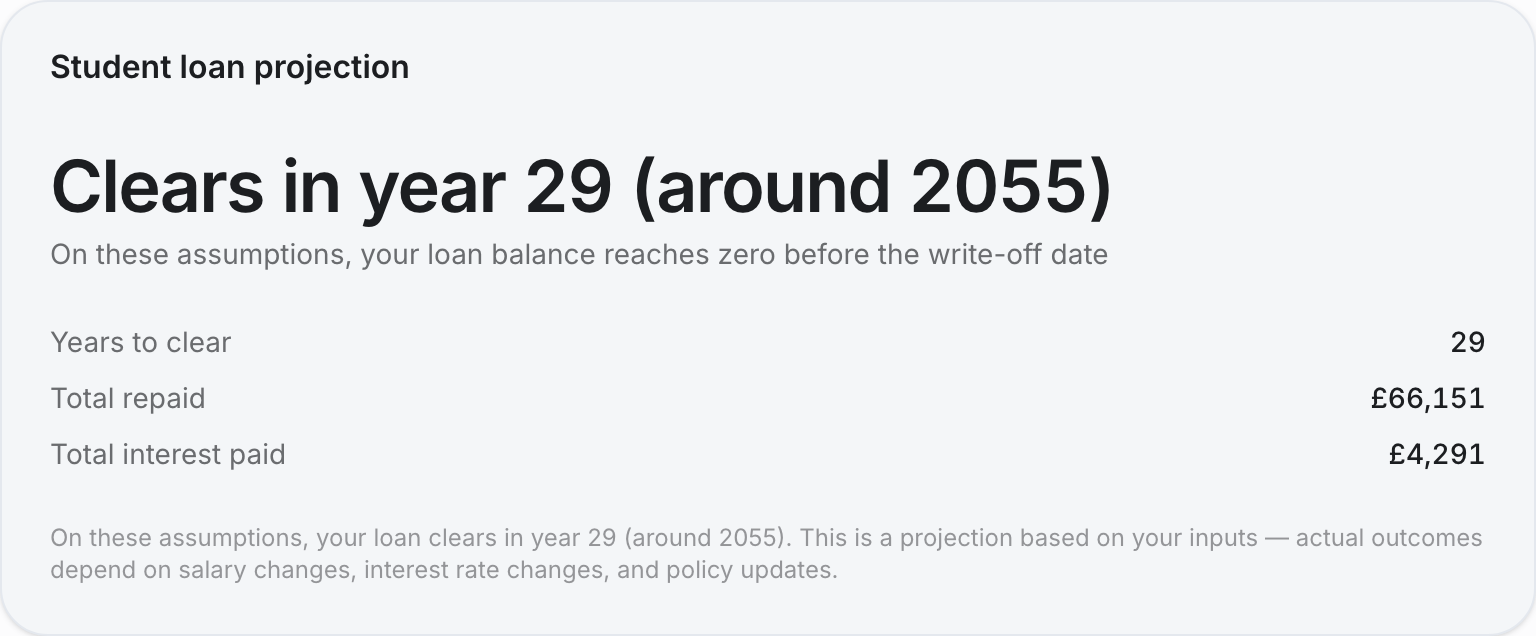
The loan clears in year 29 after £66,151 of repayments. Because it works in today's money, the calculator keeps the £25,000 threshold rising exactly in line with inflation. In reality it rises with RPI, which runs a little faster. Letting the threshold rise that bit faster gives £66,225 and clearance in year 30, a small difference.
What paying the fees up front saves
Running the same calculation across a range of starting salaries shows who repays what. The first pair of columns covers the full £61,860 loan. In the second pair the family has paid the £29,370 of tuition up front from a Junior ISA, leaving only the £32,490 maintenance loan.
| Starting salary | Repaid, full loan | Outcome | Repaid, maintenance loan only | Outcome |
|---|---|---|---|---|
| £25,000 | £29,266 | Written off | £29,266 | Written off |
| £28,000 | £44,447 | Written off | £35,572 | Cleared in year 36 |
| £32,000 | £64,687 | Written off | £34,703 | Cleared in year 28 |
| £40,000 | £66,225 | Cleared in year 30 | £33,859 | Cleared in year 19 |
| £50,000 | £64,885 | Cleared in year 22 | £33,409 | Cleared in year 13 |
| £65,000 | £63,924 | Cleared in year 15 | £33,112 | Cleared in year 9 |
Today's money, with pay rising 1.7% a year above inflation.
A graduate starting on £25,000 repays exactly the same whether or not the fees were paid, so paying up front saves them nothing at all. From about £32,000 upwards, paying the tuition saves roughly the £29,370 it cost. But that saving trickles in as smaller deductions from pay over twenty or thirty years, while the fees are paid in full at 18.
Money paid out at 18 could otherwise have stayed invested and kept growing. So a pound saved on loan repayments decades from now is worth less than a pound spent on fees today, because the pound kept today could have grown in the meantime. The table below allows for that. It shrinks each future saving by the growth the money could have earned until then.
| Starting salary | Money kept invested earns nothing above inflation | Earns 1% above inflation | Earns 3% above inflation | Earns 5% above inflation |
|---|---|---|---|---|
| £25,000 | -£29,370 | -£29,370 | -£29,370 | -£29,370 |
| £28,000 | -£20,495 | -£23,312 | -£26,514 | -£28,003 |
| £32,000 | £615 | -£8,133 | -£18,569 | -£23,779 |
| £40,000 | £2,995 | -£4,077 | -£13,763 | -£19,610 |
| £50,000 | £2,106 | -£2,970 | -£10,665 | -£15,995 |
| £65,000 | £1,442 | -£2,090 | -£7,885 | -£12,349 |
Each cell is the net gain from paying £29,370 of tuition up front, in today's money, after allowing for what the money could have earned at the return shown. A minus sign means paying up front comes out behind.
On these assumptions, paying up front only comes out ahead in one column, the one where the money, if kept, would earn nothing above inflation. Even there the gain is at most about £3,000, for graduates who would clear the loan anyway. If the money would have stayed invested at 3% to 5% above inflation, paying up front comes out behind at every salary tested. Left invested for 40 years at the long-run share return, the £29,370 would grow to about £206,800 in today's money.
None of this makes the loan painless. It takes 9% of every pound earned above £25,000 for decades, and the table counts every one of those repayments. Rules can also change, not always in borrowers' favour. The repayment threshold for Plan 2, the loan the previous generation of students took out, was frozen in the 2025 Budget until April 2030. Some families simply value a graduate starting working life free of debt. That's a legitimate reason, even though it sits outside the arithmetic.
What the Junior ISA could become instead
Nobody has to spend the money at 18 at all. On the long-run return, a Junior ISA of £50 a month from birth is worth about £15,400 in today's money at 18. Left alone until 65, it becomes about £153,000. An account paid the average £1,570 a year from birth would be worth about £400,000 by then on the same return. That's more than an 18-year-old saving £100 a month from scratch would build by 65. It depends entirely on the 18-year-old leaving it alone for 47 years.
13. What can go wrong
Nearly every table so far shows smooth growth. Real investing is bumpy, and the bumps land differently depending on when you started.
Markets fall, sometimes for years
MSCI's index of world shares lost 37.8%, measured in pounds, between October 2007 and March 2009. In early 2020 it lost 26% in under four weeks. For someone investing in pounds, the worst fall since 1987 was the dot-com crash, when the same index lost 51% between August 2000 and March 2003. Bonds aren't immune either. Long-dated UK government bonds lost 40.3% in 2022, more than five times what global shares lost, measured in pounds, that year.
Every one of those falls is already included in the long-run figures in this guide, which show what was left after them. They can't show how it feels to see a third of your savings vanish. Selling at that point turns a temporary fall into a permanent loss. That is how the long-run return can fail to reach the people it is quoted to.
Late starters have less time to recover
Time is the main defence against a fall, and the starting ages in this guide have very different amounts of it. An 18-year-old who meets a crash in their twenties has forty years for it to recover. A 45-year-old who meets one at 60 has five years before 65. For a 65-year-old hit in the first year of retirement, the pot may never make it back, as the chapter on starting at 65 shows. To limit that risk, many people move money from shares towards bonds and cash as they approach the age they need it. The bond column in every table here shows the price of doing so, in lower growth.
Charges and small pots
Platforms that charge a flat fee can take a large share of a small account. interactive investor's Core plan costs £5.99 a month, which on a £1,000 pot is 7.2% a year, enough to wipe out the whole return. A percentage fee suits a small account far better. On the same £1,000, a 0.35% platform charge comes to £3.50 a year. The two cost the same on a pot of about £20,500. Above that, the flat fee is cheaper.
High-risk products look like investing
An earlier FCA study of younger investors in high-risk products found that 68% likened that kind of investing to gambling, while 69% wrongly believed cryptoassets were regulated by the FCA. This guide's returns assume a broad slice of the world's companies held for decades. Nothing in that arithmetic carries over to a short-term bet on a single cryptocurrency.
Life gets in the way
The first table assumes someone saves the same amount, adjusted for inflation, for decades without a break. Real lives include student years and spells out of work. Then come children, or a house deposit that swallows five years of savings. An early start still pays off when the habit breaks, because the money from the early years keeps growing whether or not anything follows it. How big the final number gets, though, depends on the habit coming back.
14. Worked example: starting at 30
One saver is followed through two chapters. Everything about them stays the same except the age they start, so any difference in the result comes from the starting age alone. They start at 30 here and at 45 in the next chapter.
| Input | Value | Why this value |
|---|---|---|
| Start age | 30 | Around the age many people first invest on purpose, usually with a workplace pension already running |
| Monthly amount | £500, increased every year in line with inflation | About 13% of take-home pay on a £60,000 salary, or about 19% on £40,000 |
| Account | Stocks and shares ISA | So no tax is due at any point |
| Investment | A global share index fund | The usual low-cost choice for money invested for decades |
| Return | 5% a year after inflation | The long-run UK share return, with 5% and 10% before inflation as the lower and higher cases |
| Inflation | 2% a year | The Bank of England target. Every result is in today's money |
| Finish | The 65th birthday | The age most people picture as retirement |
A £500 monthly sum is serious but ordinary for someone in their thirties on a professional salary. It sits well inside the £20,000 allowance, so the ISA limit never gets in the way. Increasing it each year in line with inflation means it always buys the same amount. In practice most people's saving would rise faster than that as their pay grew, so more of the pot would come from the later decades.
What the projection shows
The ISA calculator takes yearly figures. Enter a starting balance of £0 and the monthly saving as a yearly contribution of £6,000. Set the growth rate to 5%, a return after inflation, so the answer comes out in today's money. Then set the number of years to 35.
At 65 the calculator shows £569,018. Of that, £210,000 is money paid in and £359,018 is growth, so almost two-thirds of the pot never came out of the saver's pocket. The other two returns land well below and well above it.
| Return | Pot at 65, in an ISA | Paid in |
|---|---|---|
| Bonds, 5% before inflation | £369,214 | £210,000 |
| Shares, long-run 5% after inflation | £569,018 | £210,000 |
| Shares, 10% before inflation | £1,076,790 | £210,000 |
At 10% the share pot is nearly three times the bond pot. Even the bond figure is three-quarters more than the money paid in, since 35 years gives a modest return time to grow into something substantial.
The same saver outside an ISA
In a general investment account, the same saver would pay the taxes described in the chapter on accounts outside an ISA, every year and again on selling. On the long-run return a basic-rate taxpayer on £30,000 ends with £476,706 after selling everything at 65, about £92,000 less than in the ISA. A higher-rate taxpayer ends with £442,111, nearly £127,000 less. In both cases every pound of the gap is tax.
15. Worked example: starting at 45
The person, the £500 a month, the fund, the return and the finish line all stay as they were. Only one thing changes. This time they start at 45.
| Input | Starting at 30 | Starting at 45 |
|---|---|---|
| Monthly amount | £500, rising each year with inflation | £500, rising each year with inflation |
| Account | Stocks and shares ISA | Stocks and shares ISA |
| Years invested | 35 | 20 |
| Total paid in | £210,000 | £120,000 |
| Return | 5% after inflation | 5% after inflation |
What the projection shows
In the calculator, only the number of years changes, from 35 to 20.
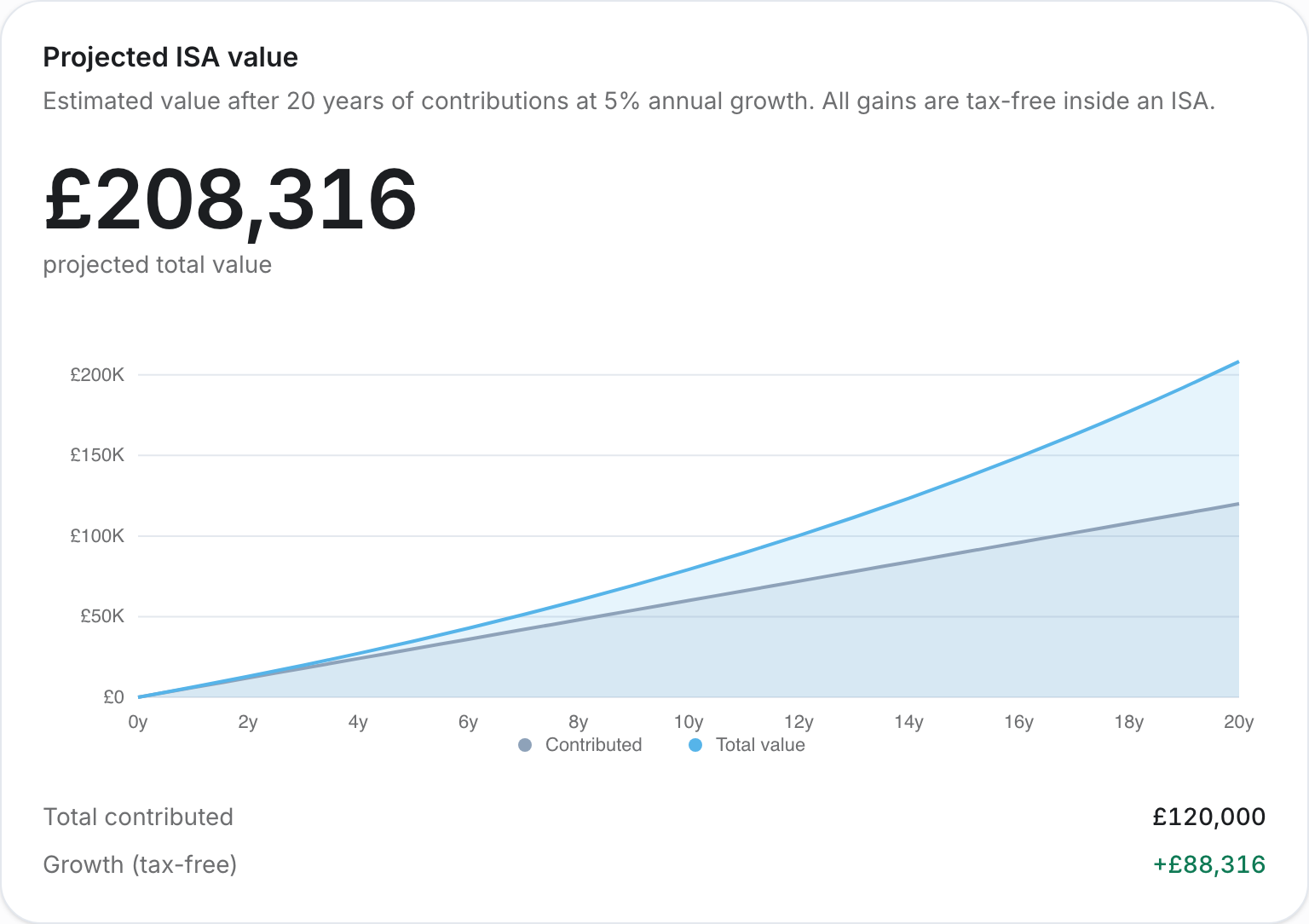
At 65 the pot is £208,316, £360,702 less than for the saver who started at 30. The 45-year-old paid in £90,000 less and ends up with 37% of the earlier starter's pot. Growth makes up 42% of the balance, against 63% for the start at 30.
What it takes to catch up
Say the 45-year-old wants to reach the 30-year-old's pot by 65. They have to pay in more each year, and how much more depends heavily on the return.
| Return | Target, the 30-year-old's pot | Needed each year from 45 | Needed each month | Fits in the £20,000 ISA allowance? |
|---|---|---|---|---|
| Bonds, 5% before inflation | £369,214 | £13,428 | £1,119 | Yes |
| Shares, long-run 5% after inflation | £569,018 | £16,389 | £1,366 | Yes |
| Shares, 10% before inflation | £1,076,790 | £22,201 | £1,850 | No, about £2,200 a year over |
Today's money. The amounts needed rise each year with inflation.
On the long-run return, catching up takes £1,366 a month, 2.73 times what the 30-year-old pays. Over twenty years that's £327,782 paid in, against the 30-year-old's £210,000. At 10% the catch-up money no longer fits in the ISA. About £2,200 a year has to go somewhere else. A higher-rate taxpayer holding that extra in a general investment account would lose about £16,500 to tax in the end. Many 45-year-olds in that position look first at a pension, with its tax relief and its larger allowance.
The full grid
Every combination of starting age, return and type of account appears below, with the same £500 a month in every row. The ISA column is the calculator's figure. Beside it, the other two columns show the same money held outside an ISA, after tax, including the tax on selling everything at 65. A start at 18 is included for comparison.
| Start age | Paid in | Return | In an ISA | Outside an ISA, basic rate | Outside an ISA, higher rate |
|---|---|---|---|---|---|
| 18 | £282,000 | Bonds, 5% before inflation | £610,178 | £456,675 | £358,630 |
| 18 | £282,000 | Shares, long-run 5% after inflation | £1,122,152 | £903,494 | £808,309 |
| 18 | £282,000 | Shares, 10% before inflation | £2,786,312 | £2,111,572 | £1,900,741 |
| 30 | £210,000 | Bonds, 5% before inflation | £369,214 | £305,359 | £253,062 |
| 30 | £210,000 | Shares, long-run 5% after inflation | £569,018 | £476,706 | £442,111 |
| 30 | £210,000 | Shares, 10% before inflation | £1,076,790 | £860,209 | £792,669 |
| 45 | £120,000 | Bonds, 5% before inflation | £164,975 | £150,514 | £135,426 |
| 45 | £120,000 | Shares, long-run 5% after inflation | £208,316 | £186,632 | £179,868 |
| 45 | £120,000 | Shares, 10% before inflation | £291,012 | £249,705 | £240,242 |
All in today's money at 2% inflation.
For these ages the start moves the result as much as the return does. From 30, the 10% share pot is nearly three times the bond pot. On the long-run return, the pot from 30 is about 2.7 times the pot from 45. The type of account comes next. For a higher-rate taxpayer, holding the money outside an ISA costs 22% of the pot from 30 and 14% from 45. The later starter loses less because a smaller balance spends less time above the tax-free allowances.
Can a better return make up for a later start? On the long-run share return, the 45-year-old's ISA ends up with little more than half of what the 30-year-old gets even in bonds, £208,316 against £369,214. No choice of fund among these makes up for the later start. The 18-year-old rows show how far ahead a start at 18 gets on the same £500 a month.
The realistic middle case
The full grid covers the extremes. Real savers are more likely to land somewhere in between, and the tables below set out one such case.
| Assumption | Value | Why |
|---|---|---|
| Return before charges | 5% after inflation | Long-run UK shares, from the Courtiers study |
| Charges | 0.3% a year | A global index fund on a low-cost platform |
| Return after charges | 4.7% after inflation, about 6.8% before | The return above, less the charges |
| Contributions | £500 a month, rising each year with inflation | As in both examples |
| Start age | In an ISA, calculator figure | In an ISA, paid monthly instead | Outside an ISA, basic rate |
|---|---|---|---|
| 18 | £1,023,769 | £1,002,530 | £829,653 |
| 30 | £533,353 | £522,288 | £449,676 |
| 45 | £201,255 | £197,080 | £181,239 |
The "paid monthly instead" column corrects a small bias in the calculator. It adds each year's money on the first day of the year, giving every contribution a full year's growth. Paying £500 on the first of each month leaves the money invested for less time on average, so the result ends up about 2.1% lower. Neither the correction nor the charges change which option comes out ahead. With realistic costs and monthly payments, starting at 30 rather than 45 is still worth about £325,000 at 65. For the saver who started at 30, the ISA still comes out about £84,000 ahead of the same money held outside one by a basic-rate taxpayer.
What the projection does not capture
A smooth line hides the falls covered in the chapter on what can go wrong, and the 45-year-old has less time to recover from one. The example also assumes the same pay, and so the same tax band, and the same contribution, both adjusted for inflation, for decades, with no withdrawals at all. Most real lives break at least one of those assumptions. Nor does it include the workplace pension most people have running alongside, which for many 45-year-olds is already the largest pot they own. When the assumptions break, starting earlier still comes out ahead, only by a different amount.
16. How to work out your own figures
The first answer is practical. Putting your own details into a thorough, UK-specific financial calculator shows where you actually stand, which matters because the same £500 a month gives very different results to a 45-year-old higher-rate taxpayer with a workplace pension and a 30-year-old saving for a deposit. Children, a mortgage and what the money is for all move the figures too. Get started with A Few Quid takes about ten minutes and gives you a projection you can question.
If you'd rather work through it yourself, these are the questions that matter, roughly in the order they come into play.
Things worth checking this week
None of these involve a decision about investing.
Anyone born between September 2002 and January 2011 almost certainly has a Child Trust Fund, and it may be sitting unclaimed. The government's find a Child Trust Fund service will say where it is.
People with a workplace pension can check what it's invested in and what it charges. They can also ask whether the employer would match a higher contribution.
For money in a general investment account, check how much of it could move into this year's ISA allowance before 5 April.
About the author and this calculator
Mike Gallagher built A Few Quid to see what everyday money decisions add up to over a lifetime, without blindly trusting a spreadsheet. Most writing about starting early stops at the familiar chart of compound growth, which is right as far as it goes. It leaves out the return being assumed, and whether that return is quoted before or after inflation. Tax taken outside an ISA is another. So are the limits on how much any account will hold. Then there's what happens when the saving stops and the spending starts.
So the app models your own household. It runs your salary, pension, ISAs, savings, mortgage and spending forward year by year in today's money. You can change one assumption at a time to see what it does. It is a calculator. Mike is not a financial adviser, and A Few Quid is not authorised by the Financial Conduct Authority. Nothing it produces is a personal recommendation. Nor is anything in this article. Every number here is an assumption to test against your own figures. For what those figures need to add up to in the end, the guide to how much you need to retire in the UK picks up where this one stops.
FAQ
How much difference does starting to invest at 30 rather than 18 make?
On long-run share returns of about 5% a year after inflation, £100 a month from 18 to 65 grows to about £224,400 in today's money, against about £113,800 from 30. The twelve extra years cost £14,400 in contributions and are worth about £110,600 at 65. To draw level, the 30-year-old would need to pay about £197 a month instead of £100. At 10% a year before inflation, the gap between the two pots is about £342,000.
Is it too late to start investing at 45?
No, but it is expensive to catch up. £100 a month from 45 reaches about £41,700 by 65 on long-run share returns, under a fifth of what the same habit builds from 18. Matching someone who started at 30 takes about £273 a month. Bigger catch-up sums also run into the £20,000 ISA allowance, which is why many people starting at 45 lean more on a pension. A pension has a larger allowance, lets you use allowance left unused in earlier years, and gives tax relief at the higher rate to higher-rate taxpayers.
Is it worth investing money at 65?
Money set aside at 65 usually has to last a long time. On ONS projections a 65-year-old man can expect about another 20 years and a woman about 23, and on our calculation from ONS data a third of men and nearly half of women will reach 90. Imagine you have £100,000 and draw £6,000 a year from it. Kept in cash earning a 3.75% Bank Rate, it runs out at about age 84. Invested at the long-run share return, it lasts to about 97. The main risk is a fall early in retirement. A 30% drop in the first year would empty the same invested pot at about 83.
Is 10% a year a realistic return for the stock market?
Before inflation, it is roughly what shares have delivered over long periods. Global shares returned 9.99% a year, measured in pounds, from the end of 1987 to August 2026 on MSCI's figures, and American shares 9.8% a year from 1900 to 2025 on UBS figures. But those returns came with inflation well above today's 2% target. After inflation, UK shares returned about 4.95% a year from 1899 to 2024. At 2% inflation, 10% a year would mean about 7.8% after inflation, well above the long-run UK figure.
Do I pay tax on investments held outside an ISA?
Yes, above some small allowances. In 2026/27 dividends above £500 a year are taxed at 10.75% for basic-rate taxpayers and 35.75% for higher-rate taxpayers. Gains above £3,000 a year are taxed when you sell, at 18% on the part that fits in your basic-rate band once your income is counted and 24% on the rest. A large gain sold in one year can push a basic-rate taxpayer well into the 24% rate. Interest, including most bond fund payouts, is taxed above a £1,000 allowance for basic-rate taxpayers and £500 for higher-rate. The tax rates on interest rise by two percentage points in April 2027. None of the allowances rises with inflation. Inside an ISA none of this applies.
How much will a Junior ISA be worth at 18?
It depends on how much goes in and what it earns. Among Junior ISAs that received money in 2024/25, the average paid in was £1,570. Paid in every year from birth, that becomes about £57,700 by 18 at the long-run share return of around 7.1% a year before inflation. In cash at 3.75% it becomes about £40,800. Filling the full £9,000 allowance every year from birth reaches about £330,900 at the share return. Those are the balances the statement would show at 18. They make no allowance for prices, which at 2% inflation would be about 43% higher by then.
Is it worth using a Junior ISA to pay university tuition fees up front?
On the calculations in this guide, it rarely comes out ahead. Plan 5 student loans charge interest in line with the Retail Prices Index, a measure of inflation. They take 9% of earnings above £25,000 and are written off after 40 years. Graduates who would never clear the loan save little or nothing by paying fees up front. Graduates who would clear it save roughly the cost of the tuition, but the saving arrives slowly, as smaller loan repayments spread across decades. If the money could instead stay invested and earn 3% to 5% a year above inflation, paying up front comes out behind at every salary tested. Personal circumstances and future rule changes can alter that.
Is a pension better than an ISA for retirement saving?
For money that can be locked away until retirement, a pension usually comes out ahead on tax. For someone who pays basic-rate tax both while working and in retirement, £100 of pay becomes £85 to spend through a pension and £80 through an ISA. For someone who pays higher-rate tax while working and basic-rate in retirement, it's £85 against £60. Money paid in by an employer widens the pension's lead far more. But from April 2028 a private pension can't normally be touched until 57, while money in an ISA can be taken out and used for anything at any time. Many people use both.
Glossary
- ISA (Individual Savings Account)
- A UK account in which interest, dividends and gains are free of tax and withdrawals are tax-free. Adults can pay in up to £20,000 a year across all their ISAs, a limit frozen until 5 April 2031. You must be 18 or over to open one.
- Junior ISA
- An ISA for under-18s, opened by a parent or guardian. Anyone can pay in, up to £9,000 a year in total. The child can manage it from 16 but nobody can withdraw until 18, when it turns into an adult ISA in the child's name.
- Stocks and shares ISA
- An ISA that holds investments such as funds and shares rather than cash. Growth and income inside it are tax-free.
- General investment account
- An ordinary investment account with none of the tax protection of an ISA or a pension. Dividends, interest and gains are taxed above small annual allowances. Platforms often shorten it to GIA.
- Lifetime ISA
- An ISA opened between 18 and 39. It takes up to £4,000 a year until the holder turns 50, and the government adds a 25% bonus. The money can go towards a first home costing up to £450,000, or be taken out for anything from 60. Other withdrawals lose 25% of the amount taken out. The government plans to replace it with a First Time Buyer ISA but has not set a date.
- Real return
- A return after inflation, which shows how much more the money will buy. A fund growing 7.1% a year while prices rise 2% has a real return of 5%. Unless a table says otherwise, the projections in this guide allow for inflation in this way and are shown in today's money.
- Nominal return
- A return before inflation, the figure a statement or factsheet shows. It counts the pounds you will have, before allowing for rising prices.
- Compound growth
- Growth on growth. Each year's return is earned on the original money and on all the returns already added to it, which is why time matters so much.
- Dividend allowance
- The amount of dividend income you can receive tax-free each year outside an ISA. It was £5,000 in 2016 and has been £500 since April 2024.
- Capital gains tax annual exempt amount
- The amount of gains you can make each year before capital gains tax is due. It was £12,300 until April 2023 and has been £3,000 since April 2024.
- Personal savings allowance
- The interest you can receive tax-free each year outside an ISA. It is £1,000 for basic-rate taxpayers, £500 for higher-rate and nothing for additional-rate taxpayers.
- Bed and ISA
- Selling investments held outside an ISA and buying them back inside one, so future growth is free of tax. The amount moved counts against that year's £20,000 allowance, and the sale can trigger capital gains tax.
- Pension carry forward
- The rule that lets you use unused pension annual allowance from the previous three tax years, on top of the current year's £60,000, provided you were in a registered pension scheme in those years. ISAs have no equivalent.
- Money purchase annual allowance
- A reduced pension allowance of £10,000 a year. It applies once someone starts taking taxable money flexibly from a defined contribution pension (a pension built up as an invested pot), for example by drawing an income from it while the rest stays invested.
- Drawdown
- Taking money from an invested pot in retirement while the rest stays invested. How long the pot lasts depends on the amount drawn, the returns and the order they arrive in.
- Sequence of returns risk
- The risk that poor returns arrive early in retirement, when the pot is largest and withdrawals force sales at low prices. Two pots with the same average return can last very different lengths of time. The FCA calls it sequencing risk.
- State pension age
- The age from which the state pension is paid. Under current law it is 67 for people born between 6 March 1961 and 5 April 1977, and 68 for anyone born after 5 April 1978. The full new state pension is £241.30 a week in 2026/27.
- Bare trust
- A simple trust in which assets are held for a named person, often a child, who becomes entitled to them outright at 18 in England and Wales. If a parent provides the money, income above £100 a year is taxed as the parent's.
- Child Trust Fund
- The account the government opened for children born between 1 September 2002 and 2 January 2011. The funds mature at 18. About 827,000 matured accounts, holding around £1.91 billion, had not been claimed at 5 April 2026.
- Plan 5 student loan
- The student loan for English undergraduates starting courses from 1 August 2023. Borrowers repay 9% of income above £25,000, interest is charged in line with the Retail Prices Index, and any balance is written off 40 years after repayments are first due.
- RPI (Retail Prices Index)
- An older inflation measure that usually runs above the Consumer Prices Index. It sets the interest rate on Plan 5 student loans, 4.1% from September 2026. The Office for Budget Responsibility expects it to settle at 2.4% in the long run.
- Auto-enrolment
- The rule that employers must put eligible staff into a workplace pension. It applies from age 22 to anyone earning over £10,000, with at least 8% of qualifying earnings paid in, 3% of it by the employer. It began in October 2012.
- Index fund
- A fund that tracks a market index, such as all the world's large listed companies, instead of picking shares. Index funds usually have the lowest charges.
Sources
- Individual Savings Accounts (ISAs), GOV.UK
- Who can invest in an ISA, guidance for ISA managers, HMRC
- Junior Individual Savings Accounts, GOV.UK
- Junior ISAs: guidance for ISA managers, HMRC
- Lifetime ISA, GOV.UK
- First Time Buyer ISA consultation, HM Treasury
- Budget 2025: overview of tax legislation and rates, HM Treasury
- Cash ISA limit reduction, HMRC
- ISA reform 2027: anti-circumvention rules factsheet, HM Treasury
- Annual savings statistics: September 2026 commentary, HMRC
- Individual Savings Account statistics, June 2020 (ISA limits since 1999), HMRC
- Tax on dividends, GOV.UK
- Income Tax: reducing the Dividend Allowance, HMRC
- Capital Gains Tax rates and annual tax-free allowances, HMRC
- Capital Gains Tax: what you pay it on, GOV.UK
- Tax on savings interest: how much is tax-free, GOV.UK
- Income Tax rates and Personal Allowances, GOV.UK
- High Income Child Benefit Charge, GOV.UK
- Trusts, Settlements and Estates Manual TSEM4310, the £100 rule for parental gifts, HMRC
- Investment Funds Manual IFM02224, interest distributions, HMRC
- Tax on your private pension: pension tax relief, GOV.UK
- Tax on your private pension: annual allowance, GOV.UK
- Tax on your private pension: lump sum allowance, GOV.UK
- Pension schemes rates and allowances, HMRC
- Pensions Tax Manual PTM056520, money purchase annual allowance triggers, HMRC
- Finance Act 2022, section 10, normal minimum pension age, legislation.gov.uk
- Pensions Act 1995, schedule 4, state pension age, legislation.gov.uk
- Deferring your State Pension, GOV.UK
- Pension Wise, GOV.UK
- Workplace pensions: joining a workplace pension, GOV.UK
- Automatic enrolment evaluation report 2019, Department for Work and Pensions
- Economic labour market status of individuals aged 50 and over, September 2026, Department for Work and Pensions
- Inheritance Tax on unused pension funds and death benefits, HMRC
- Past and projected period and cohort life tables: 2024-based, Office for National Statistics
- Saving for your children, MoneyHelper
- National Minimum Wage and National Living Wage rates, GOV.UK
- Find a Child Trust Fund, GOV.UK
- Student finance for new full-time students, GOV.UK
- Repaying your student loan: what you pay, GOV.UK
- Student loans interest rates and repayment threshold announcement, August 2026, Department for Education
- Student loans in England: financial year 2025-26, Student Loans Company
- Student loan forecasts for England 2025-26, Department for Education
- 125 years of data: the Courtiers Equity and Gilt Study, Courtiers
- Global Investment Returns Yearbook 2026, public summary, UBS
- Stocks have far outperformed over the past 125 years (UBS Yearbook 2025), Cambridge Judge Business School
- MSCI World Index (GBP) factsheet, MSCI
- iShares Over 15 Years Gilts Index Fund factsheet, BlackRock
- FTSE All-World Index factsheet, FTSE Russell
- FTSE All-Share Index factsheet, FTSE Russell
- CPI index, series D7BT, Office for National Statistics
- Consumer price inflation, UK: August 2026, Office for National Statistics
- Fiscal risks and sustainability, July 2026, Office for Budget Responsibility
- Financial Lives 2024: consumer investments, Financial Conduct Authority
- Financial Lives 2024: key findings, Financial Conduct Authority
- Retirement income advice thematic review TR24/1, Financial Conduct Authority
- FCA finds two-thirds of young investors take less than 24 hours to make investment decisions, Financial Conduct Authority
- FCA cracks down on illegal finfluencers, Financial Conduct Authority
- Young investors driven by competition and hype, Financial Conduct Authority
- Vanguard FTSE Global All Cap Index Fund factsheet, Vanguard
- Fee changes from 1 March 2026, Hargreaves Lansdown
- interactive investor launches new price plans, interactive investor
Related reading
- What percentage of your salary to save for retirement: The UK numbers behind the rules of thumb, by age and starting point.
- Living paycheck to paycheck in the UK: How many people have no buffer, and why British savers hold so much cash.
- The cost of raising a child in the UK: The headline number, and the bits the number leaves out.