
Every way to pay into a pension in the UK, and how each one is taxed
How the different ways of paying into a UK pension are taxed, and what £1,000 of pay turns into.
A long-read planning briefing, about an hour and a half
A Few Quid is not authorised or regulated by the FCA. This article is general information, not advice.
A thousand pounds of pay put aside for retirement can end up as anything from £580 to £978 of spending money after tax, depending only on the account it goes into. That's before any investment growth and before any matching money from an employer. The state pension, workplace pensions, personal pensions, self-invested personal pensions (SIPPs), final salary schemes, the Lifetime ISA and the ordinary Individual Savings Account (ISA) each treat the same pound differently. They give different tax relief on the way in and take different tax on the way out. Each also locks the money away until a different age. Paying into a partner's pension, or having your own company pay into yours, adds two more routes that many people never hear about.
This guide takes each route in turn. It starts with how the state pension is earned and how gaps in it can be filled. Then come the three ways a workplace pension takes money from your pay, and what a SIPP is for. A later chapter asks when a Lifetime ISA does a better job than a pension, and when it doesn't. The tax relief at each income level is set out in full, including the income between £100,000 and £125,140, where it is in effect worth 60%, along with the rules on when and how each pot can be drawn. Finally the guide follows £1,000 through every route to the money left to spend in retirement and runs three worked examples over a working life.
Every figure uses the same UK tax calculations as A Few Quid itself, applying the law for 2026/27 after the Budget of 28 October 2026. Each route in the guide can also be modelled in the app alongside the rest of a household's money.
This article gives general information only and is not advice. A Few Quid is a calculator and does not act as an adviser. It is not FCA-authorised, meaning it is not regulated by the Financial Conduct Authority (FCA). Nothing here is a personal recommendation. Investments can fall as well as rise, and tax rules can change.
How to read this guide
This is a long piece, so here is the shape of it before you start.
It begins with the sources of retirement money one at a time. Six places a UK retirement income can come from lines them all up in one table. How the state pension is earned and how much it pays covers qualifying years, credits, voluntary contributions and the rising state pension age. Workplace pensions and the three ways pay gets into them explains automatic enrolment, employer matching and why salary sacrifice costs least. Personal pensions and SIPPs deals with the self-employed, top-ups and charges. Final salary pensions covers the guaranteed schemes most public-sector workers still have and why transferring out of one needs advice.
The next block is about tax and the less obvious routes. How much tax relief pension contributions get sets out relief at each level of income, the band between £100,000 and £125,140 where relief is in effect worth 60%, and the yearly limits. When a Lifetime ISA beats a pension tests the claim that a Lifetime ISA is the better retirement account. Paying into your partner's pension shows what a couple gains from two pots. Paying into a pension through your own limited company covers the route open only to company owners.
Then the guide turns to getting the money out. When and how you can take money out of each pot gives the access age and withdrawal options for every pot. How pension income is taxed in retirement explains the tax a typical retiree pays and the inheritance tax change in 2027. Pensions for children, lost pots, divorce and working past state pension age collects the rules that matter only to some households.
The last part puts numbers on all of it. What £1,000 of pay or profit becomes through each route compares every route on the same footing. Three worked examples then run the routes over a working life. The first is a basic-rate employee and the second is the same saver as a higher-rate taxpayer. In the third, a company owner is paying through a limited company. How to work out which mix of pots suits your own numbers closes with the questions to answer and the things worth checking this month.
1. Six places a UK retirement income can come from
Most people in the UK end up living on a mix of money from several places. The state pays for some of it and an employer for some. The rest comes from the person themselves or from a company they own. Each source has its own rules on three things. The first two are the tax relief the money gets on the way in and the tax that comes off it on the way out. The third is the age at which you can first touch it.
Those three rules explain how two people who put aside the same amount can end up with very different incomes. The table below lines up the six sources against them. Each later chapter takes one row and works through it in detail.
| Source | Who pays in | Tax relief on the way in | Earliest age you can draw it | Tax on the way out |
|---|---|---|---|---|
| State pension | You and your employer, through National Insurance | None as such, but credits fill gaps for carers and parents | State pension age, 66 now and rising to 67 | Taxable income, paid with no tax taken off |
| Workplace pension, built up as an invested pot | You and your employer | Income tax relief at your top rate, and National Insurance too with salary sacrifice | 55 now, 57 from 6 April 2028 | A quarter tax-free, the rest taxable income |
| Personal pension or self-invested personal pension | You, your partner, your company or anyone else | Basic-rate relief added by the provider, higher rates claimed back | 55 now, 57 from 6 April 2028 | A quarter tax-free, the rest taxable income |
| Final salary pension | Your employer and you | Income tax relief at your top rate | The scheme's own pension age, often 60 to 67 | Taxable income, often with a tax-free lump sum at the start |
| Lifetime ISA | You, with a 25% bonus from the government | None on the way in, but the bonus works like basic-rate relief | 60 | None |
| Ordinary ISA | You | None | Any age | None |
The first four rows are pensions in the legal sense. Neither ISA is, but plenty of people use both to fund their retirement. The Lifetime ISA was even designed partly for that job. A general investment account, a rental property or a business can pay for a retirement too. This guide leaves them out except where they meet a pension, as a company does when it pays into its owner's pension.
Why the rules differ so much
The rules grew up piece by piece over a century, so they don't form a tidy system. The state pension goes back to 1908 and tax relief on occupational pensions to 1921. Personal pensions for employees arrived in 1988. A year later came the SIPP, a personal pension where you choose the investments yourself. In 1999 the ISA replaced the Personal Equity Plan. The Lifetime ISA followed in 2017.
The biggest single change came in April 2015, with the reforms known as pension freedoms. Before then, most people with an invested pension pot had to use most of it to buy an annuity, a guaranteed income for life from an insurer. Since then anyone over the minimum pension age can take the money out as they please, paying income tax on three quarters of each withdrawal. That freedom turned a pension pot into something much like a tax-favoured savings account with an age lock on it. It is also what makes a Lifetime ISA comparable with a pension at all.
Defined contribution and defined benefit
Pensions built up through work come in two kinds. In a defined contribution pension, you and your employer pay into a pot that is invested. What you get out depends on how much went in and how the investments did. Almost every private-sector workplace pension opened in the last twenty years works this way. So does every personal pension and SIPP.
In a defined benefit pension, the scheme promises an income based on your salary and how long you worked there. The employer carries the investment risk. Most of the public sector still runs schemes like this, and many older private-sector workers have one from an earlier job. Their rules differ in ways that matter, so they get their own chapter.
2. How the state pension is earned and how much it pays
The state pension is the base layer for almost everyone. For many households it is also the largest single source of retirement income. Yet people know less about it than any other source, because nobody pays into it on purpose. You earn it through National Insurance, the tax taken from pay alongside income tax, or through credits the state gives you when you can't work.
How much the full new state pension is
Anyone who reached state pension age on or after 6 April 2016 is on the new state pension. The full rate for 2026/27 is £241.30 a week, or £12,547.60 a year, according to gov.uk. Those who reached state pension age before April 2016 are on the older basic state pension, with extra amounts from schemes like the State Earnings-Related Pension Scheme added on top.
Every April the state pension rises under the triple lock, which lifts it by whichever is highest of price inflation, earnings growth or 2.5%. Earnings growth set the April 2026 rise at 4.8%. For April 2027 the Department for Work and Pensions (DWP) has proposed a 3.9% rise to £250.70 a week. The Budget of 28 October 2026 changed the rule from April 2030. From then on the state pension will rise by the highest of 2.5%, inflation, or whatever rise keeps it at the same level relative to average earnings as in April 2029. Over the long run that keeps it in step with earnings, while the triple lock tends to push it ahead of them.
Qualifying years: 10 for anything, 35 for the full amount
Each tax year in which you pay enough National Insurance, or get credits, counts as a qualifying year. You need 10 qualifying years to get any new state pension at all and 35 for the full amount. Between the two, each year is worth one 35th of the full rate, which in 2026/27 is £6.89 a week or £358.50 a year.
At the switchover, anyone with a National Insurance record from before April 2016 had their pension worked out under both the old and new rules. They kept whichever figure was higher, which is called the starting amount. It leaves some people above the full rate. Others sit below it because they were contracted out, which means a workplace scheme built up their pension in place of the old additional state pension. The only way to know your own number is to check your forecast on gov.uk. It shows what you've built so far and what you can still add before state pension age.
National Insurance credits for carers, parents and people out of work
Many people build qualifying years without paying anything. Credits are given automatically or on request in a long list of situations. The ones most people meet are these.
- Claiming Child Benefit for a child under 12 gives the claimant credits for every week of the claim. This holds even if the claimant's partner earns enough for the High Income Child Benefit Charge to take the money back. Opting out of the payments keeps the credits, but not claiming at all loses them. That's one reason higher-earning couples are told to fill in the form anyway.
- Grandparents and other relatives who look after a child under 12 while the parent works can have the parent's unneeded credits transferred to them. These are called Specified Adult Childcare credits.
- Carer's Allowance brings credits automatically, and Carer's Credit covers people caring for at least 20 hours a week who don't get the allowance.
- Jobseeker's Allowance, Employment and Support Allowance and Universal Credit usually bring credits too.
Filling gaps with voluntary National Insurance
If your forecast shows gaps, you can usually fill any of the last six tax years by paying voluntary Class 3 contributions. The rate for 2026/27 is £18.40 a week, so a full year costs £956.80. That buys one 35th of the full new state pension, which is £358.50 a year for life before tax. You get the money back in under three years of retirement, or a little over three if you pay basic-rate tax on your state pension. After that it keeps paying for as long as you live.
A voluntary year only helps if it lifts your pension, though. Someone who will reach 35 qualifying years anyway through work, or whose starting amount was already above the full rate, gains nothing. The forecast on gov.uk shows, year by year, whether paying would add to your pension. Before you pay, the Future Pension Centre can confirm it.
State pension age is 66, rising to 67
You can't draw the state pension before state pension age, however many years you have. That age is 66 at the moment. For people born on or after 6 April 1960 it rises step by step between 2026 and 2028, reaching 67 for everyone born on or after 6 March 1961. Current law then raises it to 68 between 2044 and 2046, for people born after 5 April 1977. A third review of state pension age began in July 2025 and hasn't reported yet. It could bring the move to 68 forward. The state pension age calculator gives your own date.
The wait matters for anyone planning to stop work sooner. Someone retiring at 60 has six or seven years to fund from private money before the state pension starts. Those are often the years when a private pension does most of its work.
Putting off the state pension to get more later
The state pension isn't paid automatically. You have to claim it, and if you don't, it builds up. Under the new state pension, every nine weeks you defer adds 1%, so a full year adds about 5.8%. Someone due the full rate who defers for a year gives up £12,547.60 and gains about £725 a year for life. Making that back takes a little over 17 years of the higher pension, before tax and price rises. Deferral tends to suit two groups. One is people who keep working past state pension age and would otherwise pay higher-rate tax on their pension. The other is people in good health from long-lived families.
Tax on the state pension
The state pension is taxable income, but it's paid with no tax taken off. If you have other income, HM Revenue and Customs (HMRC) usually collects the tax due by shrinking the tax-free amount in the tax code used for your private pension or salary. The full new state pension of £12,547.60 sits just £22.40 below the £12,570 Personal Allowance, the amount of income anyone can have before income tax starts. For most people with a full state pension, then, almost every pound of private pension income on top of it is taxed at 20%. That is the main reason a pension usually loses 15p in every pound to tax on the way out. The 15p is 20% tax on the three quarters of each withdrawal that isn't tax-free.
The April 2027 rise will take the full new state pension to £13,036.40 a year, putting it above the Personal Allowance for the first time, by £466.40. To deal with that, the Budget of October 2026 created a Pension Tax Allowance for the tax years 2027/28 to 2029/30. People over state pension age whose total income is no more than the full new state pension won't pay income tax on it. Above that line the relief shrinks by £1 for every £3 of extra income, so it soon disappears for anyone with a private pension of any size.
3. Workplace pensions and the three ways pay gets into them
For most employees the workplace pension is the main private pension. Since 2012 nearly everyone in a job has had one by default, and in 2025 90% of eligible employees in Great Britain were saving into one. Under automatic enrolment, an employer has to put staff into a pension if they are aged between 22 and state pension age and earn more than £10,000 a year. You can opt out. If you do it within a month you get back what you paid. Either way, the employer has to enrol you again every three years.
The legal minimum is 8%, and it's smaller than it sounds
The minimum is 8% of qualifying earnings, of which the employer must pay at least 3%. Qualifying earnings are the slice of pay between £6,240 and £50,270 a year, so the 8% is not 8% of your whole salary. On a salary of £35,000 the minimum from you and your employer together works out at £2,300 a year, about 6.6% of pay. On £70,000 it's still £3,522, because nothing above £50,270 counts. Whether that is enough for the retirement you want is a separate question, which what percentage of your salary to save works through.
Plenty of employers pay more than the minimum, and many will raise their share if you raise yours. A common arrangement matches extra contributions pound for pound up to a ceiling, perhaps 5% or 6% of salary. Money matched that way doubles the moment it lands, before any tax relief or growth. Nothing else in this guide comes close. So the first thing to ask about any workplace pension is how much the employer will add if you pay more.
The Pensions (Extension of Automatic Enrolment) Act 2023 gave the government power to lower the starting age from 22 to 18 and to count earnings from the first pound instead of from £6,240. No date has been set for either change. The Pensions Commission, revived in July 2025, is looking at whether 8% is enough. Its final report is due in February 2027.
How your contribution reaches the pot
Workplace pensions get confusing because your own contribution can reach the pot in three different ways. Your employer chooses which one the scheme uses, and the choice changes how much your take-home pay falls for each pound saved. Payslips rarely make it clear, so it's worth asking.
Net pay arrangement
In a net pay arrangement your contribution comes out of your pay before income tax is worked out. National Insurance is still charged on your full pay. You get income tax relief at your top rate straight away, with nothing to claim. The weak spot has always been people earning below the £12,570 Personal Allowance. They pay no income tax, so they got no relief at all. For contributions from 2024/25 onwards the government now makes up the difference with the Low Earner's Pension Payment. Nobody has to claim it. HMRC writes to the people who qualify. The first payments are being sent out between late 2026 and early 2027.
Relief at source
In a relief-at-source scheme your contribution comes out of your take-home pay, after tax. The pension provider then claims basic-rate relief from HMRC and adds it to your pot, so every £80 you pay becomes £100. Higher-rate and additional-rate taxpayers are owed more relief than that and have to claim the rest themselves, through a self assessment tax return or by contacting HMRC. Many never do. A 40% taxpayer who puts £4,000 into a relief-at-source pension sees £5,000 land in the pot. They are owed another £1,000, which HMRC won't send unless asked.
Salary sacrifice
With salary sacrifice you agree to a lower salary and your employer pays the difference into your pension as an employer contribution. Because your salary is lower, you pay less income tax and less National Insurance on it. A basic-rate taxpayer saves 28p in every pound sacrificed (20% income tax and 8% National Insurance). A higher-rate taxpayer saves 42p (40% and 2%). Your employer also saves its own National Insurance, 15% of the pay you give up. Some employers add part or all of that to your pension.
What each route costs to put £1,000 in your pot
The difference shows most clearly as the cost, in lost take-home pay, of getting £1,000 into your pension in 2026/27. These figures come from the app's own tax calculations, for earners in England, Wales and Northern Ireland.
| Who | Salary sacrifice | Relief at source or net pay | Lifetime ISA, for comparison |
|---|---|---|---|
| Basic-rate taxpayer on £35,000 | £720 | £800 | £800 |
| Higher-rate taxpayer on £70,000 | £580 | £600 (after claiming £200 back) | £800 |
| Losing the Personal Allowance, on £110,000 | £380 | £400 (after claiming £400 back) | £800 |
| Additional-rate taxpayer on £150,000 | £530 | £550 (after claiming £250 back) | £800 |
Salary sacrifice is cheapest at every income, because it saves National Insurance as well as income tax. For a basic-rate taxpayer the gap between salary sacrifice and relief at source is £80 on every £1,000 that goes in. At the higher rate the gap shrinks to £20, because National Insurance above £50,270 is 2%. The £110,000 row is the strangest one, and the chapter on tax relief explains why someone there pays only £380 for £1,000 in the pot.
The 2029 cap on salary sacrifice
From 6 April 2029 the National Insurance saving on salary sacrifice will be limited. Only the first £2,000 a year sacrificed into a pension will stay free of National Insurance. Anything above that will pay employee and employer National Insurance as if it were salary. The income tax saving stays exactly as it is. Announced at the Budget of November 2025, the cap became law in the National Insurance Contributions (Employer Pension Contributions) Act 2026.
The £2,000 is a cash figure with no link to inflation, so it will cover less each year. For a basic-rate taxpayer who sacrifices more than £2,000, every pound above the cap will cost 80p of take-home pay, the same as relief at source. A higher-rate taxpayer will pay 60p. Salary sacrifice will still be the cheapest route for most people, but the gap over net pay and relief at source will narrow sharply above £2,000 a year. Employers that pass on their National Insurance saving will have less to pass on.
What salary sacrifice can affect
A lower salary on paper has knock-on effects, and some of them are useful. Salary sacrifice lowers your adjusted net income, which is your taxable income less certain reliefs such as pension contributions. That figure decides whether you pay the High Income Child Benefit Charge or lose your Personal Allowance. It also decides whether you can get Tax-Free Childcare and the funded childcare hours. Other effects are worth checking before you sign up.
4. Personal pensions and SIPPs for the self-employed and for topping up
A personal pension is one you arrange yourself, without an employer. You choose a provider and pay in when you like. The provider adds basic-rate tax relief through relief at source. A SIPP is the same thing with a wider choice of investments. Many people who open one today do it through an investment platform and buy index funds, which track a whole stock market for a small yearly charge.
Who uses one
Three groups lean on personal pensions most.
The self-employed have no employer and no automatic enrolment, so a personal pension is their main way to get tax relief on retirement saving. Relief works the same way as for an employee in a relief-at-source scheme. Each £80 paid in becomes £100. Higher-rate relief is claimed through the self assessment return they file anyway. They do miss out on the employer's share. A self-employed person has to find the whole 8% that an employee and employer would share, or whatever they choose to save, from their own profits.
Employees use them to save more than their workplace scheme allows or to invest in things it doesn't offer. Someone whose employer doesn't run salary sacrifice, or who wants a cheaper or different fund, can pay into a SIPP on top. People who have changed jobs several times often bring their old workplace pots together in one SIPP as well.
People with no earnings use them because anyone under 75 can pay up to £3,600 a year into a pension, tax relief included, whether they earn or not. That's £2,880 of their own money topped up by £720 of tax relief from the government. A partner, a parent or anyone else can pay it for them, which is the basis of the chapter on paying into a partner's pension.
Charges
The tax relief on a pension is a one-off gain on each pound. Charges come off every year, for decades. A platform charge of 0.25% a year plus a fund charge of 0.2% adds up to 0.45% a year. On a single sum invested at the start of a 30-year stretch and growing at 4% a year above inflation, that leaves the pot about 13% smaller than with no charges at all. At 1.5% a year, a common total for an older personal pension with an actively managed fund, the pot ends up about 36% smaller. For someone paying in steadily over the same 30 years the damage is smaller, about 8% and 24%, because later payments are charged for fewer years. Workplace schemes used for automatic enrolment have their default fund charge capped at 0.75% a year. Personal pensions have no such cap. The MoneyHelper guide to pension charges explains the different kinds.
Moving old pensions into one place
Bringing pensions together makes them easier to track and can cut charges, but some old pensions carry valuable extras that a transfer throws away. Some older policies guarantee an annuity rate far above anything on offer now or pay a tax-free lump sum of more than 25%. Others allow access before 57, known as a protected pension age, and a few charge a penalty for leaving. Before moving any pension, ask the provider in writing whether it has guarantees, protected rights or exit charges. A final salary pension is a different case entirely, covered in the next chapter.
The government is also tackling small forgotten pots directly. The Pension Schemes Act 2026, which became law in April 2026, will merge workplace pots worth £1,000 or less into consolidator schemes, starting in 2030. For schemes you have lost track of, the Pension Tracing Service on gov.uk can find contact details.
5. Final salary pensions and why transferring out needs advice
A final salary pension, or defined benefit pension, promises an income for life instead of a pot of money. A formula sets the amount. Older schemes paid a fraction of your final salary for each year of service, perhaps one 60th or one 80th. Since 2015 most public-sector schemes have used your average salary over your career instead, revalued each year, hence the name career average schemes. The NHS, teachers', civil service, armed forces, police and local government pensions all work this way.
What a final salary pension pays
These pensions are generous by design. The income usually rises each year with inflation, up to a limit. When you die, a spouse or civil partner typically gets half or more of it for the rest of their life. Many schemes let you swap part of the pension for a tax-free lump sum at the start, often at a rate of £12 of lump sum for every £1 a year of pension given up. Whether that's a good swap depends on how long you expect to live. At £12 for £1, though, the scheme is in effect buying back an inflation-linked income for twelve years' worth of payments, which is usually cheap for the scheme.
The employer carries the investment risk. If a private-sector employer goes bust with a scheme that can't meet its promises, the Pension Protection Fund takes over and pays compensation. That covers the full pension for people already over the scheme's pension age and 90% for younger members. The cap that used to limit compensation for younger members was removed after a 2021 Court of Appeal ruling.
Tax relief and the annual allowance
Contributions to a final salary scheme get tax relief like any other pension. The way they are measured against the £60,000 annual allowance differs, though. For a defined benefit pension, the amount saved in a year is taken as 16 times the rise in your yearly pension, plus any rise in a separate lump sum. A big promotion can catch out a senior doctor or head teacher. The growth in their promised pension can count as a large contribution in a single year and bring a tax charge on the amount above the allowance. Their scheme will usually pay the charge for them and cut their pension to cover it.
Transferring out
You can usually swap a private-sector final salary pension for a cash sum, called a transfer value, paid into a personal pension. Unfunded public-sector schemes, such as the NHS and teachers' schemes, don't allow it. They have no invested fund and pay pensions from public money. If the transfer value is over £30,000, the law requires you to take advice first from a financial adviser regulated by the FCA. The FCA starts from the assumption that a transfer is unsuitable for most people.
A transfer gives up a guaranteed income that rises with inflation and continues to a partner. In its place comes an invested pot that you have to manage and that could run out. Transfer values also move with interest rates. They were very high in 2020 and 2021, when long-term interest rates were close to zero. When gilt yields (the interest rate on UK government bonds) rose in 2022, they fell sharply. A transfer has to come out ahead of a guarantee that the employer is paying for.
6. How much tax relief pension contributions get, and the yearly limits
Tax relief is the main reason to put retirement money in a pension at all. Money paid into a pension is treated as if you'd never earned it, so no income tax is charged on it going in. You pay income tax later, when it comes out, on three quarters of it. Whether that leaves you ahead depends on the rate you save tax at now against the rate you pay later.
Relief at your top rate of tax
Pension contributions get relief at your highest rate of income tax. In England, Wales and Northern Ireland that's 20%, 40% or 45%. For a relief-at-source pension the first 20% is added automatically and the rest is claimed. In a net pay or salary sacrifice pension it all happens through payroll.
Scotland has six rates of income tax, from 19% to 48%, set by the Scottish Parliament. Relief-at-source schemes add 20% for every Scottish taxpayer, including those on the 19% starter rate, who keep the extra 1%. Scottish taxpayers on the 21%, 42%, 45% and 48% rates claim the difference through self assessment or by contacting HMRC.
The 60% band between £100,000 and £125,140
Income tax gets strange above £100,000. The Personal Allowance shrinks by £1 for every £2 of adjusted net income over £100,000, so by £125,140 it has gone completely. In that band each extra £1,000 of pay costs you £400 in income tax. Another £200 goes because £500 of Personal Allowance disappears and is then taxed at 40%. That's an effective rate of 60%, plus 2% National Insurance.
Pension contributions work the other way. Every £1,000 paid into a pension in that band gives £600 of income tax relief. So in the table in the workplace pensions chapter, £1,000 in the pot costs someone on £110,000 only £380 through salary sacrifice. Someone earning £125,140 who sacrifices £25,140 into a pension saves £15,084 in income tax, which is 60% of the amount. They also get their whole Personal Allowance back.
Child Benefit and childcare
Adjusted net income decides two other things that make pension contributions look even better for parents. The High Income Child Benefit Charge claws back 1% of the family's Child Benefit for every £200 of the higher earner's adjusted net income above £60,000, so by £80,000 it has all gone. Child Benefit for a family with two children is worth £2,337.40 a year in 2026/27. Between £60,000 and £80,000, then, each £1,000 of extra pay loses about £117 of Child Benefit on top of income tax and National Insurance.
If either parent has adjusted net income above £100,000, the family loses Tax-Free Childcare and the funded childcare hours in England completely. Losing them can cost a family with young children thousands of pounds a year. A pension contribution that brings income back under £100,000 restores them. The cost of raising a child guide works through the figures.
The annual allowance and its three variations
There's a limit on how much can go into your pensions each year with tax relief. The standard annual allowance is £60,000, counting everything paid in by you, your employer and anyone else. Your own contributions are also capped at 100% of your earnings in the year. Someone earning £25,000 can't get relief on more than £25,000 of personal contributions. Employer contributions have no such link to your earnings, which matters a great deal to company owners.
Three rules change the £60,000. The tapered annual allowance hits people with threshold income above £200,000 and adjusted income above £260,000. These are two HMRC measures of income, and adjusted income also counts pension contributions, the employer's included. Their allowance falls by £1 for every £2 over £260,000, down to a floor of £10,000.
The money purchase annual allowance applies once you start taking taxable money from a defined contribution pension, as a drawn income or as lump sums that are partly taxed. From then on the allowance for further contributions to such pensions is £10,000 a year. Taking only the tax-free lump sum, or buying a lifetime annuity, doesn't trigger it.
Carry forward works in the other direction. If you were a member of a pension scheme in any of the previous three tax years and didn't use your full allowance, you can add the unused amount to this year's. Someone with a windfall, or a company owner with a good year, can put in well over £60,000 at once this way.
Paying in more than the allowance breaks no law. The excess is taxed at your top rate through the annual allowance charge, though, which cancels the relief. HMRC's annual allowance guidance sets out the rules in full.
7. When a Lifetime ISA beats a pension for retirement saving
The Lifetime ISA isn't a pension in law, but retirement was one of the two jobs it was designed for. For some people it does that job better than a pension. You can open one between your 18th and 40th birthdays and pay in up to £4,000 a year until the day before you turn 50. The government adds a 25% bonus, so £4,000 becomes £5,000. That £4,000 counts towards your £20,000 yearly ISA allowance.
You can take the money out without penalty for a first home costing up to £450,000, from age 60, or if you are terminally ill. Any other withdrawal pays a 25% charge on the amount taken out. The charge is a quarter of the whole withdrawal, so it takes back the bonus and a slice of your own money too. £800 of your money, topped up to £1,000, comes back as £750 if you withdraw it early. That's a loss of £50, and the charge takes a quarter of any growth as well. Since 29 October 2026 a withdrawal for a first home costing more than £450,000 pays a charge of 20%, which only takes back the bonus.
Why the bonus is the same as basic-rate tax relief
A 25% bonus on what you pay in is exactly what a relief-at-source pension gives a basic-rate taxpayer. £800 paid into either becomes £1,000 inside. The difference comes on the way out. Money from a Lifetime ISA is tax-free. Money from a pension is a quarter tax-free and three quarters taxed as income. For someone paying 20% income tax in retirement, £1,000 in a pension gives £850 to spend.
So for a basic-rate taxpayer who would otherwise pay into a personal pension from take-home pay, the Lifetime ISA comes out ahead. Each £1,000 of pay leaves £720 after tax and National Insurance. In a Lifetime ISA that becomes £900 to spend in retirement. A relief-at-source pension turns it into £765 to spend, after the tax on withdrawals. Both figures leave out investment growth, which is the same in either account if they hold the same funds. On those numbers the Lifetime ISA makes a strong retirement account.
When the pension wins instead
That lead can vanish once other money comes into play.
Salary sacrifice saves National Insurance on top. A basic-rate taxpayer's £1,000 of pay then buys £1,000 in the pension, which gives £850 to spend at 20% tax in retirement. That's still less than the Lifetime ISA's £900. If the employer adds its own National Insurance saving to the pot, though, the pot holds £1,150, which gives £977.50 to spend, and the pension wins. From April 2029 that advantage only applies to the first £2,000 a year sacrificed.
Employer matching makes a far bigger difference. An employer that adds £1 for every £1 you put in doubles the pension side before tax is even counted. Leaving a workplace pension to pay into a Lifetime ISA instead gives up that money for good. MoneyHelper makes the same point.
Higher-rate taxpayers get 40% relief on pension contributions and only a 25% bonus on a Lifetime ISA. £1,000 of their pay leaves £580 after income tax and National Insurance. That becomes £725 to spend from a Lifetime ISA, or £822 from a relief-at-source pension at 20% tax in retirement. Through salary sacrifice it's £850.
Lower tax in retirement helps the pension too. Your withdrawals might fit inside your Personal Allowance, perhaps because you retire before the state pension starts or have a small pension alongside it. Three quarters of each withdrawal is then taxed at 0% and the pension gives back the full £1,000.
The limits that make it a top-up
Even where it wins, the Lifetime ISA can't carry a whole retirement. The £4,000 a year limit caps the bonus at £1,000 a year, and you can pay in only until 50. Someone who opens one at 39 and pays the full £4,000 every year gets eleven years of bonuses, £11,000 in all. And it unlocks at 60, three years later than the age at which a pension opens from April 2028.
Its future is limited too. The Budget of October 2026 announced a First Time Buyer ISA from April 2029, with the same £4,000 limit and 25% bonus, for first homes only. For new savers, the new account replaces the Lifetime ISA. Lifetime ISAs opened before then carry on under the existing rules, including the tax-free withdrawal at 60. Anyone who wants one for retirement therefore has until April 2029 to open it and must be under 40 when they do.
Where it fits next to a pension
A Lifetime ISA has some advantages a pension lacks. Withdrawals from it don't count as income, so they can't push you into a higher tax band, reduce your Personal Allowance or trigger the money purchase annual allowance. It can be used for a first home, which no pension can. And because it's an ISA, you can get at the money before 60 if you have to, at the cost of the 25% charge.
A pension has advantages too. Money in it usually doesn't count towards means-tested benefits before you start drawing it, and until April 2027 it falls outside your estate for inheritance tax. You can usually reach it three years earlier. With no £4,000 limit, it can also hold far more.
Many people use both. A basic-rate taxpayer whose employer matches up to a point might pay enough into the workplace pension to get all of the match. Up to £4,000 a year could then go into a Lifetime ISA, with anything above that going back into the pension. The worked example for a basic-rate employee compares the routes one at a time over 25 years.
8. Paying into your partner's pension and sharing retirement income
A pension belongs to one person, but couples tend to plan retirement together. The rules let one partner pay into the other's pension. Doing so can add tax relief that would otherwise be lost and cut the tax the couple pays later.
How paying into someone else's pension works
Anyone can pay into someone else's personal pension or SIPP. The payment is treated as if the pension holder had made it, so the tax relief depends on the holder's earnings and tax rate. Whoever pays gets no relief of their own.
For a partner who doesn't earn, that means up to £2,880 a year, which the provider tops up to £3,600. Every £2,880 brings £720 of tax relief that the household would otherwise miss. If it's paid in at the start of every year for 20 years and grows at 4% a year above inflation, it builds a pot of about £111,500 from £57,600 of the payer's own money. Both figures are in today's money. That assumes the £2,880 rises with prices each year, so in 20 years it still buys what £2,880 buys now.
If the partner does earn, the limit is their own earnings for the year, or the £60,000 annual allowance if that's lower. The provider adds 20% relief. If the partner pays higher-rate tax they can claim the rest, even though the money came from you.
Most workplace pensions only accept contributions through the payroll, so you usually can't pay into your partner's workplace scheme directly. Opening a personal pension or SIPP in their name gets round that.
Why two pots can beat one
The bigger gain often comes in retirement. Each person has their own Personal Allowance of £12,570 and basic-rate band, the income taxed at 20%, up to £50,270, plus their own £268,275 lump sum allowance. A couple whose pension savings all sit in one name can use only one set.
Imagine a couple who both have the full state pension and want to draw a further £54,905 a year of taxable income from their pensions, taking their joint income to £80,000. If it all comes from one person's pot, that person has a total income of £67,452, state pension included, and pays higher-rate tax on £17,182 of it. Drawn equally from two pots, it gives each of them a total income of £40,000, and neither reaches the higher rate. On 2026/27 rates the couple pays £14,413 a year in income tax with one pot and £10,972 with two, a saving of £3,441 a year, every year.
At lower incomes the gain shrinks. If the same couple draw only enough to bring their joint income to £60,000, they pay £6,976 with one pot and £6,972 with two, because even when it all comes from one pot, that person's income stays under £50,270. Splitting matters most when it keeps one person out of the higher rate or below £100,000.
Married, unmarried and inheritance tax
Gifts between spouses and civil partners are free of inheritance tax, so paying into a married partner's pension raises no issue. Gifts to an unmarried partner aren't exempt in the same way. Regular contributions from income usually qualify for the exemption for normal spending out of income, though. The £3,000 annual exemption, the amount anyone can give away each year free of inheritance tax, covers smaller sums.
Pensions don't pass under a will. The scheme decides who gets a pension after death, guided by the expression of wish form you give it. Unmarried partners in particular need to fill that form in, because without it the scheme may not know they exist.
Unlike the old basic state pension, the new state pension mostly can't be inherited by a spouse, so each partner's own National Insurance record matters. A partner who stays at home with young children builds qualifying years through Child Benefit only if the claim is in their name.
Marriage allowance in retirement
In a married couple or civil partnership where one person's income is below the Personal Allowance and the other pays only basic-rate tax, the first can transfer £1,260 of their allowance to the second through the marriage allowance. It's worth up to £252 a year. People often forget it in retirement, when a partner with a small pension may have unused allowance and the other draws a larger pension.
9. Paying into a pension through your own limited company
Directors of their own limited companies have a route nobody else has. The company can pay into the director's pension as an employer contribution, out of profits that haven't yet been taxed at all.
Most owner-directors pay themselves a small salary and take the rest of their income as dividends. A salary of about £12,570 is common, because it uses the Personal Allowance and earns a qualifying year for the state pension without paying any employee National Insurance. A salary above the lower earnings limit, £6,708 in 2026/27, is enough for the qualifying year. Dividends come out of profits after corporation tax and then pay dividend tax.
Why an employer contribution is so efficient
When the company pays into the director's pension instead, three taxes fall away at once. The payment is a company expense, so it comes off profits before corporation tax. Because it isn't the director's pay, neither side owes income tax or National Insurance on it. Nor is it a dividend, so no dividend tax is due.
The usual limit on personal contributions, 100% of your earnings, doesn't apply to employer contributions either. A director on a £12,570 salary can have the company pay £60,000 into their pension, or more with carry forward. Only the annual allowance limits it.
HMRC requires the payment to be made wholly and exclusively for the purposes of the trade. For a director who works in the business, contributions in line with the value of the director's work for the company are rarely questioned. The Business Income Manual sets out HMRC's approach.
What £1,000 of profit becomes each way
The comparison depends on the company's profits and the owner's tax band. For £1,000 of profit, the app's corporation tax and dividend tax calculations for 2026/27 give these figures.
| Company and owner | Corporation tax on £1,000 | Dividend after corporation tax | Dividend tax | Left to put in an ISA | Paid into a pension instead |
|---|---|---|---|---|---|
| Profits £40,000, basic-rate owner | £190 | £810 | £87.07 | £722.93 | £1,000 |
| Profits £100,000, higher-rate owner | £265 | £735 | £262.76 | £472.24 | £1,000 |
| Profits £300,000, higher-rate owner | £250 | £750 | £268.13 | £481.88 | £1,000 |
Corporation tax is 19% on profits up to £50,000 and 25% above £250,000. Between the two, marginal relief makes the rate on each extra pound 26.5%, so the middle row loses more than the bottom one. From April 2026 dividends are taxed at 10.75% in the basic-rate band and 35.75% in the higher-rate band, after a £500 tax-free allowance.
The £1,000 in the pension still pays income tax when it comes out. At 20% income tax in retirement it gives £850 to spend. Set against £722.93 in an ISA, that's a gain of about 18% for a small company with a basic-rate owner. A company in the marginal relief band with a higher-rate owner does far better. There the £850 is 80% more than the £472.24 a dividend leaves for an ISA.
Paying a partner who works in the business
A director's spouse or partner who works in the company can be paid a salary and given employer pension contributions too. Stricter rules apply, though. The whole package of salary and pension together has to be justifiable for the work they actually do. The test is what the company would pay someone else for the same job, and HMRC can refuse the deduction for any part above that. A partner who does a few hours of bookkeeping a week can't reasonably be given £40,000 a year of pension contributions.
Things a company owner has to watch
The contribution has to be paid within the company's accounting period to count against that year's profits. An amount owed but unpaid at the year end doesn't count. Very large one-off contributions can have their tax relief spread over several years, though that rule only applies to sums far larger than most small companies pay in.
Once the minimum pension age rises in 2028, money in the pension is locked away until 57. Profits kept in the company can be reached at any time. Some owners keep part of their profit in the company to draw as dividends in retirement, when their other income is low and more of it falls in the basic-rate band. That carries its own risks. Company cash is exposed to the business, and dividend tax rates have risen twice since 2022.
Sole traders and partners in a partnership can't use this route, because there's no company to make the payment. Their pension contributions are personal ones, with relief at source, limited to 100% of their profits.
10. When and how you can take money out of each pot
Getting money into the right place is only half the job. The other half is knowing when you can reach it and what each way of taking it out costs in tax.
The minimum pension age rises to 57 in 2028
You can't normally take money from a personal or workplace pension until the normal minimum pension age of 55. From 6 April 2028 it rises to 57. Anyone who turns 55 after that date waits until 57. People who are 55 or 56 on that date will usually have to wait until 57 too, unless their scheme gives them a protected pension age. That protection belongs to members whose scheme rules gave them an unconditional right to take their pension before 57, held before 4 November 2021. Check with your scheme before planning on it. Uniformed public-service schemes such as the police and firefighters' schemes have their own rules. Serious ill health allows access at any age.
The government's stated aim, which isn't yet law, is to keep the minimum pension age ten years below state pension age. On that aim, a state pension age of 68 would bring a minimum pension age of 58.
Four ways to take money from a pension pot
Once you reach the minimum age, you can use a defined contribution pot in four ways and mix them as you like.
The first is to take up to a quarter of the pot tax-free and move the rest into flexi-access drawdown. That money stays invested, and you take income from it when you choose, taxed as income.
You can also take lump sums straight from the pot, each one a quarter tax-free and three quarters taxed. These are called uncrystallised funds pension lump sums. They suit people who want to take money now and then without moving the whole pot.
A third option is an annuity, an income for life from an insurer, usually bought after taking the tax-free quarter. Annuity rates rose sharply when interest rates went up from 2022. An annuity is also the only way to rule out running out of money.
Finally, you can take the whole pot as cash. A quarter is tax-free and the rest is added to that year's income. For a pot of any size, that usually pushes a good part of it into the higher or additional rate.
Whichever you choose, the tax-free part over your lifetime is capped at the £268,275 lump sum allowance.
Emergency tax on the first withdrawal
The first time you take a taxable lump sum from a pension, the provider often has no tax code for you and uses an emergency code. That code treats the payment as if you'd receive the same amount every month for a year, so it can take far too much tax. You can claim it back straight away using form P55 if you haven't emptied the pot, P53Z if you've emptied it and have other income, or P50Z if you've emptied it and have no other income. Otherwise it's sorted out after the tax year ends.
Taking taxable money cuts what you can pay in later
Taking any taxable income from flexi-access drawdown, or any uncrystallised funds pension lump sum, triggers the money purchase annual allowance. From then on, only £10,000 a year can go into defined contribution pensions with tax relief. It isn't triggered by taking only the tax-free quarter or by buying a lifetime annuity. Up to three small pots of £10,000 or less can also be cashed in without triggering it. The rule tends to catch people who take money from an old pension at 55 or 57 while still working and paying into a new one.
The other pots
The state pension starts at state pension age and can't be taken earlier. A final salary pension starts at the scheme's normal pension age. Most let you take it early with a reduction, often 4% to 6% for each year early, or late with an increase. A Lifetime ISA can be emptied tax-free from 60. An ordinary ISA can be drawn at any time, which makes it the natural source for anyone retiring before the minimum pension age.
| Pot | Earliest access | Tax on what you take |
|---|---|---|
| Workplace or personal pension pot | 55, rising to 57 on 6 April 2028 | A quarter tax-free, the rest taxable income |
| Final salary pension | The scheme's pension age, earlier with a reduction | Taxable income, lump sum often tax-free |
| State pension | State pension age, 66 rising to 67 | Taxable income |
| Lifetime ISA | 60, or earlier with a 25% charge | None |
| ISA | Any age | None |
Free guidance before you start
Anyone aged 50 or over with a defined contribution pension can get a free appointment with Pension Wise, the government's guidance service run by MoneyHelper. It explains the options without recommending a product. Providers have to offer it before you take money out for the first time.
11. How pension income is taxed in retirement, and the inheritance tax change in 2027
Most of the gain from saving in a pension comes from paying a lower rate of tax on the way out than the rate of relief you got on the way in. That only works if the money comes out at a sensible pace.
What tax a typical retiree pays
Pension income is taxed with everything else at the ordinary rates of income tax. A retiree with the full new state pension has almost used up their Personal Allowance before taking a penny from a private pension. If they draw £20,000 a year from a pension pot with a quarter of each withdrawal tax-free, the other £15,000 is taxed at 20%. They pay £2,996 a year in income tax and keep £17,004, or 85% of what they drew.
Before the state pension starts, the same person has the whole Personal Allowance free. They can draw up to £16,760 a year with a quarter of each withdrawal tax-free and pay no income tax at all. So the years between stopping work and state pension age are often the cheapest time to draw from a pension.
Keeping out of the higher rate
The higher rate starts at £50,270 of total income, and it bites in retirement just as it does at work. Someone with a large pot who draws £70,000 a year pays 40% on the slice above £50,270. Over a long retirement that can cost far more than the extra relief the pension earned on the way in. Spreading withdrawals over more years keeps more of it in the basic-rate band. So does drawing from ISAs and Lifetime ISAs in high-spending years, or splitting income between partners. Above £100,000 the loss of the Personal Allowance applies to pension income too, with the same 60% effective rate it has on pay.
The tax-free quarter can be taken all at once or spread across many withdrawals. Taking it all at the start gives a large tax-free lump sum, but leaves every later withdrawal fully taxable. Spreading it keeps a quarter of every withdrawal tax-free for as long as the pot lasts.
Unused pensions and inheritance tax from 6 April 2027
Until now, most pensions have sat outside your estate for inheritance tax. That made it sensible for many people to spend their ISAs and other savings first, leaving the pension untouched to pass on. From 6 April 2027 that changes. Under the measure legislated in the Finance Act 2026, most unused pension funds and death benefits will count as part of the estate and can be charged inheritance tax at 40%. Death-in-service benefits paid by a registered pension scheme are left out. The October 2026 Budget added that personal representatives (the people who deal with the estate) can ask the pension scheme to pay the inheritance tax due on it.
Pensions left to a spouse or civil partner stay exempt, as other gifts between them are. The income tax rules on death don't change. When someone dies before 75, their beneficiaries can usually draw what they inherit tax-free. If they die at 75 or over, the beneficiaries pay income tax on it at their own rates. A large pension left to children by someone who dies after 75 can therefore face inheritance tax at 40% and then income tax on the rest. An heir paying higher-rate tax would keep about 36p of each pound.
The change reverses a long-standing piece of planning. For households with estates large enough to pay inheritance tax, spending the pension earlier and keeping ISAs or giving money away during life may now leave more for the family. Whether it does depends heavily on the size of the estate, the ages involved and who inherits.
12. Pensions for children, lost pots, divorce and working past state pension age
A few rules don't fit any of the routes above but can make a large difference to particular households.
A pension for a child
Children can have a pension too, usually a Junior SIPP opened by a parent or guardian. As for anyone without earnings, the limit is £3,600 a year, tax relief included, so £2,880 a year paid in by parents or grandparents is topped up to £3,600. The money is locked until the child reaches the minimum pension age, which will be at least 57 and probably later. That's a very long wait. Few families choose it over a Junior ISA, which opens at 18. For grandparents planning to pass money on, though, it's one of the few gifts that comes with a 25% top-up from the government.
Lost and forgotten pensions
Someone who changes jobs every few years can easily collect a dozen small pots, and many lose track of some. The Pensions Policy Institute estimated in October 2026 that around 3 million pension pots, holding about £18.7 billion, have been lost by their owners. Contact details for old schemes can be found through the Pension Tracing Service. Pensions dashboards, which will let people see all their pensions in one place online, finished connecting schemes in October 2026. They aren't open to the public yet, and the government expects them to open in 2027.
Pensions on divorce
For many couples the pensions are worth more than the house. They're easy to overlook in a divorce, though, because they can't be seen or lived in. A court can split pensions with a pension sharing order or offset them against other assets. It can also earmark part of one person's pension for the other. Final salary pensions are often valued at their cash equivalent transfer value, the sum the scheme would pay to transfer them out. That can understate what the promised income is really worth. Specialist advice usually pays for itself here.
Working past state pension age
Once you reach state pension age you stop paying employee National Insurance, even if you keep working. Your employer still pays its share. You can keep paying into a pension and get tax relief until 75. Someone who keeps working and defers their state pension can build a bigger state pension and a bigger pot at the same time.
13. What £1,000 of pay or profit becomes through each route
Every route so far has its own tax on the way in and the way out, so they're hard to compare one at a time. The simplest way to line them up is to start each one from the same place, £1,000 of gross pay (pay before tax and National Insurance) or £1,000 of company profit. From there you follow it through to the money you can spend in retirement.
Two assumptions make the comparison fair. One is that the money grows at the same rate whichever account it sits in. ISAs, Lifetime ISAs and pensions can all hold the same funds, so growth multiplies every route by the same amount and drops out of the comparison. The other concerns the tax rate in retirement. Here the main figures use 20% tax on the taxable three quarters of each pension withdrawal, because a full state pension uses up almost all of the Personal Allowance, as the state pension chapter explained.
The routes side by side
| Route | Basic-rate employee on £35,000 | Higher-rate employee on £70,000 |
|---|---|---|
| Take the pay and save it in an ISA | £720 | £580 |
| Take the pay and save it in a Lifetime ISA | £900 | £725 |
| Take the pay and put it in a personal pension | £765 | £822 |
| Salary sacrifice into a workplace pension | £850 | £850 |
| Salary sacrifice, with the employer's National Insurance saving added | £978 | £978 |
All figures are for 2026/27 law and assume 20% income tax on pension withdrawals in retirement.
For a company owner the comparison runs from £1,000 of profit. If the company pays it into the owner's pension, it gives £850 to spend at 20% tax in retirement. Taken as a dividend and saved in an ISA, it gives £723 for a small company with a basic-rate owner and £472 for a company in the marginal relief band with a higher-rate owner.
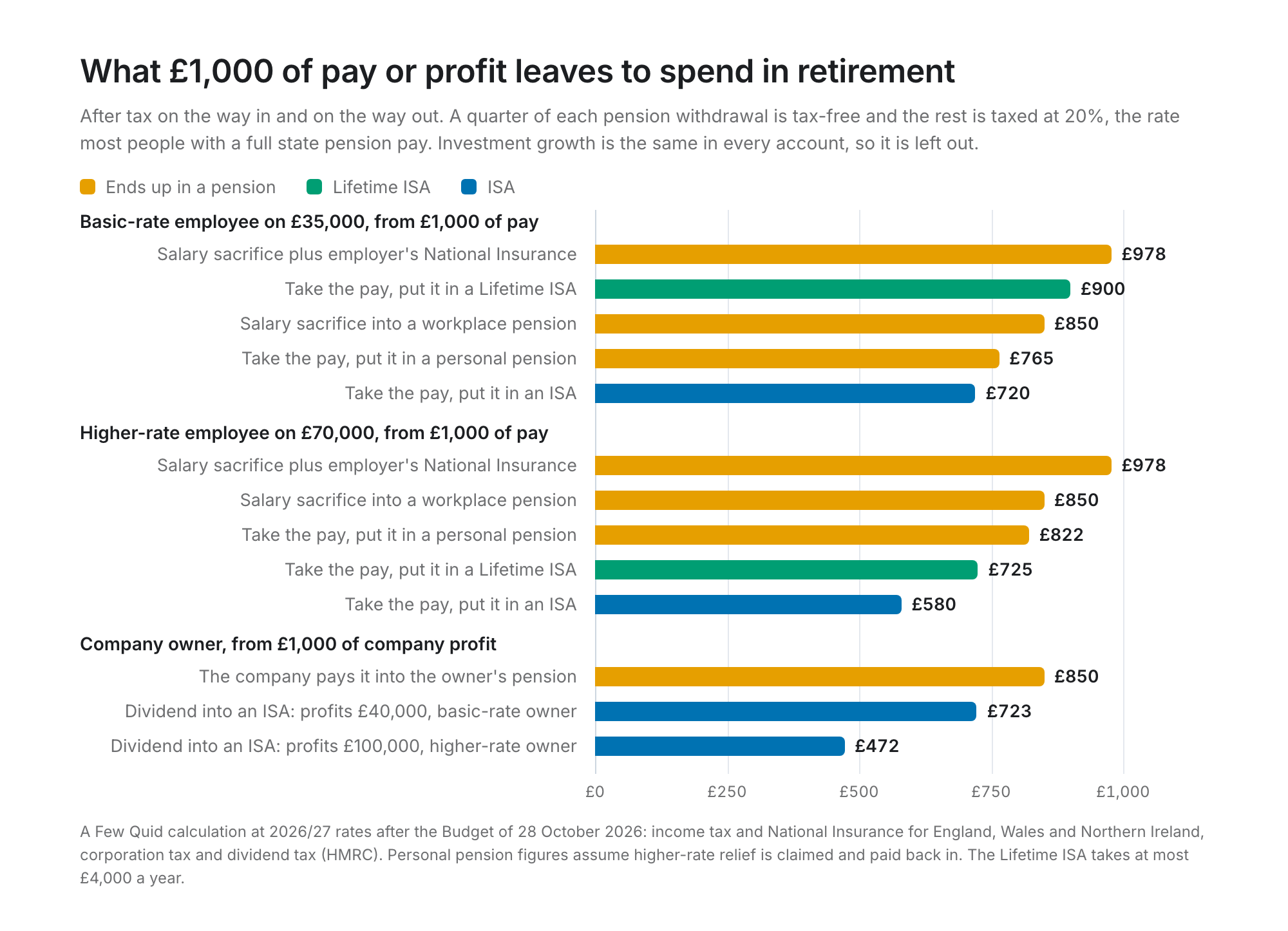
The ISA gives the lowest figure in each column and makes a natural baseline, because it gives no relief going in and charges no tax coming out. Every other route beats it. For a basic-rate taxpayer the Lifetime ISA comes top, with plain salary sacrifice second, unless the employer adds its National Insurance saving to the sacrifice. For a higher-rate taxpayer the pension routes pull well clear, because relief at 40% on the way in beats 20% tax on the way out by a wide margin.
How much rides on the tax rate in retirement
The pension figures depend entirely on the tax you pay when you draw the money, while the ISA and Lifetime ISA figures stay put. The table shows what £1,000 of gross pay leaves to spend at different rates of tax on pension withdrawals in retirement.
| Route | Basic-rate now, 0% in retirement | Basic-rate now, 40% in retirement | Higher-rate now, 0% in retirement | Higher-rate now, 40% in retirement |
|---|---|---|---|---|
| Lifetime ISA | £900 | £900 | £725 | £725 |
| Personal pension | £900 | £630 | £967 | £677 |
| Salary sacrifice | £1,000 | £700 | £1,000 | £700 |
At 0% in retirement, a basic-rate saver's salary sacrifice gives back every pound and a personal pension ties with the Lifetime ISA. That happens when pension withdrawals fit inside the Personal Allowance, typically in the years before the state pension starts. At 40%, the Lifetime ISA beats every pension route for a basic-rate saver. It beats them for a higher-rate saver too, £725 against £700 through salary sacrifice, unless the employer adds its National Insurance saving, which lifts salary sacrifice to £805.
What the table leaves out
Employer matching is the biggest omission and outweighs everything above. An employer that adds 50p for every £1 you pay in turns the salary sacrifice figure of £850 into £1,275 for a basic-rate taxpayer. Any match at all puts the workplace pension first.
Access matters too. The ISA is open at any age, pensions at 57 from 2028 and the Lifetime ISA at 60. Someone planning to stop work at 50 needs money they can reach.
Then there are the limits. The Lifetime ISA takes £4,000 a year at most and nothing after 49. From April 2029 the National Insurance saving on salary sacrifice applies only to the first £2,000 a year. Above that, each £1,000 a basic-rate taxpayer sacrifices costs £800 of take-home pay, the same as a personal pension.
The rules themselves also change. Pension tax has been rewritten several times in the last decade. The inheritance tax change in 2027 shows that a rule which once favoured pensions can be reversed. An ISA is the least exposed to that, while money locked in a pension for 30 years is the most.
14. Worked example: a basic-rate employee
The figures per £1,000 show which route is cheapest. A worked example adds up the difference over a working life, with growth, the Lifetime ISA's limits and the 2029 cap on the National Insurance saving from salary sacrifice all included.
The saver is a 35-year-old basic-rate taxpayer who wants to put £250 a month of take-home pay towards retirement, on top of the minimum workplace pension they already pay. They plan to start drawing the money at 60.
| Input | Value |
|---|---|
| Age at the start | 35 |
| Salary | £35,000, basic-rate taxpayer |
| Take-home pay set aside | £3,000 a year (£250 a month), in today's money |
| Years of saving | 25, the payments made at ages 35 to 59 |
| Money drawn from | 60 |
| Growth | 4% a year above inflation, after charges, about 6.1% a year before inflation |
| Inflation | 2% a year |
| Tax on pension withdrawals in retirement | 20% on the taxable three quarters |
Every figure is in today's money. The £3,000 a year rises with prices. In ten years' time the saver would be putting in about £3,657 in cash, which buys what £3,000 buys now. The growth rate of 4% above inflation is roughly what a mixed fund of shares and bonds might earn over a long period after charges. That's a little below the long-run return on shares alone, about 5% a year above inflation. Money is paid in at the start of each year. Drawing from 60 puts every route on an equal footing, because 60 is when the Lifetime ISA opens.
How much reaches each account
The same £3,000 of take-home pay puts different amounts into each account.
In an ISA it's £3,000. In a Lifetime ISA it's £3,750 with the bonus, but only for payments up to age 49. After that no more can go in, so for the last ten years the £3,000 goes into an ordinary ISA instead.
A personal pension with relief at source gets £3,750 a year, the same as the Lifetime ISA.
Through salary sacrifice, £3,000 of take-home pay buys a sacrifice of £4,167 in 2026/27, because every pound sacrificed costs only 72p of take-home pay. From April 2029 only the first £2,000 a year sacrificed is free of National Insurance. The cap is a cash figure with no link to inflation. In today's money it's worth £1,885 in 2029/30 and less after that. The sacrifice that £3,000 buys falls to £3,938 in 2029/30 and £3,874 by the last year. If the employer adds its own National Insurance saving to the pension, the pot gets another 15% of the part of the sacrifice that stays free of National Insurance.
What each route leaves to spend
| Route | Total put into the account | Pot at 60 | To spend after tax |
|---|---|---|---|
| ISA | £75,000 | £129,935 | £129,935 |
| Lifetime ISA until 49, then ISA | £86,250 | £153,054 | £153,054 |
| Personal pension, relief at source | £93,750 | £162,419 | £138,056 |
| Salary sacrifice | £98,394 | £171,291 | £145,597 |
| Salary sacrifice, employer adds its National Insurance saving | £105,361 | £184,598 | £156,908 |
Without the employer's help, the salary sacrifice pot is the largest at £171,291. A pension pot isn't all spending money, though. After 20% tax on three quarters of it, the saver keeps £145,597. The Lifetime ISA and ISA pots are smaller, at £153,054, but none of it is taxed. So the Lifetime ISA route leaves £7,457 more to spend than salary sacrifice and £14,998 more than a personal pension. Saving the same money in an ordinary ISA leaves £23,119 less than the Lifetime ISA route.
The order flips if the employer adds its National Insurance saving to the pension. Then salary sacrifice leaves £156,908, ahead of the Lifetime ISA by £3,854.
A realistic middle case
Many people who stop work at 60 have six or seven years before the state pension starts. In those years they can draw from a pension inside their Personal Allowance and pay no tax on it. Suppose the saver takes a third of their pension that way and the other two thirds after 67 at 20%. The average tax on the taxable part of the pension is then about 13.3%. Each pound in the pension gives 90p to spend.
| Route | To spend, a third drawn tax-free before state pension age |
|---|---|
| Lifetime ISA until 49, then ISA | £153,054 |
| Personal pension, relief at source | £146,177 |
| Salary sacrifice | £154,162 |
| Salary sacrifice, employer adds its National Insurance saving | £166,138 |
In that case salary sacrifice and the Lifetime ISA come out almost level, £1,108 apart over 25 years. For a basic-rate taxpayer with no help from the employer, the tax figures barely separate them. Other differences matter more. The pension opens three years sooner. The Lifetime ISA can be reached in an emergency at the cost of the 25% charge, and its withdrawals don't count as income in retirement. Many people in this position split their saving between the two.
15. Worked example: the same saver as a higher-rate taxpayer
Now the same person earns £70,000 and pays 40% income tax on the top slice of their pay. Everything else stays the same. They still set aside £3,000 a year of take-home pay from 35 to 59 and start drawing at 60.
The higher rate stretches the £3,000 further in a pension. Through relief at source, each £1,000 in the pot costs £600 after claiming back the extra 20%, so £3,000 of take-home pay puts £5,000 into the pension. With salary sacrifice each pound costs 58p, so £3,000 buys a sacrifice of £5,172 in 2026/27, falling to £5,063 once the £2,000 National Insurance cap starts in 2029/30. The Lifetime ISA still adds only 25%, so it gets the same £3,750 as before.
| Route | Total put into the account | Pot at 60 | To spend after tax |
|---|---|---|---|
| ISA | £75,000 | £129,935 | £129,935 |
| Lifetime ISA until 49, then ISA | £86,250 | £153,054 | £153,054 |
| Personal pension, relief at source | £125,000 | £216,559 | £184,075 |
| Salary sacrifice | £126,649 | £219,774 | £186,808 |
| Salary sacrifice, employer adds its National Insurance saving | £134,068 | £234,242 | £199,106 |
The pension now wins by a wide margin. Salary sacrifice leaves £33,754 more to spend than the Lifetime ISA route, even after 20% tax in retirement. A personal pension comes close, £31,021 ahead, provided the saver claims the higher-rate relief every year and pays it back into the pension. Without the claim, only £3,750 a year reaches the pension instead of £5,000.
The 2029 cap barely matters here. National Insurance above £50,270 is only 2%, so losing it on part of the sacrifice costs the higher-rate saver very little.
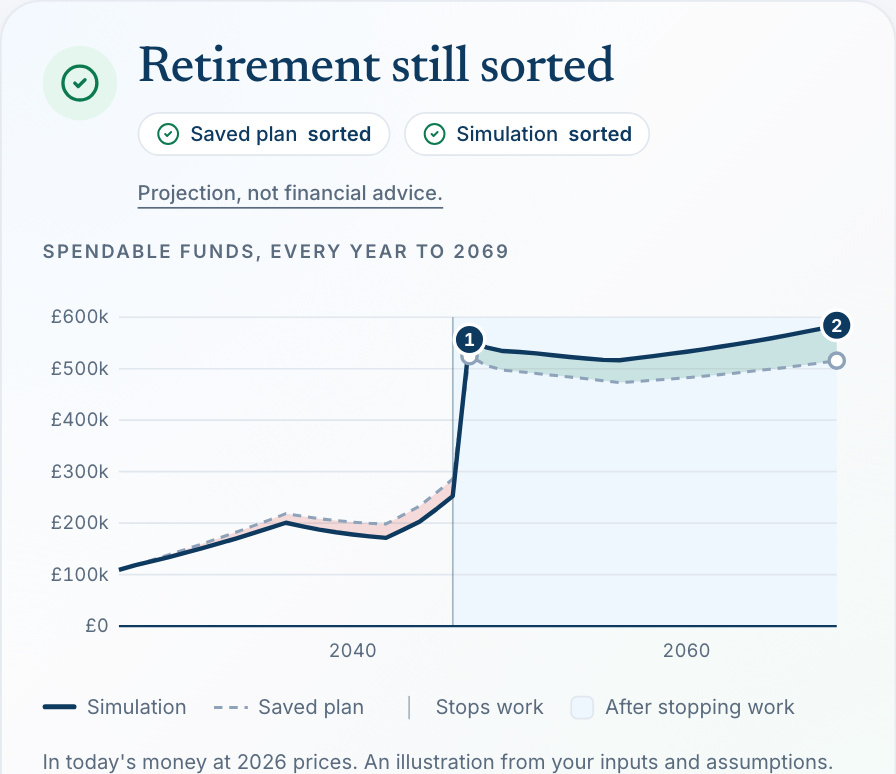
The screenshot shows the same kind of change in A Few Quid's what-if simulator for a fuller household. It is the app's demonstration household, a 45-year-old on £75,000 with two children and a mortgage, who pays 5% of their salary into the workplace pension by salary sacrifice. Raising the sacrifice to 10% gives them less to spend while they work, the shaded gap under the saved plan (the plan as it stands before the change), because more of their pay goes into the pension. From the year they stop work the simulation pulls ahead. The chart measures spendable funds, the app's figure for the money the household could spend. It counts savings, ISAs and investments, plus each pension once its owner has stopped work, after the income tax due on drawing it. The home is left out. In today's money, the household has £557,000 at 66 against £524,000 in the saved plan, and £585,000 against £516,000 by 88.
Every combination of tax band now and in retirement
The only difference between the two examples is the tax band the saver is in now. This table runs both through every tax rate they might pay on pension income in retirement, with and without the employer's National Insurance saving. Each figure is the amount left to spend after tax, from the same £3,000 a year of take-home pay from 35 to 59.
| Tax band now | Tax on pension income in retirement | ISA | Lifetime ISA, then ISA | Personal pension | Salary sacrifice | Salary sacrifice with employer's National Insurance |
|---|---|---|---|---|---|---|
| Basic rate | 0% | £129,935 | £153,054 | £162,419 | £171,291 | £184,598 |
| Basic rate | 20% | £129,935 | £153,054 | £138,056 | £145,597 | £156,908 |
| Basic rate | 40% | £129,935 | £153,054 | £113,693 | £119,903 | £129,219 |
| Higher rate | 0% | £129,935 | £153,054 | £216,559 | £219,774 | £234,242 |
| Higher rate | 20% | £129,935 | £153,054 | £184,075 | £186,808 | £199,106 |
| Higher rate | 40% | £129,935 | £153,054 | £151,591 | £153,842 | £163,969 |
Step for step, today's tax band moves the result most. Going from the basic to the higher rate adds 28% to what salary sacrifice leaves to spend, because the band sets how many pounds reach a pension for each pound of take-home pay, and that gap compounds for 25 years. A 20-point change in the tax rate in retirement moves it by 18% either way. For a basic-rate saver that rate picks the winner between the pension and the Lifetime ISA. For a higher-rate saver it mostly changes how far ahead the pension finishes. The employer's National Insurance saving matters least, adding 7% to 8% to the salary sacrifice figures in every row.
Two rows stand out. A higher-rate saver who expects to pay 40% in retirement too gains almost nothing from a pension over a Lifetime ISA. Salary sacrifice puts them just £788 ahead over 25 years, and a personal pension leaves them worse off. At the other end, a basic-rate saver who can draw the whole pension inside the Personal Allowance gets more from salary sacrifice than from any other route. That's £18,237 more than the Lifetime ISA, even without the employer's help. For most people the realistic expectation sits between those extremes, at 20% or a little below.
16. Worked example: paying through a limited company
The third example is a 45-year-old company owner. Their company makes £100,000 of profit a year before this decision, and they pay themselves a salary of £12,570 plus £60,000 of dividends. That already makes them a higher-rate taxpayer. Each year until 64 they have £10,000 of profit left to put towards retirement, and they plan to draw it from 65.
| Input | Value |
|---|---|
| Age at the start | 45 |
| Company profit before this decision | £100,000 a year |
| Salary and dividends already taken | £12,570 salary, £60,000 dividends |
| Profit set aside for retirement | £10,000 a year, in today's money |
| Years of saving | 20, from 45 to 64 |
| Growth | 4% a year above inflation, after charges |
| Tax on pension withdrawals in retirement | 20% on the taxable three quarters |
There are two ways to get the £10,000 into retirement savings. The company can pay it straight into the owner's pension. Alternatively, the company can pay corporation tax on it and pay out the rest as a dividend. The owner then pays dividend tax and puts what's left in an ISA.
The dividend route loses a lot on the way. Corporation tax on the top £10,000 of a £100,000 profit is £2,650, at the 26.5% marginal rate. The £7,350 dividend then pays £2,628 of dividend tax at 35.75%. That leaves £4,722 a year for the ISA. The pension route puts the whole £10,000 in.
| Route | Paid in each year | Pot at 65 | To spend after tax |
|---|---|---|---|
| Company pays into the pension | £10,000 | £309,692 | £263,238 |
| Dividend, then an ISA | £4,722 | £146,248 | £146,248 |
The pension route leaves £116,990 more to spend, about 80% more than the dividend route. If the owner can draw some of the pension inside their Personal Allowance before their state pension starts, the gap widens further.
The gap is smaller for a small company with a basic-rate owner, but it doesn't close. A company making £40,000, whose owner takes £12,570 of salary and £20,000 of dividends, pays 19% corporation tax on the spare £10,000. The owner then pays 10.75% dividend tax. That leaves £7,229 a year for an ISA, which grows to £223,884 by 65. The pension route still leaves £263,238 to spend, £39,354 more.
The comparison leaves out what the owner gives up. The company's £10,000 is locked in the pension until 57. Profit kept in the business or taken as dividends can be spent at any time. Owners whose business might need the cash, or who want to retire before 57, often keep part of their profit outside the pension for that reason.
17. How to work out which mix of pots suits your own numbers
The fastest way to an answer for your own situation is to put your details into a thorough financial calculator built for UK rules. You can then see how each route plays out on your actual pay, pensions and plans. Every household is different. The tax band you're in, what your employer adds, when you want to stop work and what your partner earns all change the result. They also interact in ways a rule of thumb can't follow. A Few Quid models every route in this guide together, from your state pension to your company's pension payments, then projects them year by year in today's money. Get started with A Few Quid and you'll have a projection of your own within a few minutes.
For the size of pot to aim at in the first place, how much you need to retire in the UK works through the figures. If you'd rather work through the decision yourself, the questions below settle most of it.
About the author and this calculator
A Few Quid was built by Mike Gallagher. He wanted a planner that dealt properly with the UK's own rules, from salary sacrifice and the Lifetime ISA to a company paying into a director's pension. It also had to show a whole household's money in one projection instead of one product at a time. Every figure in this guide comes from the same tax calculations the app uses, worked out by a script rather than by hand.
A Few Quid is a calculator. It is not a financial adviser and is not authorised by the FCA, so nothing in this guide is a personal recommendation. Treat every number here as an assumption worth testing against your own figures. Take regulated advice before any decision you can't undo, such as transferring a final salary pension.
FAQ
What are the main types of pension in the UK?
There are four. The state pension is earned through National Insurance and pays up to £241.30 a week in 2026/27. Workplace pensions are set up by employers, who must enrol most staff and pay at least 3% of qualifying earnings, the slice of pay the minimum applies to. Personal pensions, including self-invested personal pensions (SIPPs), are ones you arrange yourself. Final salary or defined benefit pensions promise an income based on your salary and years of service. Many people also use a Lifetime ISA or an ordinary ISA for retirement, though neither is a pension in law.
Is salary sacrifice better than relief at source?
On cost, yes. Salary sacrifice saves National Insurance as well as income tax, so £1,000 in the pension costs a basic-rate taxpayer £720 of take-home pay, against £800 through relief at source. With relief at source you pay from take-home pay and the pension provider adds basic-rate tax relief. For a higher-rate taxpayer it costs £580 against £600. Some employers also add their own 15% National Insurance saving to the pension. From 6 April 2029 the National Insurance saving applies only to the first £2,000 a year sacrificed. Salary sacrifice also lowers the salary used for statutory pay and sometimes for mortgages, so it is worth checking how your employer and lender treat it.
Is a Lifetime ISA better than a pension for retirement?
For a basic-rate taxpayer paying from take-home pay with no extra employer money, usually yes. The 25% bonus matches basic-rate relief, and withdrawals from 60 are tax-free, where three quarters of a pension withdrawal is taxed. £1,000 of pay gives £900 to spend through a Lifetime ISA against £765 through a personal pension, assuming 20% income tax on the taxable three quarters of each pension withdrawal. For higher-rate taxpayers, and for anyone whose employer matches contributions or adds its own National Insurance saving to the pension, a pension leaves more. A Lifetime ISA takes at most £4,000 a year, you can pay in only until 50, and new accounts can only be opened until April 2029.
Can I pay into my partner's pension?
Yes. Anyone can pay into someone else's personal pension or SIPP. The tax relief depends on the partner's earnings and tax rate, and you get none of your own. A partner with no earnings can receive £2,880 a year, which the provider tops up to £3,600. A partner with earnings can receive up to their earnings for the year, within the £60,000 annual allowance, the yearly limit on pension saving with tax relief. Two pots also let a couple use two Personal Allowances and two basic-rate bands in retirement, so more of their income is taxed at 0% or 20%. Gifts between spouses and civil partners are free of inheritance tax, and regular payments to an unmarried partner from income are usually exempt too.
Can my limited company pay into my pension?
Yes. A company can make employer contributions to its director's pension. The payment comes off profits before corporation tax, and no National Insurance, income tax or dividend tax is due on it. It is not limited by the director's salary, only by the £60,000 annual allowance plus any unused allowance carried forward from the previous three tax years. HMRC expects the payment to be made wholly and exclusively for the business, which is rarely questioned for a working director. For a company with profits between £50,000 and £250,000, where marginal relief applies, and an owner who pays higher-rate tax, £1,000 of profit puts £1,000 in the pension. Paid out as a dividend instead, it leaves £472 to put in an ISA after corporation tax and dividend tax.
When can I take money out of my pension?
Personal and workplace pension pots can be drawn from 55, rising to 57 from 6 April 2028, unless you have a protected pension age (an earlier age some schemes kept under older rules) or serious ill health. A quarter of what you take is usually tax-free, up to £268,275 over your lifetime, and the rest is taxed as income. The state pension starts at state pension age, which is 66 and rising to 67 by 2028. Final salary pensions start at the scheme's pension age. A Lifetime ISA can be emptied tax-free from 60.
How much tax will I pay on my pension in retirement?
Pension income is taxed with your other income at the ordinary rates. The full new state pension of £12,547.60 uses almost all of the £12,570 Personal Allowance, so most pension income on top of it is taxed at 20% until total income reaches £50,270. With a quarter of each withdrawal tax-free, someone with a full state pension who draws £20,000 a year from a pot pays about £2,996 in income tax and keeps 85% of what they draw. Before the state pension starts, up to £16,760 a year can be drawn from a pension pot tax-free if there is no other income.
Is it worth paying voluntary National Insurance to top up my state pension?
Often, if it fills a year that would otherwise be missing. A year of voluntary Class 3 contributions costs £956.80 in 2026/27 and adds about £358.50 a year to the full new state pension for life, so it pays back in under three years before tax. It only helps if the year would raise your pension, so check your forecast on gov.uk or with the Future Pension Centre before paying. You can usually fill gaps from the last six tax years.
Glossary
- State pension
- The pension paid by the government from state pension age. The full new state pension is £241.30 a week in 2026/27, and needs 35 qualifying years of National Insurance contributions or credits. Ten years are needed to get any of it.
- Qualifying year
- A tax year in which you paid enough National Insurance or received National Insurance credits for it to count towards your state pension. Each year adds one 35th of the full new state pension, about £6.89 a week in 2026/27.
- Voluntary National Insurance
- Payments that fill gaps in your National Insurance record. Class 3 contributions cost £18.40 a week in 2026/27, or £956.80 for a full year, and gaps can usually be filled for the last six tax years.
- State pension age
- The age from which the state pension is paid. It is 66, rising to 67 for people born on or after 6 April 1960 between 2026 and 2028, and to 68 between 2044 and 2046 under current law.
- Automatic enrolment
- The rule that employers must put staff aged 22 to state pension age who earn over £10,000 a year into a workplace pension, with at least 8% of qualifying earnings paid in, 3% of it by the employer.
- Qualifying earnings
- The band of pay that automatic enrolment minimums apply to, between £6,240 and £50,270 a year in 2026/27.
- Defined contribution pension
- A pension built up as an invested pot. What it pays depends on how much went in, how the investments did and the charges. Almost all new workplace pensions and every personal pension work this way.
- Defined benefit pension
- A pension that promises an income based on salary and years of service, also called a final salary or career average pension. The employer carries the investment risk. Most public-sector schemes work this way.
- SIPP (self-invested personal pension)
- A personal pension in which you choose the investments, usually through an investment platform. It gets the same tax relief as any other personal pension.
- Relief at source
- A way of giving pension tax relief in which you pay from take-home pay and the provider claims basic-rate relief from HMRC, so £80 becomes £100. Higher-rate and additional-rate taxpayers claim the rest themselves.
- Net pay arrangement
- A way of giving pension tax relief in which the contribution is taken from pay before income tax is worked out, while National Insurance is still charged on the full pay. Low earners below the Personal Allowance receive a Low Earner's Pension Payment from HMRC for contributions from 2024/25 onwards.
- Salary sacrifice
- An arrangement in which you give up part of your salary and your employer pays it into your pension instead. It saves income tax and National Insurance. From 6 April 2029 the National Insurance saving applies only to the first £2,000 a year.
- Lifetime ISA
- An ISA opened between 18 and 39 that takes up to £4,000 a year until 50, with a 25% government bonus. Money can be withdrawn without charge for a first home, from 60 or on terminal illness. Other withdrawals pay a 25% charge. New accounts can be opened until a First Time Buyer ISA replaces it in April 2029.
- ISA (Individual Savings Account)
- A UK account in which interest, dividends and gains are tax-free and withdrawals are not taxed. Adults can pay in up to £20,000 a year across all their ISAs.
- Personal Allowance
- The income you can have each year before income tax starts, £12,570 in 2026/27 and frozen until April 2031. It is withdrawn by £1 for every £2 of adjusted net income above £100,000.
- Adjusted net income
- Your total taxable income less certain reliefs, including pension contributions. It decides whether you lose the Personal Allowance, pay the High Income Child Benefit Charge or lose Tax-Free Childcare.
- Annual allowance
- The most that can go into your pensions in a tax year with tax relief, counting money from you, your employer and anyone else. It is £60,000, and personal contributions are also limited to 100% of your earnings.
- Tapered annual allowance
- A reduced annual allowance for people with threshold income above £200,000 and adjusted income above £260,000. These are two HMRC measures of income, and adjusted income also counts pension contributions, the employer's included. It falls by £1 for every £2 over £260,000, down to £10,000.
- Money purchase annual allowance
- A reduced allowance of £10,000 a year for contributions to defined contribution pensions. It applies once you start taking taxable money from such a pension, as drawdown income or as lump sums that are partly taxed.
- Carry forward
- The rule that lets you add unused annual allowance from the previous three tax years to this year's, if you were a member of a registered pension scheme in those years.
- Lump sum allowance
- The most you can take tax-free from your pensions over your lifetime, £268,275 for most people. It replaced the lifetime allowance, which was abolished in April 2024.
- Normal minimum pension age
- The earliest age you can usually take money from a personal or workplace pension. It is 55 and rises to 57 on 6 April 2028.
- Flexi-access drawdown
- Keeping a pension pot invested after retirement and taking income from it as you choose, usually after taking up to a quarter tax-free. The income is taxed with your other income.
- Uncrystallised funds pension lump sum
- A lump sum taken straight from a pension pot without moving it into drawdown first. A quarter of each lump sum is tax-free and the rest is taxed as income.
- Annuity
- An income for life bought from an insurer with some or all of a pension pot. Once bought, it usually cannot be changed or cashed in.
- Pension Tax Allowance
- A tax reduction for people over state pension age in the tax years 2027/28 to 2029/30. Those whose total income is no more than the full new state pension pay no income tax, and the reduction shrinks by £1 for every £3 of income above that.
- Employer pension contribution
- A payment into a pension by an employer. For a company owner, a contribution from their own company comes off profits before corporation tax and pays no National Insurance or dividend tax.
- Marginal relief
- The corporation tax relief for companies with profits between £50,000 and £250,000. It makes the rate on each extra pound of profit in that band 26.5%.
- Expression of wish
- A form telling a pension scheme who you would like to receive your pension after you die. Pensions do not pass under a will, so the scheme relies on this form.
- Pension Wise
- The government's free, impartial guidance service on pension options for people aged 50 and over with a defined contribution pension. It is run by MoneyHelper.
Sources
- The new State Pension: what you'll get, GOV.UK
- The new State Pension: eligibility, GOV.UK
- Benefit and pension rates 2026 to 2027, Department for Work and Pensions
- Proposed benefit and pension rates 2027 to 2028, Department for Work and Pensions
- Check your State Pension forecast, GOV.UK
- State Pension age calculator, GOV.UK
- Third State Pension age review, Department for Work and Pensions
- Voluntary National Insurance: rates, GOV.UK
- National Insurance credits: eligibility, GOV.UK
- Deferring your State Pension, GOV.UK
- Inheriting or increasing State Pension from a spouse or civil partner, GOV.UK
- Reduction in income tax for eligible pensioners, HMRC
- Budget 2026 document, HM Treasury
- Income Tax rates and allowances, HMRC
- Scottish income tax rates and bands 2026 to 2027, Scottish Government
- Rates and thresholds for employers 2026 to 2027, HMRC
- Tax on your private pension: pension tax relief, GOV.UK
- Tax on your private pension: annual allowance, GOV.UK
- Tax on your private pension: lump sum allowance, GOV.UK
- Pension schemes rates and allowances, HMRC
- Pensions Tax Manual PTM044100, contributions by third parties, HMRC
- Increasing normal minimum pension age, HMRC
- Salary sacrifice reform for pension contributions from 6 April 2029, HMRC
- National Insurance Contributions (Employer Pensions Contributions) Act 2026, section 1, legislation.gov.uk
- Pension schemes newsletter 184, August 2026 (Low Earner's Pension Payment), HMRC
- Review of the automatic enrolment earnings trigger and qualifying earnings band for 2026/27, Department for Work and Pensions
- Workplace pension participation and savings trends of employees, 2009 to 2025, Department for Work and Pensions
- Pensions Commission, Department for Work and Pensions
- Pension Schemes Act 2026, legislation.gov.uk
- Business Income Manual BIM46035, pension contributions, HMRC
- Business Income Manual BIM47105, remuneration of relatives, HMRC
- Corporation Tax rates and allowances, HMRC
- Tax on dividends, GOV.UK
- Lifetime ISA, GOV.UK
- First Time Buyer ISA consultation and government response, HM Treasury
- Lifetime ISAs, MoneyHelper
- Marriage Allowance, GOV.UK
- Inheritance Tax: gifts, GOV.UK
- Inheritance Tax on unused pension funds and death benefits, HMRC
- Tax when you get a pension: tax-free amounts, GOV.UK
- PAYE Manual PAYE76170, flexible pension payments, HMRC
- Pension benefits with a guarantee and the advice requirement, Department for Work and Pensions
- Removing the compensation cap, Pension Protection Fund
- Pension Wise, MoneyHelper
- Pension charges, MoneyHelper
- Find pension contact details (Pension Tracing Service), GOV.UK
- Lost Pensions 2026: The Scale of the Challenge, Pensions Policy Institute
- ScamSmart, Financial Conduct Authority
Related reading
- What percentage of your salary to save for retirement: The UK numbers behind the rules of thumb, by age and starting point.
- How much do you need to retire in the UK? PLSA benchmarks, withdrawal rates and the state pension, worked through in detail.
- How much difference does it make to start investing at 18, 30, 45 or 65? £100 a month invested from 18 grows to about £224,000 by 65 in today's money on long-run share returns, against £114,000 from 30 and £42,000 from 45.